

The Department of State Services (DSS) has backed the proposed legislation establishing a Trust Fund for the agency but called for key amendments, including the removal of provisions allowing foreign organisations to finance intelligence and security operations.
The Service also warned against creating overlapping intelligence institutions, saying a separate bill seeking to establish a Strategic Intelligence Management Institute could duplicate the functions of an existing federal security training institution unless its mandate is redefined.
The position was presented by Emmanuel Daubry on behalf of the DSS during a public hearing organised by the House of Representatives Committee on National Security and Intelligence on Thursday in Abuja.
The hearing considered three bills: the Department of State Services Trust Fund Bill (HB.2178), the Strategic Intelligence Management Institute Bill (HB.2589), and the DSS Research and Development Institute Bill (HB.2716).
In its submission, the DSS described the proposed Trust Fund as a critical step towards strengthening national security financing by providing stable and dedicated funding for intelligence gathering, counterterrorism operations and other security activities.
According to the Service, the Fund would enable the acquisition of modern operational equipment, improve personnel training, facilitate rapid responses to emerging threats and reduce delays associated with conventional budgetary processes.
The DSS, however, raised concerns over several provisions of the bill and proposed amendments to strengthen its implementation.
One of its major recommendations was the removal of the word “Security” from the title of the bill, arguing that it was unnecessary.
The Service proposed that the legislation be renamed: “A Bill for an Act to Establish the Department of State Services Trust Fund, to Provide for its Management, Funding and Utilisation to Enhance National Security Operations; and for Related Matters.”
It also called for corresponding amendments to relevant sections and the explanatory memorandum.
On funding, the DSS expressed reservations over provisions granting the National Assembly discretion to determine annual contributions to the Fund.
According to the Service, the absence of a clearly defined funding formula could create uncertainty and affect long-term planning.
It recommended the adoption of a fixed percentage or specific funding framework for contributions from the Federal and State Governments.
The agency was particularly emphatic on the issue of foreign funding, urging lawmakers to delete provisions permitting grants, donations and endowments from international organisations.
The DSS warned that external funding could compromise operational secrecy, expose intelligence activities to undue scrutiny and create avenues for foreign influence over Nigeria’s security priorities.
It argued that reporting and disclosure obligations often attached to international funding arrangements could reveal sensitive information relating to intelligence methods, procurement processes and operational deployments.
The Service therefore proposed that grants and donations to the Fund should be restricted strictly to local organisations.
The DSS also sought changes to the composition of the proposed governing board.
It noted the absence of mandatory legal representation and questioned the inclusion of the Nigerian Governors’ Forum, describing it as a voluntary association without statutory recognition.
Instead, the agency proposed that the Nigerian Bar Association should nominate a representative with expertise in national security and human rights.
It further recommended that the Secretary of the Board be appointed by the President and be either a serving or retired DSS officer not below the rank of Assistant Director, with at least 10 years post-call experience as a legal practitioner.
The Service also observed that the bill failed to provide procedures for the resignation or removal of board members.
To address this, it proposed provisions allowing members to resign through written notice to the President and empowering the President to remove board members for misconduct, gross incompetence, inability to perform official duties or other sufficient reasons.
Despite its recommendations, the DSS urged lawmakers to pass the bill, describing it as a significant measure for strengthening the operational capacity of the Service through sustainable funding.
On the proposed Strategic Intelligence Management Institute, the DSS cautioned that its functions substantially overlap with those of the National Institute for Security Studies established under the National Institute for Security Studies (Establishment) Act, 2019.
The Service noted that both institutions were designed to provide strategic and specialised training for intelligence personnel and public officials.
To avoid duplication, the DSS recommended that the proposed institute be redesigned to focus exclusively on external intelligence, foreign intelligence operations and international intelligence cooperation in line with the mandate of the National Intelligence Agency (NIA).
According to the agency, such a restructuring would create a clear distinction between both institutions while strengthening Nigeria’s external intelligence capabilities.
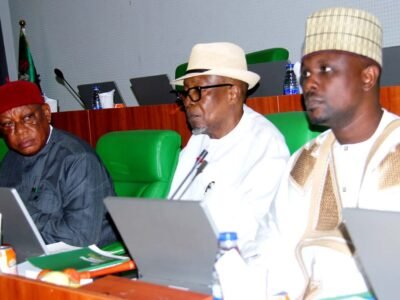
Speaking at the hearing, Chairman of the House Committee on National Security and Intelligence, Hon. Ahmed Satomi, said the three bills were designed to strengthen the operational capacity of the DSS through sustainable funding, professional intelligence training and indigenous research and technological development.
“These Bills are interlinked. One addresses funding, the second addresses professional training and coordination, and the third addresses indigenous capacity and technology. Together, they aim to position our intelligence agencies to better protect Nigerians and Nigeria’s national interest,” he said.
Satomi described the public hearing as a crucial stage in the legislative process, assuring stakeholders that all credible recommendations would be considered before the committee submits its report to the House.
Also speaking, Speaker of the House of Representatives, Hon. Abbas Tajudeen, represented by House Leader Prof. Julius Ihonvbere, described national security as the foundation of Nigeria’s survival and development.
He said challenges such as terrorism, banditry, kidnapping, cybercrime and transnational organised crime require stronger intelligence capacity, innovation and institutional reforms.
According to him, predictable funding, improved intelligence training and enhanced research capacity remain essential for improving the effectiveness of Nigeria’s security architecture.
The Speaker urged stakeholders to provide constructive input to enrich the legislative process, stressing that national security requires the collective efforts of government institutions and citizens alike.
Never miss a moment! Get the stories shaping Nigeria, delivered straight to your phone. Follow Peoplesdaily Newspaper on WhatsApp for breaking news, exclusive reports, and the headlines everyone will be talking about, before anyone else.

