

The Sokoto Caliphate also known as the Sultanate of Sokoto situated in West Africa. It was founded by Uthman Dan Fodio in 1804. The boundaries of the caliphate extended to parts of present-day Cameroon, Burkina Faso, Niger, and Nigeria. By 1837, the Caliphate had a population of 10–20 million people, becoming the most populous empire in West Africa. It was dissolved when the British, French, and Germans conquered the area in 1903 and annexed it into the newly established Northern Nigeria Protectorate, Senegambia and Niger and Kamerun.
The caliphate emerged after the Hausa King Yunfa attempted to assassinate Uthman Dan Fodio in 1802. To escape persecution, Uthman and his followers migrated towards Gudu in February 1804. Uthman’s followers pledged allegiance to Uthman as the Commander of the Faithful (Amīr al-Muʾminīn). By 1808, the Sokoto Caliphate had gained control over Hausaland and several surrounding states. Under the sixth Caliph Ahmadu Rufai, the state reached its maximum extent, covering a large swath of West Africa. In 1903, the twelfth and last Caliph Attahiru was assassinated by British forces, marking the end of the caliphate.
Developed in the context of multiple independent Hausa Kingdoms, at its peak, the caliphate linked over 30 different emirates over 20 million people in the largest independent polity in the continent at the time. According to historian John Iliffe, Sokoto was “the most prosperous region in tropical Africa”. The Caliphate was a loose confederation of emirates that recognized the suzerainty of the Amir al-Mu’minin, the Sultan of Sokoto.
Slaves worked plantations and much of the population converted to Islam. By 1900, Sokoto had “at least 1 million and perhaps as many as 2.5 million slaves” behind only the American South (which had four million in 1860) and perhaps Brazil (1.7–2.5 million) among all modern slave societies. Jan Stafford Hogendorn and Paul Ellsworth Lovejoy writes that “Our own estimate is based on the assumption that slaves constituted between a quarter and a half of the population of the Caliphate, which certainly numbered many millions and perhaps as many as 10 million.”
Although European colonists abolished the political authority of the Caliphate, the title of Sultan was retained and remains an important religious position for Muslims to the current day. Uthman Dan Fodio’s jihad inspired a series of related jihads in other parts of the Sudanian Savanna and the Sahel far beyond the borders of what is now Nigeria that led to the foundation of Islamic states in the regions that are now in modern-day Senegal, Mali, Ivory Coast, Chad, the Central African Republic, and Sudan.
The legacy of the Sokoto Caliphate and Uthman dan Fodio’s teachings have left a lasting impact on the contemporary Nigeria and other parts of West Africa. The Sokoto era produced some of the most renowned writers in West Africa with the three main reformist leaders, Usman, Abdullahi and Bello, writing more than three hundred books combined on a wide variety of topics, including logic, tafsir, mathematics, governance, law, astronomy, grammar, medicine, and so on. Some other famous scholars of that era were Shaikh Dan Tafa and Nana Asma’u. All of these scholars are still being widely studied around West Africa and some as far as the Middle East.
Nomenclature
Throughout the 19th Century, the Islamic state founded by Uthman Dan Fodio had no fixed name. In Hausa, it was referred to as Daular ‘Uthmaniyya (“Uthmani state”), not to be confused with the Ottoman state, the original daular ‘uthmaniyya. Uthman and his successors, who ruled from Sokoto, used the title of Commander of the Believers (Amir al-mu’minin in Arabic; Sarkin Musulmi in Hausa; Lamido Julbe in Fulfulde).
Following the British conquest of Sokoto, the British colonist appointed Muhammad Attahiru II as Emir (correctly written and pronounced Amir) of the newly established Sokoto Emirate, indicating the loss of sovereign powers over the other emirs and his subordination to the governor. Unlike other Native emirs in the region, however, he was given the courtesy title of Sultan.
In post-colonial Nigeria during the 1960s, the label “Sokoto Caliphate” was introduced by Murray Last and became the most widely accepted name. According to Last, the term was influenced by the work of Professor Abdullahi Smith, Head of the History Department at Ahmadu Bello University, Zaria. Smith had liked to use the term ‘caliphate’ when teaching the history of Uthman’s state. When Last titled his 1966 PhD dissertation “The Sokoto Caliphate”, his supervisor Smith preferred “The Caliphate of Sokoto”, but the shorter “Sokoto Caliphate” (Daular Sakkwato in Hausa) became more widely adopted. Last explained his reasoning:
‘The decision to relabel the historical state whose capital was at Sokoto was partly intellectual, partly political: intellectual, because we needed a properly Islamic term for a properly Islamic state (and a term that could be justified both on textual evidence and on a technical legal rationale); political, because the newly autonomous regional government of Northern Nigeria needed a model on which to base its new political morality of “work and worship.”
Some scholars contest this rationale and continue to use old terms like Fulani Empire (l’empire peul in French). The relabeling by Last and Smith reflected an interpretation of Uthman’s jihad as a religious movement and, thus of Sokoto as an Islamic state, rather than as an ‘empire’ as was common among colonial British writers. The assumption was that an ‘empire’ was a political system in which one ‘race,’ ‘nationality’ or ‘tribe’ dominated other groups, and excluded them from government.[ The interpretation of the movement as an ‘ethnic’ revolution by the Fulani was mainly based on the fact that all but one of the new emirs were indeed Fulani. However, the prevailing view among scholars is that Uthman’s movement was primarily religious. The early emirs were chosen on their piety as Muslim scholars, and they were expected to provide proper Islamic governance.
Background
The major power in the region in the 17th and 18th centuries had been the Bornu Empire. However, revolutions and the rise of new powers decreased the power of the Bornu empire and by 1759 its rulers had lost control over the oasis town of Bilma and access to the Trans-Saharan trade. Vassal cities of the empire gradually became autonomous, and the result by 1780 was a political array of independent states in the region.
The fall of the Songhai Empire in 1591 to Morocco also had freed much of the central Bilad as-Sudan, and a number of Hausa sultanates led by different Hausa aristocracies had grown to fill the void. Three of the most significant to develop were the sultanates of Gobir, Kebbi (both in the Rima River valley), and Zamfara, all in present-day Nigeria. These kingdoms engaged in regular warfare against each other, especially in conducting slave raids.
The region between the Niger River and Lake Chad was largely populated with the Fulani, the Hausa, and other ethnic groups that had immigrated to the area such as the Tuareg.
Much of the population had converted to Islam in the centuries before; however, local pagan beliefs persisted in many areas, especially in the aristocracy. In the end of the 1700s, an increase in Islamic preaching occurred throughout the Hausa kingdoms. A number of the preachers were linked in a shared Tariqa of Islamic study. Maliki scholars were invited or traveled to the Hausa lands from the Maghreb and joined the courts of some sultanates such as in Kano. These scholars preached a return to adherence to Islamic tradition. The most important of these scholars is Muhammad al-Maghili, who brought the Maliki jurisprudence to Nigeria.
Fulani Jihad
Uthman Dan Fodio, an Islamic scholar and an urbanized Fulani, had been actively educating and preaching in the city of Gobir with the approval and support of the Hausa leadership of the city. However, when Yunfa, a former student of Dan Fodio, became the Sultan of Gobir, he restricted Dan Fodio’s activities, eventually forcing him into exile in Gudu. A large number of people left Gobir to join Dan Fodio, who also began to gather new supporters from other regions. Feeling threatened by his former teacher, Sultan Yunfa declared war on Dan Fodio on 21 February 1804.
Uthman Dan Fodio was elected as the “Commander of the Faithful” (Amir al-Mu’minin) by his followers, marking the beginning of the Sokoto state. Uthman Dan Fodio then created a number of flag bearers amongst those following him, creating an early political structure of the empire. Declaring a jihad against the Hausa kings, Dan Fodio rallied his primarily Fulani “warrior-scholars” against Gobir. Despite early losses at the Battle of Tsuntua and elsewhere, the forces of Dan Fodio began taking over some key cities starting in 1805. The Fulani used guerrilla warfare to turn the conflict in their favor, and gathered support from the civilian population, which had come to resent the despotic rule and high taxes of the Hausa kings. Even some non-Muslim Fulani started to support Dan Fodio. The war lasted from 1804 until 1808 and resulted in thousands of deaths. The forces of Dan Fodio were able to capture the states of Katsina and Daura, the important kingdom of Kano in 1807,[ and finally conquered Gobir in 1809. In the same year, Muhammed Bello, the son of Dan Fodio, founded the city of Sokoto, which became the capital of the Sokoto state.
The jihad had created “a new slaving frontier on the basis of rejuvenated Islam.” By 1900, the Sokoto state had “at least 1 million and perhaps as many as 2.5 million slaves”, second only to the United States (which had 4 million in 1860) in size among all modern slave societies.
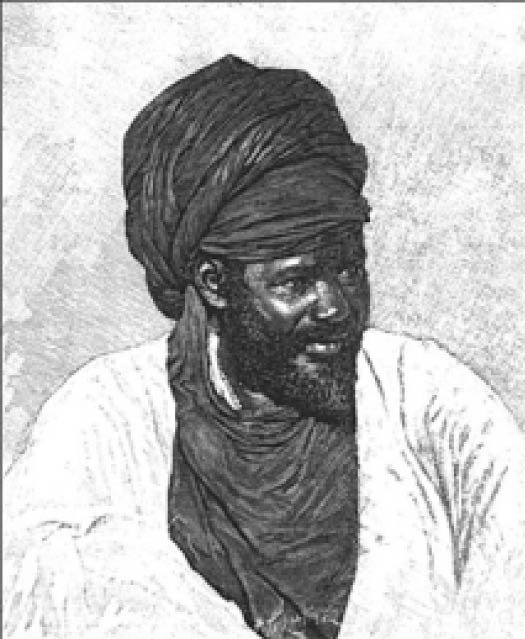
A brother of Sultan Umaru bin Ali (1888) by Élisée Reclus
Notable Flag-Bearers of the Caliphate and their Emirates
Name Emirate
Abdullahi Dan Fodio
Gwandu Emirate
Umar Dallaji
Katsina Emirate
Suleiman Dan Abu Hamma
Kano Emirate
Yaqubu Dan Dadi Bauchi Emirate
Ishaq Daura Emirate
Musa ibn Suleiman Ibn Muhammad Zazzau Emirate
Ibrahim Zakiyul Kalbi Katagum Emirate
Modibbo Adama
Adamawa Emirate
Buba Yero
Gombe Emirate
Shehu Alimi Ilorin Emirate
Mallam Dendo
Nupe Emirate
The Hubbare (Shehu’s Tomb)
Shehu Uthman Dan Fodio died in 1817, he was buried within his wives’ rooms, specifically the quarters of Hauwa’u, mother of the first Sultan. The enclave houses the tomb of the Shehu, graves of two of his sons (Sambo and Hassan), and the burial sites of his wives and early companions. The compound contains the “Jangirde,” the ancient classroom where Dan Fodio taught his disciples.
Recognized today as an epicenter of the Sokoto Royal Cemetery, it attracts hundreds of pilgrims, academics, and tourists from the West African sub-region daily. It preserves the legacy of the Sultanate of Sokoto.
Culled from Wikipedia
A comprehensive list of the Sultans of Sokoto who have succeeded dan Fodio up through today is as follows:
- Muhammad Bello: 1817–1837
- Abubakar Atiku: 1837–1842
- Ali Babba Bin Bello: 1842–1859
- Ahmadu Atiku: 1859–1866
- Aliu Karami: 1866–1867
- Ahmadu Rufai: 1867–1873
- Abubakar II Atiku na Raba: 1873–1877
- Mu’azu: 1877–1881
- Umaru bin Ali: 1881–1891
- Abd al-Rahman bin Atiku: 1891–1902
- Muhammadu Attahiru I: 1902–1903 (Last independent Sultan before British conquest)
- Muhammadu Attahiru II: 1903–1915
- Muhammadu dan Ahmadu: 1915–1924
- Muhammadu dan Muhammadu: 1924–1931
- Hasan dan Mu’azu Ahmadu: 1931–1938
- Siddiq Abubakar III: 1938–1988 (Longest-serving Sultan, reigned for 50 years)
- Ibrahim Dasuki: 1988–1996
- Muhammadu Maccido: 1996–2006
- Muhammadu Sa’adu Abubakar: 2006–Present (20th and current Sultan of Sokoto)
8 sites
- Sokoto Caliphate – Wikipedia
Scholarship. Islamic scholarship was a crucial aspect of the Caliphate from its founding. Sultan Usman dan Fodio, Sultan Muhammed …
Wikipedia
- List of sultans of Sokoto – Wikipedia
Usman dan Fodio, the founder of the dynasty of Sokoto State and of the Fulani Empire (consisting of the Fulbe Jihad states of whic…
Wikipedia
- The Sultan of Sokoto’s position as the leader of Muslims in Nigeria …
15 Feb 2025 — The Sultan of Sokoto’s position as the leader of Muslims in Nigeria was established by Usman Dan Fodio, a prominent Islamic schola…
Facebook·straightfromnaija.com
Never miss a moment! Get the stories shaping Nigeria, delivered straight to your phone. Follow Peoplesdaily Newspaper on WhatsApp for breaking news, exclusive reports, and the headlines everyone will be talking about, before anyone else.


