

Contact with Islam (c. 1000–1380)
Islam reached modern-day Chad already in the time of the Umayyad Caliphate (661–750), when Arab raiders reached Fezzan and the Tibesti Mountains. The religion was probably introduced to Kanem from the north by either the Toubou people or trans-Saharan traders. Islam was probably an important influence within the empire from as early as the mid-8th or 9th century. The early rulers of Kanem approached Islam carefully since they perceived the religion to contain some dangerous ideas, such as the equality of all believers before God. In traditional local religions, the ruler was often accorded superhuman powers and unlimited authority.
The first Muslim ruler of Kanem was the 11th-century mai Hu (or Hawwa), who may have been a woman. Hu’s successor, Selema I, may have been overthrown in the second half of the 11th century by mai Hummay, who established the new Sayfawa dynasty. The Sayfawa were Kanembu in origin but claimed descent from the Yemeni noble Sayf ibn Dī Yazan, a well-known legendary hero in the medieval Islamic world. Other African dynasties of this time sometimes made similar claims to Arab origin as a source of prestige.
Information from the Akhbār al-zamān, written between the late 10th to 11th century, states that Kanem was a “vast and large” kingdom that was partly on the Nile and at war with Nubians. Kanem transitioned into a true empire through expansion to the Kaouar oases in the 11th century. Through control of the trade routes to the north, the Kanem Empire exported ivory, slaves, and animal products. Foreign products, including weapons, books, beads, and cloth, were imported into the empire.
Increasing Islamisation of Kanem is evident from the 11th century and Kanem had developed into a literate society by the 12th century, when the scribes of the empire are recorded to have developed an original script style, the barnāwī. In the 13th century, a ruler of Kanem is recorded to have gone on Hajj to Mecca. Shortly afterwards, the 13th-century mai Dunama II Dibalemi is recorded to have “opened” the mune, an important religious artefact of unclear nature. Dunama II brought Kanem to the zenith of its power. He commanded a cavalry of 40,000 horsemen and extended his rule as far as the Fezzan. Pilgrimages to Mecca became a common occurrence, so much so that a hostel for pilgrims and students from Kanem was founded in Cairo. In 1257, the mai sent a giraffe as a gift to Muhammad I al-Mustansir of the Hafsid dynasty in Ifriqiya.
Era of Instability (c. 1380–1472)
In the 13th century, the mais came into conflict with the Bilala people, who lived within the empire. The Bilala leaders may have been a cadet branch of the Sayfawa dynasty. The Conflict may have been motivated by the increased Islamisation alienating the more traditionalist Bilala. Kanem was at the same time becoming overstretched, suffering from pastures becoming overgrazed and dried out, lacking the natural resources required for a state of its size, and having become too dependent on the personal authority of the mai.
The 14th century saw the beginning of the so-called “Era of Instability”, plagued by both internal and external conflict. In the 14th century, around the year 1380, the Bilala were able to oust the Sayfawa from power in Kanem and capture Njimi. Imperial control of the lands east of Lake Chad was terminated, and the Bilala would rule there independently until the 16th century. The rulers of the Bilala declared themselves sultans, established a proper aristocracy, and posed a serious political alternative to the Sayfawa in the region surrounding Lake Chad.
Mai Umar I Idrismi relocated across Lake Chad to Bornu in the west, a former tributary territory established in the 13th century. The Sayfawa quickly regrouped in Bornu, re-establishing a powerful kingdom there, and the mais continued to rule as they had in Kanem. Intermarriages between the Kanembu people and the local Sao may have given rise to the modern-day Kanuri people, who are often linked to the Kanem–Bornu Empire. Civil wars impacted regions as far away from the imperial core as Hausaland and Darfur through economic upheaval and migrations of refugees.
After the fall of Njimi, the empire lacked a permanent capital for about a century, with the court of the mai constantly moving from one site to another. Prior to the foundation of the permanent capital of Ngazargamu c. 1472, the mai had apparently resided at a site called Garu Kime for seven years and seven months. This site may correspond to modern-day Monguno.
Modern period (1472–1893)
Imperial apex (1472–1650)
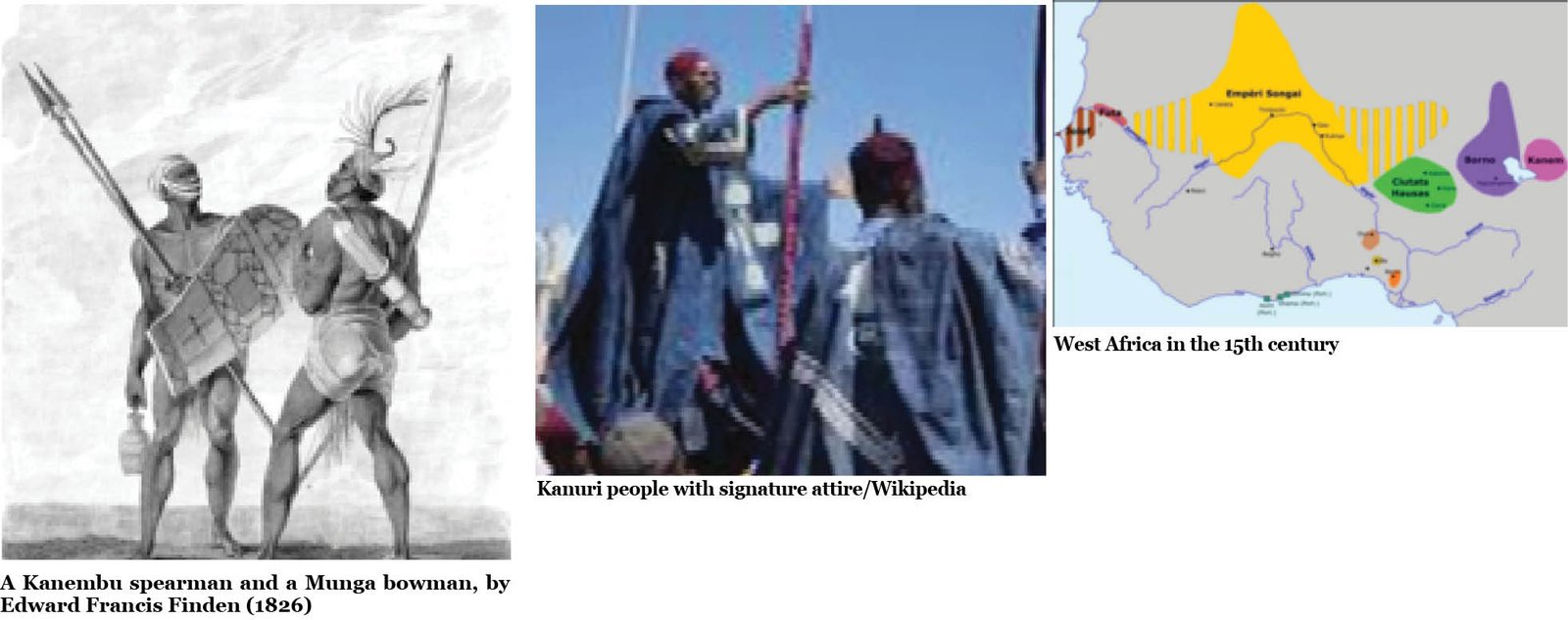
The rise of the Songhai Empire (yellow) was a considerable threat to Bornu (dark purple). Kanem (light purple) remained autonomous under the Bilala but was reduced to a vassal state in the early 1500s.
In c. 1472, Ali founded the empire’s first substantial capital city, Ngazargamu on the shores of the Yobe River. Ngazargamu served as a firm basis of political authority and was ideally positioned at the southern terminus of the trans-Saharan trade routes, and closer to emerging trade centers in Hausaland than previous capitals. Indigenous practices and beliefs continued to persist even at this date, such as the mai customarily appearing behind a veil or screen.
In the west, Idris III failed to conquer the Kingdom of Kano but was recognised as the kingdom’s suzerain and was paid tribute. By the reign of Idris III’s son mai Muhammad VI Aminami, the empire had fully regained its former prominence in the trans-Saharan trade. Through the political influence of Bornu, the Kanuri language spread over a wide area. So-called Old Kanembu was also a prominent language, though reserved for Islamic scholarly studies.
Bornu had been in contact with the Ottomans since the Ottoman conquest of Tripoli (1551), and Ottoman mercenaries had been enlisted in various local conflicts. Prior to Alooma’s reign, Ottoman firearms and tactical superiority had helped with conquests in the south and west of Bornu. Through diplomacy with Ottoman sultan Murad III, Alooma secured Turkish muskets, as well as military training by Turkish instructors for the Bornuan army. Alooma was an ambitious ruler, who led several military campaigns and brought the empire to the height of its power.
By the end of the 16th century, Bornu’s sphere of influence extended from Hausaland to the Bahr el Ghazal River, and from south of Lake Chad to the Fezzan. The collapse of the Songhai Empire in 1591 and the decline of cities such as Timbuktu and Djenné made Bornu the new center of Islamic learning in central Africa. Alooma’s reign was followed by a period of stabilisation in the early 17th century. Islam spread further into rural areas of the empire during this time.
Never miss a moment! Get the stories shaping Nigeria, delivered straight to your phone. Follow Peoplesdaily Newspaper on WhatsApp for breaking news, exclusive reports, and the headlines everyone will be talking about, before anyone else.


