
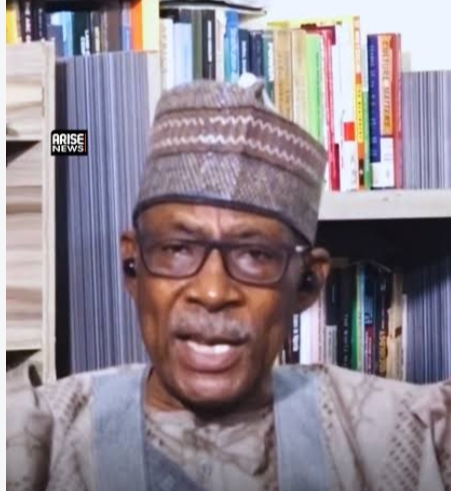
The Publicity Secretary of the Arewa Consultative Forum (ACF), Tukur Mohammed-Baba, has attributed growing public anger against President Bola Tinubu’s administration to worsening economic hardship, poverty and insecurity across the country.
Mohammed-Baba said Nigerians, irrespective of region or religion, were increasingly dissatisfied with the government as deteriorating living conditions continued to make life difficult for millions.
He made the remarks during an interview on Arise TV on Thursday, warning against framing public discontent as a Northern or religious grievance.
“I would rather see it not as anger from the North. I will talk about citizens are angry,” he said.
According to him, the growing frustration among Nigerians was evident in reactions witnessed during political campaigns across the country, including protests, confrontations and other expressions of displeasure.
He argued that focusing on regional or religious divisions could distract from the underlying economic challenges confronting citizens.
“When we keep promoting the binary of North-South divide or religion, we tend to mask the real problems. Let me say bluntly, the citizens are angry, and I don’t think it’s confined to the North alone,” he said.
The ACF spokesman said the North was particularly affected by worsening living conditions, rising poverty and insecurity, which had disrupted livelihoods, especially among farmers and rural communities.
He noted that insecurity had made it increasingly difficult for people to engage in agriculture and other primary production activities, while the absence of processing industries had further compounded economic challenges.
He said the economic difficulties Nigerians had endured in recent years could not be overlooked, even where some food prices had reportedly declined.
“The last four years have seen a dip in living conditions, insecurity, economic conditions and so on. Maybe foodstuff have gone down, but at what expense?” he asked.
To illustrate the burden on farmers, he cited a video of a woman from Adamawa State who lamented the cost of agricultural inputs, noting that fertiliser was selling for over N60,000 per bag, despite lower prices of some food commodities.
Mohammed-Baba argued that the high cost of farm inputs was making it difficult for farmers to benefit from the reduction in food prices.
“There is no doubt that standards of living have become very challenged. Conditions of living have become very challenging. There is more poverty, there is greater difficulty,” he said.
Mohammed-Baba also questioned the state of electricity supply, referencing recent remarks by the Minister of Power on the performance of the sector.
He further questioned the capacity of political office holders to convince struggling Nigerians about the government’s performance, arguing that their numbers were insignificant compared with the millions battling economic hardship.
According to him, the disconnect between official narratives about government performance and the everyday realities of citizens was making it increasingly difficult for political appointees to defend the administration.
“How can you talk to someone who can hardly afford one meal a day about the performance of the government? It’s going to be very difficult because there is a dissonance between what they are experiencing and what they are being told,” he said.
He stressed that the growing dissatisfaction was largely driven by the living conditions of the people rather than necessarily the competence of government officials.
His remarks come amid early political manoeuvres ahead of the 2027 general elections, with economic hardship, insecurity, unemployment and the cost of living expected to feature prominently in political debates.
Never miss a moment! Get the stories shaping Nigeria, delivered straight to your phone. Follow Peoplesdaily Newspaper on WhatsApp for breaking news, exclusive reports, and the headlines everyone will be talking about, before anyone else.