
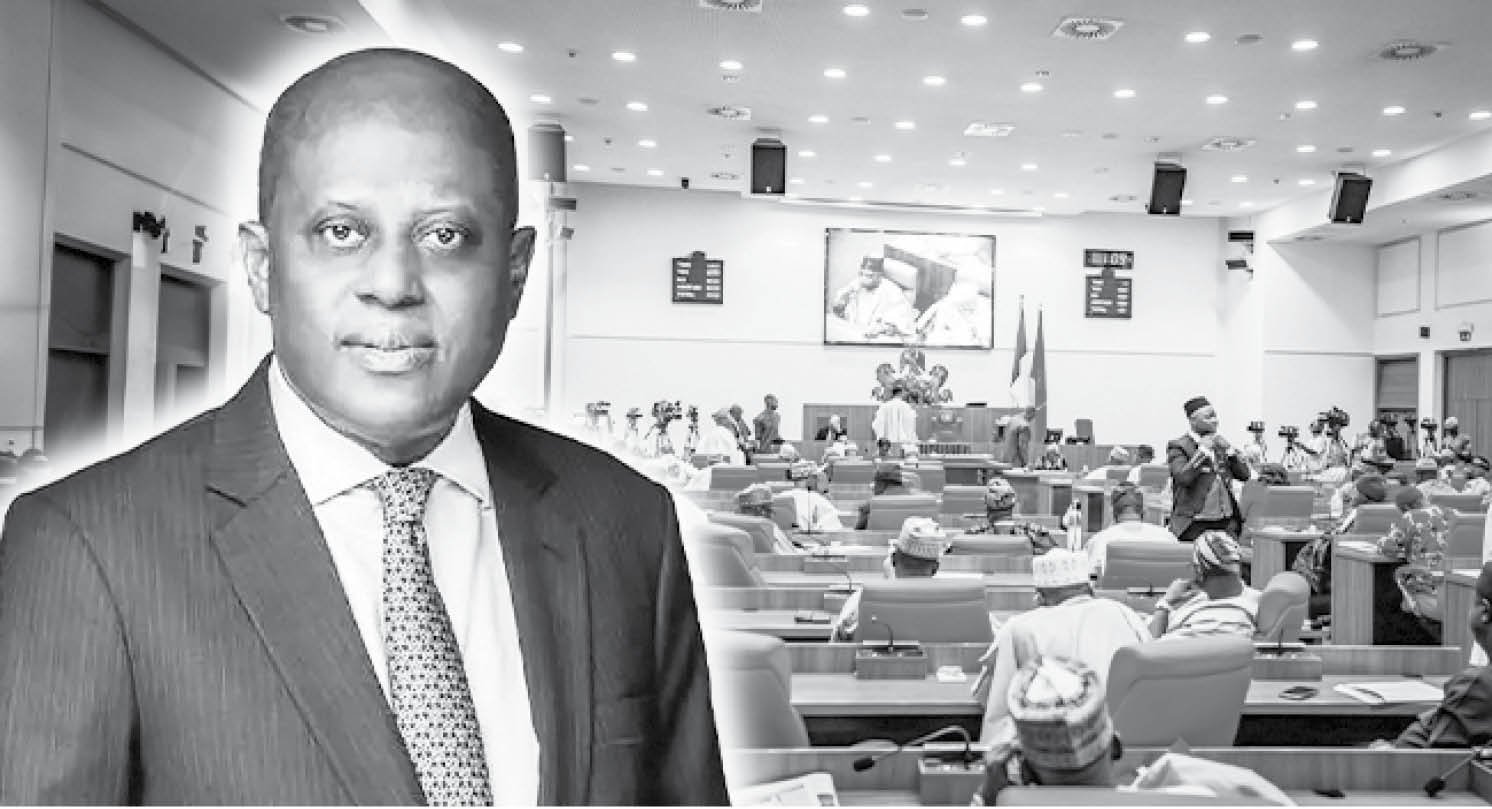
The Nigerian Senate on Tuesday, September 26, 2023, confirmed Dr. Olayemi Cardoso as the Governor of the Central Bank of Nigeria (CBN).
The Senate also confirmed Mrs. Emem Nnana Usoro, Mr. Muhammad Sani Abdullahi Dattijo, Mr. Philip Ikeazor, and Dr. Bala M. Bello, as Deputy Governors of the CBN.
They were to fill the vacuum created by the suspension of the former governor, Mr. Godwin Emefiele, and the former Acting Governor, Mr. Folashodun Shonubi, Mr. Edward Adamu, Mrs. Aishah Ahmad, and Dr. Kingsley Obiora who resigned their appointments.
Recall, President Bola Tinubu on September 15, 2023, nominated Dr. Olayemi Cardoso, the former head of Citibank in Nigeria, as the country’s new Central Bank Governor.
Cardoso was announced together with the four deputy governors for the apex bank. They were nominated for a term of five (5) years at the first instance.
Tinubu’s directive was in conformity with Section 8 (1) of the Central Bank of Nigeria (CBN) Act, 2007, which vests in the President of the Federal Republic of Nigeria, the authority to appoint the Governor and Four (4) Deputy Governors for the CBN, subject to confirmation by the Senate of the Federal Republic of Nigeria.
Dr. Olayemi Michael Cardoso is a Nigerian banker, chartered stockbroker, and public policymaker with over 30 years of experience in the financial and development sectors.
He was born in Lagos and studied managerial and administrative studies at Aston University in the UK in the 1970s.
Cardoso served as the former chairman of Citibank Nigeria and was the Commissioner for Lagos State Ministry of Economic Planning and Budget from 1999 to 2003, under Tinubu’s administration as the then Governor.
The Tasks Before Cardoso
With his confirmation by the Senate, he will be facing the following challenges:
Rising Inflation: Nigeria has been experiencing high inflation rates, with 25.80% in August, relative to the July 2023 headline inflation rate which was 24.08%, therefore, Cardoso would need to implement policies to curb inflation and stabilize prices.
Declining Reserves: Nigeria’s external reserves have been declining. As of August 10, 2023, Nigeria’s external reserves stood at $33.88 billion, down from $37.08 billion in July 2023, and Cardoso will need to find ways to build up the reserves and restore investor confidence.
Stabilizing the Naira: The Nigerian currency has been volatile, and Cardoso will need to implement policies to stabilize the naira and maintain a stable exchange rate. He is expected to clear the foreign exchange backlog to stabilize the naira and restore confidence in the economy.
Working with Stakeholders: Cardoso is expected to work closely with the government, other financial institutions, and stakeholders to address challenges faced by the CBN and ensure the stability of Nigeria’s economy.
The Currency Redesign Policy and the deadline for the use of old Naira notes. The deadline for the use of old Naira notes has been extended multiple times due to the shortage of new notes and the difficulties faced by Nigerians in exchanging their old notes. Initially, the deadline was set for January 31, 2023, but it was extended to February 10, 2023, to allow more time for the exchange of old notes.
After the February 10 deadline, Nigerians had a further seven days to deposit old notes directly with the CBN. However, the Supreme Court suspended the deadline to stop using old banknotes on February 8, 2023.
The Supreme Court later extended the validity of the N200, N500, and N1,000 Naira notes till December 31, 2023.
Therefore, Cardoso would be required to work towards the December 31, 2023 timeline.
eNaira. The implementation of the eNaira has been criticized as less than 1.22 million Nigerians have used the eNaira wallet. The CBN has plans to remodel the eNaira to make it more attractive to more Nigerians. The eNaira has grown 190%, and the CBN aims to strengthen the digital economy. The future of the eNaira is uncertain, therefore, Cardoso will need to find ways to make it work.
Cardoso’s policies are expected to have a positive impact on the Nigerian economy and restore investor confidence in the country.
Apart from its main mandate of ensuring monetary and price stability, issuance of legal tender currency, and maintaining external reserves to safeguard the international value of the legal currency, the CBN under the last administration introduced about 37 intervention programmes to boost the economy.
These interventions were aimed at addressing market failures and other critical issues within the nation’s economic space. The interventions include:
The Anchor Borrowers Programme, Creative financing initiatives, Solar energy interventions, Intervention in the textile sector, Non-interest financial institution intervention schemes, Agri-Business/Small and Medium Enterprise Investment Scheme (AGSMEIS), Micro, Small and Medium Enterprises Development Fund (MSMEDF),
Real Sector Support Facility (RSSF), Targeted Credit Facility (TCF), Nigeria Electricity Market Stabilisation Facility (NEMSF), Nigerian Incentive-Based Risk Sharing System for Agricultural Lending (NIRSAL), Youth Entrepreneurship Development Programme (YEDP), National Mass Metering Programme (NMMP), National Collateral Registry,
Commercial Agriculture Credit Scheme (CACS), Nigerian Content Intervention Fund (NCIF), Health Care Sector Intervention Facility (HIF), Non-oil Export Stimulation Facility (ESF), Credit Support for the Healthcare Sector, Creative Industry Financing Initiative (CIFI), Development Finance Department (DFD), Agri-Business/Small and Medium Enterprise Investment Scheme (AGSMEIS) for Non-Interest Financial Institutions (NIFI),
Accelerated Agricultural Development Scheme (AADS), Nigeria Youth Investment Fund (NYIF), Nigeria Electricity Market Stabilisation Facility (NEMSF), Nigeria Electricity Market Stabilisation Facility (NEMSF) Phase II, Nigerian Content Intervention Fund (NCIF) Phase II, Non-oil Export Stimulation Facility (ESF) Phase II, Real Sector Support Facility (RSSF) Phase II,
Targeted Credit Facility (TCF) Phase II, Agri-Business/Small and Medium Enterprise Investment Scheme (AGSMEIS) Phase II, Creative Industry Financing Initiative (CIFI) Phase II, Health Care Sector Intervention Facility (HIF) Phase II, Non-interest Financial Institutions (NIFI) Intervention Schemes Phase II, and Nigerian Youth Investment Fund (NYIF) Phase II.
Some of the benefits of the CBN interventions include:
Improved liquidity: The injection of fresh capital by CBN has improved the liquidity position of affected banks, ensuring the safety of deposits of these banks.
Stability in the economy: Policy measures were introduced to restore stability in the economy by supporting households that have been severely affected by the economic downturn.
Mitigation of stress in currency and bond markets: Many emerging market central banks used foreign exchange interventions and asset purchase programs to mitigate stress in currency and bond markets.
Provision of credit: CBN interventions aim to maintain the flow of credit, which reduces the probability that shocks to the financial system disrupt the provision of financial services and cause serious negative consequences.
Developmental role: CBN interventions are seen as a key intervention in breaking the haemorrhage of the economy.
Beneficiaries of CBN interventions have counted gains, including households, businesses, and educational institutions.