

Monday Column By Emmanuel Yawe
royawe@yahoo.com | 08024565402
Harold Macmillan in the historic speech he delivered on 3rd February 1960 to both Houses of Parliament of the Union of South Africa in Cape Town predicted a “wind of change” will blow through the continent of Africa. As the British Prime Minister at the time of the speech, his words were closely watched. In less than twelve months, what he promised as a wind of change came, but did not come as a wind but a hurricane of change. In one fell swoop, 17 countries of Africa under colonial bondage followed the trail of Ghana and became free.
“At long last, the battle has ended! And thus Ghana your beloved country is free forever!” The speaker did not forget to add the words which later defined his legacy in Africa. “Our independence is meaningless unless it is linked up with the total liberation Africa.” Those were the wise words of Kwame Nkrumah as he delivered his inaugural speech to a cheering crowd on March 6 1957 as Ghana’s Prime Minister.
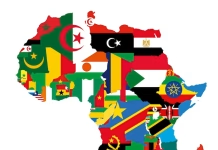
On May 23 1963, Kwame Nkrumah teamed up with Haile Selaise, (who ruled Ethiopia as Emperor between 1930 and 1974, successfully defending his country to become the only African county to evade colonial conquest), formed the Organisation of African Unity (OAU). This was preceded by the Cassablanca group and the Monrovia group. By this time 32 independent countries had signed up. The main aim of the OAU was to rid the continent of the remaining vestiges of colonisation and apartheid; to promote unity and solidarity among African states etc.
All though the existence of the OAU, (1963 to 2002) as divided as Africa was and still is on many issues, colonialism, especially the most repugnant version of it, apartheid became the issue that rallied all countries of the continent together. Long after the original founders – Nkrumah and Selaise were overthrown and dead – African peoples and governments continued to fight for the freedom of their fellow Africans still under the control of colonial masters and the racial bigots that were holding them in bondage. So much was the solidarity feeling that when some of us entered the university in the 70’s we contributed small, small Naira and Kobo for the war chest of the cause of liberation. We were all too willing to go and fight particularly apartheid in South Africa if only the government would allow us. Forget about the fact that most of us had never fired a dane gun in our life, not to talk of facing the bloodshed and commotion of war.
The cry for African freedom in Nigeria reached a frenzied height when General Murtala Mohammed became the Head of State after General Yakubu Gowon was overthrown. Then there was a serious war going on for the liberation of Angola which was under the colonial control of Portugal. South Africa which was already occupying Namibia by force of arms saw an opportunity to dig deeper in Africa by taking advantage of the confusion in Angola. With America in their support, they started lobbying some African countries to support them. The President of the United States then Gerald Ford wrote to General Mohammed. The hot headed new Nigerian Head of State did not only reject his ideas, he took the non- diplomatic step of publishing the classified letter and replying it – all in the media.
The star performance of the new Nigerian Head of state came when an extraordinary meeting was held in Addis Ababa Ethiopia. On January 11 1976, he delivered a thundering speech in which he said: “When I contemplate the evils of apartheid my heart bleeds and I am sure the heart of every true blooded African bleeds…Rather than join hands with forces fighting for self-determination and against, racism and apartheid, the United States policy makers clearly decided that it was in the best interest of their country to maintain white supremacy and minority regimes in Africa. Africa has come of age. It is no longer under the orbit of any continental power….”
Very soon after that speech, Gen Muritala fell to an assassin’s bullet and so did Angola also fall from colonial control. The puppet liberation movements were routed on the battlefield by those supported by the Nigerian and majority of African governments. With the support of independent African counties, Angola, (Rhodesia) Zimbabwe, Namibia, Mozambique all became the last batch of independent counties in the 70’s and 80’s. In the 90’s South Africa itself released their long held prisoner, dismantled apartheid and became free.
So much hope was put on that country. It is the most technically advanced and as a settler colony, the white minority there who controlled the economy and power never knew they would one day go. They developed South Africa on the lines of the developed industrial complex of Western countries. If the whites had moved out immediately, the country would have collapsed and South Africa and Africa would have been the worse for it. It would have proved the point that the black-man is incapable governing himself. The wisdom in Nelson Mandela virtually maintaining the status quo saved South Africa from the anarchy, commotion and bloodshed of the early post-apartheid years.
But some years after Apartheid, South Africa came to grapple with another problem. They were no longer content with mere discrimination against immigrants from other counties. An alarming rate of xenophobic attacks spread widely all through the country leading to scores of deaths because of these attacks. Now and then we hear of these attacks targeted at Africans who are from poorer countries. South African blacks appear to have forgotten that when they were enslaved by the whites, brother black African countries bailed them out.
With the jailing of the former President Jacob Zuma, we have begun to see another side of South Africa. The journalists who came to cover the return to civil rule in Nigeria in 1999 complained to us about the prevalence of corruption and tribalism in Nigeria. But immediately Jacob Zuma was convicted on corruption related issues and he handed himself over to the authorities to be imprisoned, a violence which according to South African President Cyril Rhamaphosa was preplanned erupted along ethnic groups around Kwazulu – Natal and Guateng – the convicted ex-president’s home base. Nobody is asking whether the ex-president broke the law. All they are concerned about is that he is their own and should be left alone.
The South African journalists who accused us in Nigeria in 1999 of making everything in our country look tribal and corrupt may have discovered by now that South Africa is another Nigeria after all.