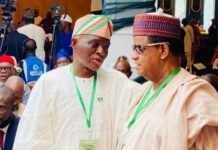

By Musa Baba Adamu
The Director General of Progressives Governors Forum (PGF), Salihu Lukman, has said there is need to revive the National Labour Advisory Council (NLAC) as a measure to settle the misgivings of the Nigeria Labour Congress (NLC) over the Bill seeking to move minimum wage from exclusive to concurrent legislative list.
The National Labour Advisory Council (NLAC) comprises of Representatives of NLC, employers and government, all of which sit round table to negotiate issues of minimum wage for the members of the organised labour.
Salihu Lukman, a chieftain of the All Progressives Congress (APC), was a top official of the NLC before he joined APC, observed with regrets that NLAC which was very vital in the peaceful resolution of major labour challenges during his stint in NLC, has become almost non-existent.
The PGF DG was reacting to the nationwide protest organised by the labour union, both at the National Assembly and across states of the Federation, to press home their demands that the Bill seeking to move minimum wage from exclusive list to concurrent list, currently before the House of Representatives, be withdrawn with immediate effect.
The Controversial labour wage reform Bill, is sponsored by Garba Mohammed Datti (APC, Kaduna), has passed second reading in the House, with the clause that allows State Governors to fix minimum wage for workers in their respective States according to their capacity.
But Lukman in a statement said the NLAC model which was used around 2005 to resolve the challenge of amending Nigeria’s pension law could also be effectively applied to tackle the ongoing minimum wage debacle.
“When the contributory pension law was passed by the National Assembly and accented to by President Olusegun Obasanjo, both unions, employers and state governments were opposed to the new pension law,” Lukman said.
“But through consultations at the level of NLAC, both labour and employers agreed to a prototype pension bill, modelled based on provisions of the new Pension Act, which was presented to the NEC.
“Eventually, NEC adopted the prototype pension bill, which was transmitted to all the 36 states. The rest is now history as all states have domesticated the pension act based on their peculiarities”.
“If we have NLAC, why can’t we have members agree to all the variables determining minimum wage in the country – productivity, conditions of living and affordability, based on which the national minimum is reviewed on an annual basis being the proposed benchmark for the country?
“The National Bureau of. Statistics (NBS), National Salaries, Wages and Income Commission and National Productivity Centre (NPC) can handle the task of providing information about the variables of productivity, cost of living and affordability.
“With objectively computed information, the process of achieving consensus that highlight the minimum threshold for wages can be handled very effectively.
“Agreement under NLAC can serve as the federal minimum wage. Once agreement is reached at the level of NLAC, a prototype minimum wage bill can be developed and sent to the National Economic Council (NEC), chaired by the Vice President of the Federal Republic with Governors of the 36 states as members.
“Following consideration and adoption by NEC, states can then domesticate provisions of the agreement as contained in the prototype bill based on their peculiar circumstance.
“Part of what needs to be resolved is the issue of whether states are allowed to adopt minimum wages below the agreed federal minimum wage established by NLAC as adopted or approved by NEC? Or what minimum wage should apply to workers employed by private organisations whose operations cover many states?
“First, no state should be allowed to have a minimum wage lower than the benchmark as provided in prototype bills adopted by NEC. Secondly, in the case of private employers operating in more than one state, the highest minimum wage should apply,” he said.