
By Christiana Ekpa
The House of Representatives has initiated a major move to overhaul Nigeria’s planning and budgeting system, unveiling plans for a high-level national policy dialogue aimed at fixing longstanding gaps in development execution.
The initiative comes as Nigeria intensifies efforts to position itself as a $1 trillion economy.
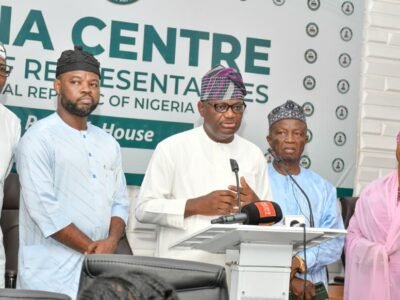
Chairman of the House Committee on National Planning and Economic Development, Hon. Gboyega Isiaka (APC, Ogun), disclosed this on Monday during a press briefing at the National Assembly.
Speaking on behalf of a joint committee of the Senate and House, he announced that the two-day dialogue will hold on April 14 and 15, 2026, at the Bola Ahmed Tinubu International Conference Centre in Abuja.
According to Isiaka, the forum is designed to bridge the persistent disconnect between national development plans and budget implementation an issue widely blamed for slowing Nigeria’s economic progress.
He explained that the dialogue will bring together key stakeholders across government, the private sector, and policy institutions to craft a more coordinated and results-driven development strategy.
The initiative, organised in collaboration with the Office of the Vice President, the Ministry of Finance, the Ministry of National Planning, and the Budget Office of the Federation, will focus on aligning Nigeria’s development priorities with its fiscal framework.
Isiaka noted that Nigeria’s current growth rate of about 3.54 per cent falls short of what is required to achieve its long-term economic ambitions, especially the $1 trillion target. He stressed that growth must significantly outpace the country’s population increase, estimated at 2.7 per cent.
“We cannot continue on a business-as-usual path. Growth must be accelerated and deliberately anchored on a structured and implementable national plan,” he said.
Reflecting on past development frameworks from pre-independence plans to Vision 2020 and the Economic Recovery and Growth Plan Isiaka said many fell short due to structural weaknesses, economic volatility, and external shocks like fluctuating oil prices.
“The lesson is simple: planning alone is not enough. Execution, consistency, and adaptability are key. This dialogue is about getting it right going forward,” he added.
He further noted that the forum will provide a platform for robust engagement among policymakers, legislators, heads of Ministries, Departments and Agencies (MDAs), and experts in finance and economic planning, with a focus on producing actionable outcomes.
“We are bringing everyone to the table to build consensus around a system that delivers real and measurable results for Nigerians,” he said.
Also speaking, Deputy Chairman of the House Committee on Budget and National Planning, Hon. Clement Jimbo, emphasised the importance of strategic planning, warning that weak frameworks could continue to stall national development.
“If you fail to plan, you are planning to fail,” Jimbo said, citing global success stories like Singapore’s transformation through disciplined, forward-looking policies.
He added that even minimal improvements from the dialogue could significantly strengthen Nigeria’s planning outcomes.
“Even a one percent improvement from this engagement can have far-reaching impact,” he noted.
On the current envelope budgeting system, Jimbo acknowledged its limitations but said alternatives like zero-based budgeting may be difficult to fully implement given the size of government operations.
“With over a thousand MDAs, a wholesale shift to zero-based budgeting could be impractical. What we need is a system that reflects our realities while improving efficiency and accountability,” he explained.
He added that the dialogue will explore options such as performance-based budgeting, with breakout sessions allowing MDAs to share experiences and propose context-driven reforms.
On managing potential oil windfalls, Jimbo noted that while the responsibility lies with the executive, strategies such as saving excess revenues and adjusting budgets in response to economic shifts remain critical.
“There are several ways to manage windfalls effectively, and with the right framework, Nigeria can optimise such opportunities,” he said.
Lawmakers expressed optimism that the dialogue will mark a turning point in Nigeria’s development planning, laying the foundation for a more responsive, coordinated, and results-oriented budgeting system capable of driving sustained economic growth.
End
READ MORE  KWIRS declares N59.9bn revenue take in 2018

LEAVE A REPLY

Please enter your comment!
Please enter your name here