
WEDNESDAY COLUMN BY USSIJU MEDANER
info@medaner.com, justme4justice@yahoo.com
Of concern to my piece for the week was the just concluded political party primaries, particularly that of the ruling APC and PDP which became eye opener for me – and probably for many other people out there – on many fronts. While I see the refusal of Atiku Abubakar and his likes to discourage the nation’s electoral system away from money politics; I also experienced first-hand the impact of his long-term friendship building and constructive, continuous contribution to the successes of others, especially, politically. While Atiku once again won the ticket of his party on the strength of, allegedly, money and regional sentiments, I see an Asiwaju who mobilised huge opposition to his advantage, and for his emergence as the party’s flag bearer, flying on the shoulders of friends and allies he built overtime across the regions and in the most unexpected places. I just hope, going forward, the party APC would recognise and reward the absolute solidarity that plays out at its primary. It should become much easier to pick a running mate for Asiwaju taking a clue from the figures that committed themselves for his emergence. They would most likely do it again as he searches for his running mate.
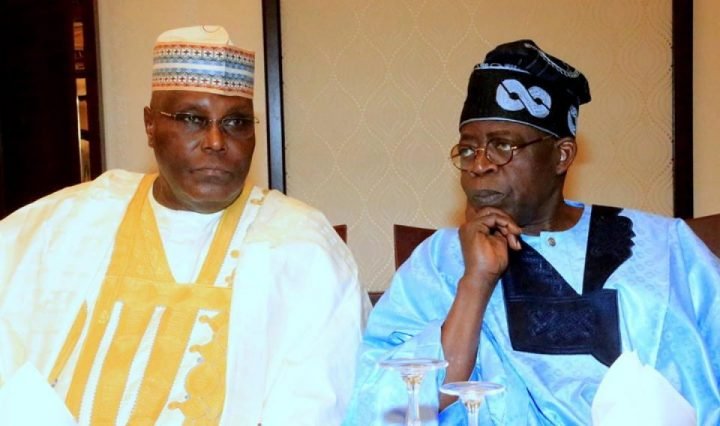
Now, to the business of this week; finally, the die is cast. It is an Atiku Abubakar against Asiwaju Bola Ahmed Tinubu. Many are of the opinion that it would be a spectacular battle of the titans that the country is about to witness one of its most fiercely contested elections. Of course, if the party primaries are to be reckoned with as the determining factor for what is to be expected, they would not be wrong but the general elections are way too different from the party primaries. If the intrigues that swayed the primaries for each of the contestants are anything to go by, projections into the general elections would not be as difficult; the capacity of an Atiku to induce delegates as it believably happened during the PDP primary against the mobilisation of unbelievable supports across unbelievable lines by the APC candidate; a product of long time conscious preparation and support base building, are two opposing strategies, and one in which the former has no stance against the latter, when the consideration for the latter to roll out money and perfectly match if not drown the former, if necessary, is placed on the table.
I waste no time coming to terms with the realities of what is to come; side by side, weighing all attributes and capacities, an Atiku candidacy, except for the purpose of media politics, dramas and luck trying coupled with the jobs of praise singers, cannot stand Tinubu. Atiku Abubakar knows that; his party, PDP knows it, and they are jittery already, but of course would try their luck. PDP did wish for a different flag-bearer for APC; they had been happy to see an attempt to muscle Asiwaju out of the contest and foster some other consensus candidate for the party. Anybody other than Asiwaju Ahmed Tinubu was the dream and hope of PDP and Atiku. Little wonder, the party and its candidate are in panic mode, staging meetings and hoping for alliances that could better their chances against their new confounding realities. How can a party as big as PDP as claimed be going after a member that has abandoned it, begging and offering him its VP position just because Asiwaju has emerged as the APC candidate?
Where do we begin to compare the two candidates? But for the purpose of necessity and political education, I would take the trip to assess and compare the life and times of the two men who have taken the center stage in our national politics and would remain the subject of discussion until sometimes in the middle of the year 2023 after the swearing in of the next president of Nigeria. I have already made an attempt at comparing the educational preparation of the two; noting that we are now in the age where much is attached to academic preparation and administrative capacity of leaders. It is obvious that academically, an Atiku Abubakar is a minor in comparison with the academic giant that Asiwaju Ahmed Tinubu is by all ramifications. Academically, Atiku has a very brief profile; a diploma that took him via quota system and a rumoured consistent manipulation of processes through the ranks in the Nigeria Custom Service and nothing else besides being the Vice-President for eight years. On the part of Tinubu, he was a decorated graduate of Chicago State University in the United States of America; an accountant, worked for the best of American companies in Arthur Andersen, Deloitte, Haskins & Sells, and GTE Service Corporation, before returning home to join ExxonMobil Petroleum where he rose to become the company’s Treasurer before retirement. Need I remind us that he was a two-term governor of Lagos State, at the same time Atiku was the Vice-President.
It is obvious that if all it takes to pick from the two contesting candidates is the strength of their academic qualifications and yearlong administrative capacities and experience, Asiwaju would have already floored Atiku.
Secondly, having occupied political offices in trust for Nigerians at the level the two of them had done in the past, I found it also interesting to dissect their contributions to Nigeria’s growth and development while in office. Atiku Abubakar was the Vice-President to Olusegun Obasanjo in the period between 1999 and 2007; a period he was saddled with the responsibility of supervising the nation’s privatisation drive and was solely responsible for the sale and unbundling of several high ranking national investment during the period. Very unfortunate for the country and all future attempts of Atiku Abubakar to venture into politics as it is now, his gross mishandling and maladministration of the privatisation process to allegedly favour himself and his friends represent a gory tale for the country.
Between 1999 and 2007, he presided over the privatisation of Nigeria’s public companies, but under the guise of privatising national assets and the slogans “government has no business with business,’ he handed over all viable companies in the country over to ineffective individuals including indirectly to his cronies and himself, who took over not with the intention of revamping the enterprises but scavenging them for what could be realised immediately. The process led to the cheap sale of many strategic national assets; stripping of valuables from these assets; de-industrialisation and the loss of hundreds of thousands of jobs; and the entrenchment in the economic and political space of Nigeria, of the worst specimens of humans without patriotism, but an obscene gluttony and greed, and of theft and more theft. The list is endless, but I will dwell today only on the Aluminium Smelting Company of Nigeria, ALSCON; a company built by the Abacha administration at a sum of $3.2 billion, and with the national intention of feeding the country with 30 percent of its production and the remaining 70 percent for export. Atiku Abubakar, sold it off to a Russian firm, Russal, for a paltry $130million; an immediate loss of approximately 95 percent of invested capital to the country and a perpetual loss of operation of the company that was only dismembered by the buying company and abandoned till date. He similarly sold off Delta Steel which was set up in 2005, at a cost of $1.5billion, to Global Infrastructure for just $30million. When he was asked about the ALSCON sale in the build up to the 2019 election, he apologised, saying it was a mistake; a mistake he can only make with national assets but never with his personal businesses. That summarises the realism of Atiku Abubakar’s bulk contribution to the Nigeria economy – all the way till now.
On the part of Asiwaju Bola Ahmed Tinubu, the exposition of his contributions to economic, social and political development of Lagos state, a state he ruled for eight years and has continued to contribute to it till date and the nation at large, where he has not occupied any political office at the center since his narrow stint at the Senate before the June 12 era. He has continued to remain a national figure considering the shape and quality Lagos state has continued to assume in all ramifications. The enemies of Asiwaju have always had a hard time wishing away the undeniable transformation of Lagos State over the decades to what it is now. Aside from the infrastructural transformation that we see, what amazed me the most is the economic giant the state has become; internally generated revenue (IGR) consistently larger than that of the remaining 35 states put together; that is amazing. Rather than accepting the reality and giving praise to whom it is due, they have argued that Lagos is just privileged by virtue of its former federal capital status and strategic placement. Is Rivers state and a host of other oil producing Niger delta states not just as lucky considering the enormous monthly federal allocation, IGR and revenue from oil operators? Shouldn’t those states have become paradise? Shouldn’t Bayelsa state, small but huge allocation and resources reflect that status? Lagos is unique; the architect of modern Lagos has placed the state in auto pilot as far as developmental sustainability is concerned. Nowhere else in the country do you see structures that guarantee continuous and uninterrupted development of a state; Tinubu’s leadership created a century long development plan for the state, and set up a permanent structure to enforce compliance by elected officers with their city development plan.
Of truth, no single politician in Nigeria, after the Awolowo’s era has possessed the foresight of Tinubu and has contributed so immensely to the development of their base state as much as Tinubu has done with Lagos; no one, and Atiku Abubakar is definitely not exempted. Atiku Abubakar’s political legacy became more pronounced only on account of his stupendous wealth and the capacity to expend same to garner support.
GOD BLESS THE FEDERAL REPUBLIC OF NIGERIA !
To be continued.