

Insecurity can’t be solved overnight, says Katsina Governor
Katsina State Governor, Malam Dikko Umaru Radda, says security challenges cannot be solved overnight, but through thorough understanding and coordinated approach with all key stakeholders, including communities.
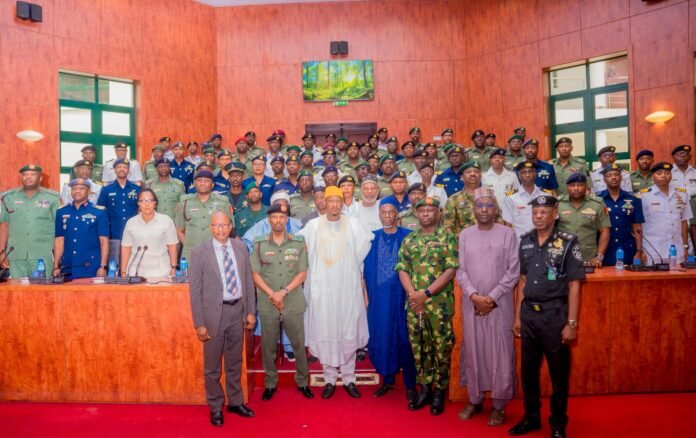
The governor made the remarks on Tuesday in Katsina when he received participants of Senior Course 48 of the Armed Forces Command and Staff College, Jaji, who were in the state on a study tour.
“Security is not something that can be resolved overnight. It requires a thorough understanding and a coordinated approach. We believe your study will contribute to developing workable solutions for the country,” he said.
Radda highlighted his administration’s community-based security strategy and key development strides, while reaffirming his commitment to strengthening security through inclusive community engagement.
He described the theme of the study tour, “Promoting Community Engagement for Enhanced National Security and Prosperity,” as timely and highly relevant to Nigeria’s current security realities, stressing that sustainable security solutions must involve local communities.
“The kind of study you are undertaking is what the nation needs at this moment. It helps us understand the role communities can play in strengthening our security architecture at both sub-national and national levels,” Radda said.
He said that the study tours would shape professional military knowledge and generate practical research findings that will influence policies not only in Nigeria but across Africa.
The governor Radda explained that prior to his administration, Katsina state had faced significant security challenges, with many local government areas under threat.
He said a detailed assessment revealed that conventional security personnel alone were insufficient to address the scale of insecurity nationwide.
“We realized that the number of military, police, and civil defence personnel is far below what is required to effectively secure the state. That is why we had to adopt a community-driven approach,” he said.
According to him, most security incidents occur in remote communities where response time can take hours, making it necessary to establish a local first line of defence supported by community-based intelligence.
The governor clarified that insecurity in the state is largely criminal in nature, driven by cattle rustlers and kidnappers.
This, he said, made the government to establish the Katsina State Community Watch Corps as a major intervention to complement conventional security forces.
“They understand the terrain and can respond faster. Their role in intelligence gathering and early response has significantly helped us reduce insecurity to the barest minimum,” he noted.
He also told the senior military and security officers that the community-led engagements involves traditional rulers, religious leaders, youth groups, and local authorities.
The Governor distanced the state government from recent negotiations with bandits in various parts of the state, insisting that it was driven by local leaders.
“We made it clear that government would not negotiate from a position of weakness, but communities themselves engaged constructively, and in some cases, it yielded positive results,” he said.
He commended the Armed Forces and other security agencies for their sacrifices, acknowledging the personal cost borne by personnel in the line of duty.
“Our soldiers and security personnel make enormous sacrifices, leaving their families behind to protect the country. This commitment must never be taken for granted,” he said.
Earlier, the Team Leader of the delegation, Brigadier General K. Rabiu, said the visit formed part of the nationwide study tour of participants of Senior Course 48 of the Armed Forces Command and Staff College.
He said that the team is one of seven syndicate groups deployed across selected states, including Benue, Jigawa, Katsina, Kogi, Nasarawa, Niger, and Plateau.
Speaking on the objective of the study tour, Brigadier General Rabiu said it is designed to expose participants to real-life governance, development, and security challenges across the country.
“Participants are required to conduct research on critical national issues and present practical, policy-relevant solutions that can contribute to national development,” he said.