

By Stanley Onyekwere
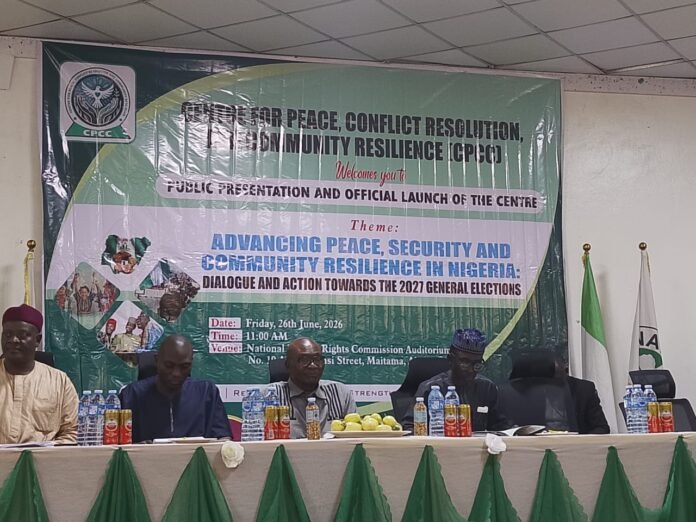
In a proactive move to address growing security anxieties and build grassroots stability ahead of the upcoming political cycle, the Centre for Peace, Conflict Resolution, and Community Resilience (CPCC) was officially launched Friday.
The high-profile public presentation, held under the critical theme “Advancing Peace, Security and Community Resilience in Nigeria: Dialogue and Action towards the 2027 General Election,” brought together top academics, government officials, civil society leaders, and international development partners.
Speaking at the launch, Centre Director Rev. Dr. Austin Uchegbu emphasized that the institution’s arrival comes at a defining moment for the nation, as communities confront a complex mix of violent conflicts, environmental strains, and socio-political tensions.
“Today marks not merely the unveiling of a new institution, but the beginning of a strategic and transformative journey.
“These realities call for innovative responses, informed research, practical interventions, and collaborative action,” Dr. Uchegbu stated during his welcome address.
With the 2027 general elections firmly on the horizon, the Centre aims to pivot away from reactionary security measures, focusing instead on building “community resilience”—equipping local populations with the tools to resist polarization and violence.
Unlike traditional think tanks, the CPCC is positioning itself as an active, boots-on-the-ground collaborator. To mark its opening day, the Centre achieved two initial milestones by launching its official digital platform and unveiling the maiden edition of the African journal of peace and community resilience.
According to its leadership, the Centre will operate across four core pillars interdisciplinary research, professional certification ,policy guidance, and direct consultancy: and offering risk assessments
The Centre’s leadership made it clear that tackling Nigeria’s structural security issues cannot be done in isolation. Dr. Uchegbu issued an open call for robust, mutually beneficial partnerships with universities, non-governmental organizations, and international bodies.
“We believe that through these partnerships, we can build stronger networks of knowledge, innovation, and action capable of addressing complex realities confronting our communities,” he said.
As stakeholders look tentatively toward the political landscape of 2027, the establishment of the CPCC offers a glimmer of systemic hope—uniting scholarship with community action to ensure that peace and justice thrive across Nigeria’s diverse regions.