

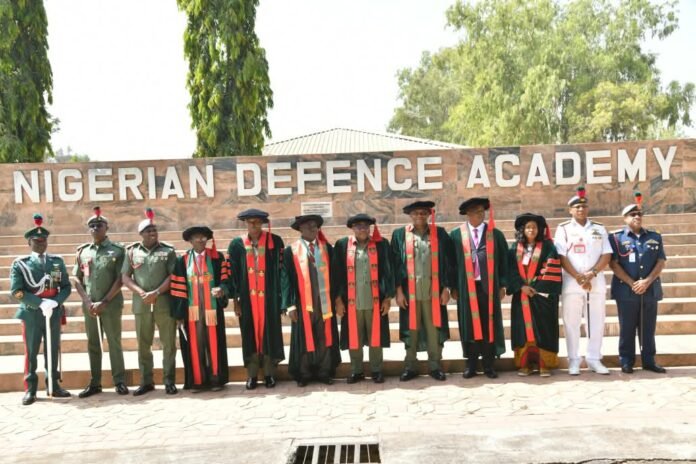
A Professor of Telecommunications Engineering at the Nigerian Defence Academy (NDA), Prof. Dominic Nyitamen has called for affordable and dependable broadband connectivity to drive education, healthcare, commerce, and access to public services in Nigeria.
Nyitamen made the call on Thursday in Kaduna while delivering the 25th Professorial Inaugural Lecture of the NDA, titled “Beyond Connectivity: Telecommunications – Architect of Modern Society.”
He said telecommunications had become a critical driver of development, shaping virtually every sector, including education, agriculture, banking, healthcare, industrial development, and national security.
The professor recommended that rural broadband funding be tied to verified service delivery, with federal and state agencies publishing data on connectivity quality, affordability, and usage.
He urged the government to award broadband grants transparently through the Universal Service Provision Fund (USPF) and to ensure payments were linked to independently verified service delivery and affordability targets.
Nyitamen also called for improved access to essential digital services through the connection of schools, clinics, and libraries, with adequate provision for electricity, maintenance, and personnel.
He recommended that public digital platforms be designed to consume less data, work on affordable mobile devices, and accommodate persons with disabilities, while digital skills training and support for devices and data should be strengthened.
The lecturer further advocated the deployment of fibre, wireless, and satellite technologies based on the peculiar needs of communities, alongside fair tower and infrastructure-sharing arrangements.
He said telecommunications infrastructure should be subjected to measurable coverage obligations, with service tested under different conditions, including indoor environments, peak periods, and power outages.
Nyitamen also emphasised the need to incorporate privacy protection, equipment standard, and energy efficiency into procurement processes, urging service providers to collect only necessary personal data and ensure its protection.
He proposed collaborative field trials involving universities, telecommunications operators, standards bodies, and communities to assess indigenous innovations and publish findings, costs, and implementation challenges.
The professor suggested that the NDA and the Standards Organisation of Nigeria (SON) establish a partnership to develop common measurement protocols, train researchers and facilitate comparative studies among laboratories, using ISO/IEC 17025 as a reference for laboratory competence.
He said the partnership could begin with a replicable telecommunications pilot, with anonymised data, uncertainty estimates, and installation lessons shared with AFSEC TC 77 for consideration in its guidance and standards reviews.
About future research, Nyitamen said his immediate priority was to investigate how renewable energy affected telecommunications reliability by measuring electrical disturbances and their relationship with service interruptions at selected Nigerian sites.
He also proposed research into the compatibility of connected medical equipment, improved radio coverage, selective surfaces, microwave inspection technologies, and low-power sensors.
The Special Guest of Honour, Maj.-Gen. Oladele Arogundade, Commander, Command Engineering Depot, Rigachikun, described the lecture as timely, noting that information and communication technology was increasingly shaping modern society and warfare.
Arogundade said the growing use of drones in contemporary warfare underscored the importance of telecommunications and technological innovation in military operations, adding that remotely operated systems had significantly transformed the character of conflict.
He disclosed that the Command Engineering Depot had upgraded the firing system of a multi-barrel rocket launcher from an analogue to a digital system, enabling remote operation from a laptop at a distance of up to 400 metres.
The general said the innovation had been successfully tested at the Nigerian Army School of Artillery range in Kachia and that four units had been deployed to operations in the North-East and North-West as force multipliers.
He pledged to sponsor two PhD students and three master’s students to undertake research in telecommunications under the supervision of the inaugural lecturer while urging professionals to embrace continuous learning and technological advancement.
NDA reaffirms commitment to research
The Commandant of the NDA, Maj.-Gen. Oluyemi Olatoy said telecommunications had evolved from a specialised communication tool into a major driver of social transformation, technological innovation, and national security.
Olatoye said emerging technologies, including artificial intelligence, cyber operations, command systems and electronic warfare, had created new opportunities and vulnerabilities requiring military professionals to adapt to evolving technological realities.
He reaffirmed the Academy’s commitment to promoting intellectual excellence, professional military education and research, while commending Nyitamen for his contributions to scholarship and the development of the institution.
The Commandant urged participants to engage meaningfully with the ideas presented at the lecture and explore practical ways of harnessing telecommunications for national development and security.
Never miss a moment! Get the stories shaping Nigeria, delivered straight to your phone. Follow Peoplesdaily Newspaper on WhatsApp for breaking news, exclusive reports, and the headlines everyone will be talking about, before anyone else.