

Vaccination programmes are underway across Africa, bolstered by the international Covax initiative to help poorer countries access supplies.
Many countries have now received some vaccines, and a growing number have started administering them.
But African nations are still significantly behind other parts of the world.
How are African countries getting vaccines?
Deliveries of vaccine supplies under the Covax programme started in February, and most countries in Africa have signed up.
The programme – backed by the World Health Organization (WHO) and other multilateral bodies – aims to distribute an initial half million doses of the Oxford-AstraZeneca vaccine worldwide, with the aim of supplying two billion vaccines by the end of 2021.
Of this total, the WHO says 600 million doses will be for Africa, enough to vaccinate at least 20% of the population.
The Covax initiative has so far delivered AstraZeneca and Pfizer vaccines to African countries.
The Democratic Republic of Congo (DRC) has become the first country in Africa to put on hold its rollout of the AstraZeneca vaccine as a precaution after concerns were raised in some countries over its safety.
The World Health Organization and the European Medicines Agency however say there is no indication of a link between the vaccine and reports of blood clots.
The DRC has received 1.7 million doses of the AstraZeneca vaccine through the Covax scheme.
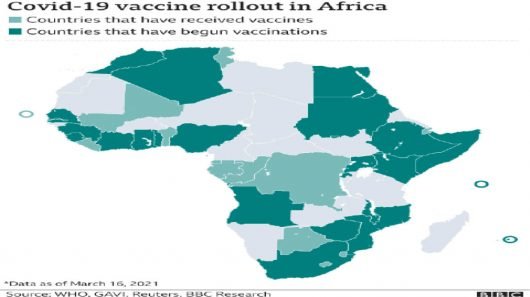
Tanzania and Madagascar have said they have no plans to acquire vaccines, and Burundi says that at the moment, they don’t need vaccines.
And some nations have sourced vaccines from outside the Covax scheme.
They’ve done so through direct purchases from the manufacturers, or as donations from countries such as China, Russia, India and the United Arab Emirates (UAE).
China has donated doses of the Sinopharm vaccine to Zimbabwe, Namibia, Equatorial Guinea, Egypt, Tunisia, Sierra Leone and Guinea.
The United Arab Emirates also donated Sinopharm doses to the Seychelles.
India has donated the AstraZeneca vaccine to Kenya, Uganda, Rwanda, DR Congo, Ghana, Ivory Coast, Senegal, Mozambique, eSwatini, Botswana, Mauritius and Seychelles.
Senegal donated some of the vaccine doses it bought from China to neighbouring Gambia.
Russia donated some doses of the Sputnik-V vaccine which were used on an experimental basis in Guinea.
Globally, there’ve been calls for developed nations to ensure that poorer countries are not left behind in the push to vaccinate against Covid-19.
France’s President Emmanuel Macron recently proposed that rich countries in Europe and the US share their extra vaccines with Africa.
He says he wants these doses be made available quickly for African countries.
The global humanitarian body, the International Rescue Committee (IRC), estimates that all the extra supplies bought by the US, UK and the EU could vaccinate everyone aged 16 and over in the 20 countries most at risk of humanitarian disaster.
Out of these countries, 13 are in Africa.
As a comparison, by the end of February, the UK had given out more than 31 doses per 100 people, the US more than 22, Asia just over two and Africa less than 0.3, according to statistics compiled by Our World in Data.
African nations face not just supply problems, but also issues relating to storage and logistics when it comes to administering the vaccines.
Are the vaccines enough?
John Nkengasong, head of the Africa Centres for Disease Control and Prevention (CDC), says the vaccines provided under the Covax scheme “will not get the pandemic out” of the continent without further assistance.
He says African countries will eventually need to vaccinate at least 60% of their populations, with his target for this year being 35%.
There’s also an African Union plan to pool supply arrangements on behalf of all 55 countries in the continent.
Africa’s leading mobile network provider, MTN, has made a donation of $25m (£17.8m) to this plan to secure about seven million doses of the Covid-19 vaccine for the continent’s health workers.
The Africa CDC says an initial one million doses acquired through the MTN arrangement are ready be shipped to about 20 countries.
It’s not known yet which ones will receive these.
What’s happened to vaccinations in South Africa?
South Africa, the worst affected country on the continent, delayed an initial vaccination plan using the AstraZeneca vaccine due to concerns about its efficacy against a new variant of coronavirus.
It started vaccinating on 17 February after receiving 80,000 doses of the Johnson & Johnson vaccine, which is administered as a single dose and has been shown to be effective against the variant.
The country later received another consignment of this vaccine in late February and so far has immunised more than 100,000 healthcare workers.
Pfizer has also committed to supply 20 million vaccine doses, with deliveries expected by the end of March.
South Africa has offered the one million doses of the AstraZeneca vaccine it ordered from the Indian supplier to the African Union, to distribute to other countries which might be interested in using it.
Source: BBC
Never miss a moment! Get the stories shaping Nigeria, delivered straight to your phone. Follow Peoplesdaily Newspaper on WhatsApp for breaking news, exclusive reports, and the headlines everyone will be talking about, before anyone else.

