
Guest Columnist By USSIJU MEDANER
Nigeria has a pivotal role in Africa development. Where and when we slide from what we are capable of becoming and the position that our location and endowments bestowed upon us as a nation would remain a question for ages and one that must be answered for posterity’s sake.
We are talking of a nation that has been blessed since independence with all capacities to dictate pace of development beyond its shores; a nation blessed with every sought after mineral resource, land size, population, name it. We weren’t called the ‘giant of Africa’ for nothing, but unfortunately, the greatness and giantness was soon to become more of a name without a substance, and our nation would soon become the land of the poor but smiling people. A nation overtly blessed with the capacity to feed itself and its neighbours and with surpluses for export; a nation once pride as the food basket of the West Africa sub-region; the good old days of the national agricultural mass production and exportation.
We lost that status and consistently ranked among the poor nations; our citizens getting poorer despite the ever increasing GDP of the nation. Nigeria has become a dumping ground for all the things that are dump-able; from all finished goods to foreign aids. We seem incapable of surviving any longer on our own without several exporting nations and international donors. We lost out on industrialisation as we find it an uphill task to provide adequate energy to run our economy despite the innate capacity and our endowed resources particularly oil and gas; rather than being the blessing that projects us as a nation, these resources have altogether become a curse that rampages and spoils us with myriads of corruption, insecurity and non-ending internal divisions and rumblings.
Have we lost our status as a great nation to be reckoned with? Yes in principle; while our mere size and population continue to earn us respect across the continent and beyond, we are no longer seen as that country capable of effectively and efficiently developing to merit a space in the higher echelon of powerful nations. Why wouldn’t Nigeria be a permanent member of the United Nations as the greatest nation in Africa? It is because we are no longer capable of bringing to the table what a holder of that position would bring to the global table and it is so correct.
We got it all wrong where it matters most – leadership. As a matter of fact, perhaps, since the days of Aguiyi Ironsi, who came onboard at the back of the first coup-d’etat in the country, and up until now, it appears that we have been repeatedly having presidents and leaders who were never prepared to occupy the position of ruling the country. President after president came in by chance either through a coup or by a position of influence in a political party and not any demonstrable readiness and programs for governing the country.
So, unfortunately, we continue to engage in recurrent trial and error to run a country that should be setting pace for other nations to follow. For decades, rather than growing, we paraded leaders who oversaw the degeneration of the nation’s infrastructure, industries, economy and the capacity of the people to live a full life.
How do we expect growth and development in a nation that produces nothing substantial and has leaders who are comfortable with gross importation? How would a nation have leaders who were comfortable with exporting the country’s crude oil to import all its local requirements of refined product while watching all local refineries die; a nation that literally lost grip of its fiscal policy and allowed anything and everything to go.
We got to this point where and when the citizens have altogether totally lost trust in their leaders to perform exceptionally. Nigeria got it repeatedly wrong where it matters most; leadership and we are where we are today. And that is one reason why it was more important that we got it right at the last presidential election.
And so it happened, Asiwaju Bola Ahmed Tinubu became the President of the Federal Republic of Nigeria. It however becomes obvious that the President has spent decades getting ready for the job. For the first time in the history of Nigeria, we have a president who came in on the back of irresistible and undeniable capacity, antecedents, and an unwavering demonstration of readiness to alter the development status quo of the country, creating a new development trajectory and a pedestal that can only translate to glory for the nation.
This is an Administration with a plan for Nigeria. In just a few weeks, the country is beginning to witness uncommon changes and a new direction. The nation’s oil industry is for the very first time receiving the best turn-around policy; fuel subsidy gone and restoration of lost investment and glory of the sector gradually revealing. The political will to take decisive decisions that has forever been missing is here now. We have seen the conscious and direct decision to unify the exchange rate and cut off the middle saboteurs who were the real beneficiaries of the variances while the nation bleeds. The nation’s educational sector is also being opened up for real quality transformation and development; for instance, the end of the ever recurring strike actions with only one bold policy direction.
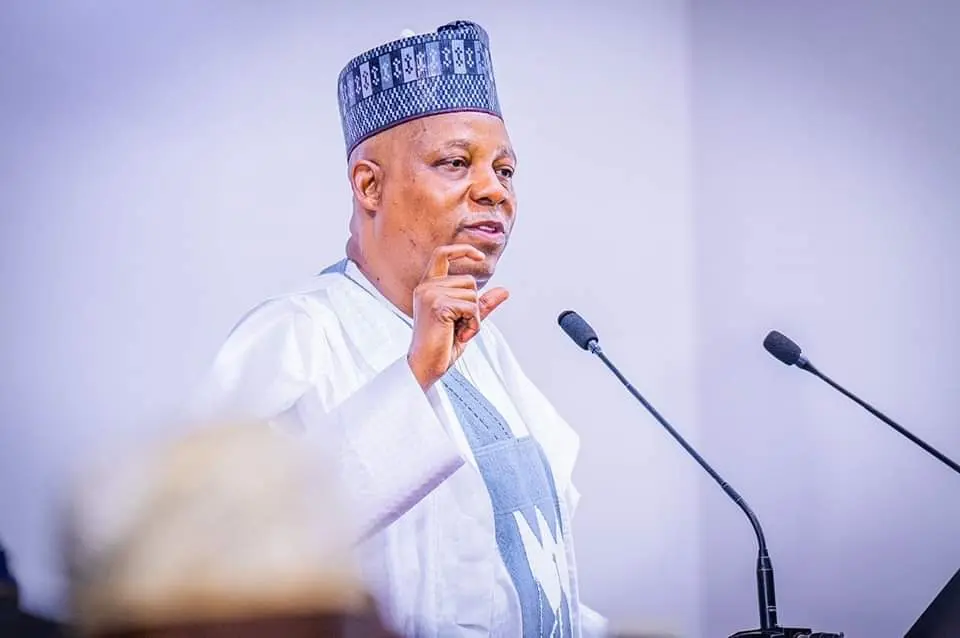
And now, Nigeria’s face is being lifted up internationally; the lost glory, respect and recognition is gradually being restored. Nigeria is taking its rightful place in the committee of nations; we are no longer a begging nation, but a nation ready to explore her capacities to the benefits of her people under a decisive leadership. That much the Vice president Kashim Shettima doled out in Rome while speaking at the UN World Food Systems Financing Model meeting.
At the United Nation Food System Summit that was held in Rome Italy recently, vice president Kashim Shettima laid bare the structure of the Administration’s policy direction on guaranteeing food security for Nigerians. He began by informing the world that the Bola Ahmed Tinubu government in response to the need for food security as a first step to many necessary changes that are desirable in the country, has mobilised over half a billion dollars for innovative, profitable, equitable and sustainable food systems transformation initiatives. He said the fund would be strategically utilised to fund food system transformation in the country.
When this becomes a reality soon as expected, we would be seeing mass production, coordinated value chain and increased commerce in the agro industry that meets two broad needs of Nigeria simultaneously: food security and job provision.
Nigeria is indeed a sleeping giant; and now it is waking up. The world should await the return of the glory of the giant of Africa as Nigeria takes its place to redefine the meaning and concept of modern leadership. I will borrow the words of the vice president: “Give me a lever long enough and a fulcrum on which to place it,” so said Archimedes, “and I shall move the world.” Nigeria needs no handouts but real partnerships. We have removed the albatrosses of fuel subsidies and multiple exchange rates from our necks; hence, we are seeking investments for mutually beneficial partnerships, not handouts.
It is true, the bearing has changed; the redefinition has begun, and the giant of Africa has woken to take the world. We are seeing the real meaning of changes, as difficult as it may appear coming from a leadership poised to get results.
It can only get better with Asiwaju Bola Ahmed Tinubu and Vice President Kashim Shettima.
GOD BLESS THE FEDERAL REPUBLIC OF NIGERIA!
info@medaner.com, justme4justice@yahoo.com