
Art Square Gallery, New York
By Akintayo Abodunrin
Gabriel Otu’s latest exhibition, Beyond the Frame, broadly considers coastal life as a site where labor, environment, and survival intersect with the quiet relentlessness of the everyday. The show extends his longstanding interest in littoral communities, shifting his focus from the immediate aesthetics of water to the peripheral ecologies, human and material that sustain it. Presented at Art Square Gallery’s International Photography Exhibition in New York (8 March – 10 May 2025), the series marks a contemplative deepening of themes the artist has circled for years.
Where his earlier series, See Never Dry, foregrounded coastal toil with an almost ethnographic directness, Beyond the Frame attempts something more elusive. It looks for what escapes immediate depiction: the informal architectures, the inherited gestures, and the socio-economic tensions that operate just outside the photograph’s border. Across the three works on view, Otu’s images are deceptively sparse yet thickened by histories that rarely announce themselves.
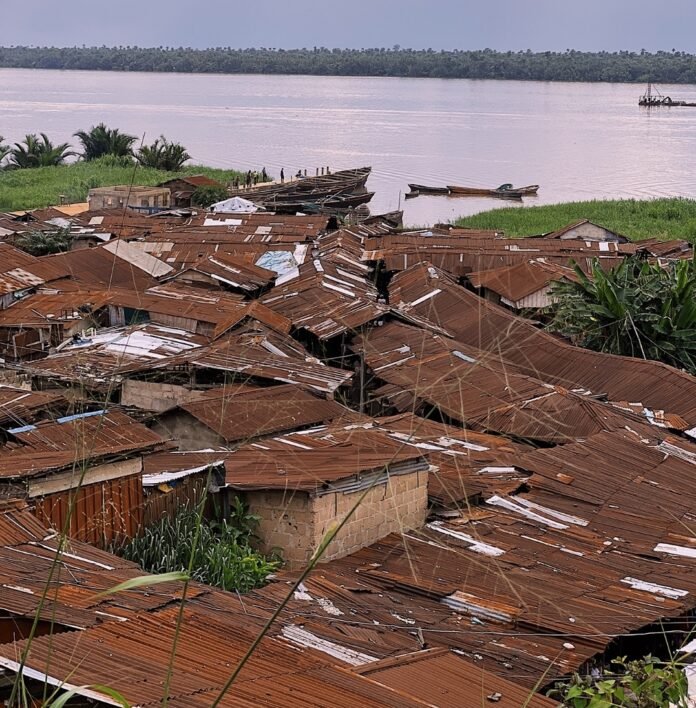
Rusted Roofs, Restless Waters — A Landscape of Compression and Continuity
Perhaps the exhibition’s anchor, this image presents an expanse of rust-brown rooftops tapering toward a placid river. The contrast is striking but not sensationalized. Otu’s attention is trained not on spectacle but on the atmospheric tension between a densely compacted settlement and the indifferent serenity of the water behind it.
The photograph brings to mind what Okwui Enwezor described as the “excess of the seen,” though here the excess lies not in archival repetition but in the unavoidable weight of socio-economic familiarity. The patchwork roofs evoke resource scarcity and improvisation conditions so ubiquitous as to risk becoming visual shorthand. Yet Otu manages a degree of restraint, letting the river serve as a counterbalance, a reminder of continuity and the long histories of adaptation that give such places their uneasy equilibrium.
The Fisher and the Horizon — A Solitary Dialogue with Labor
A lone figure casting a net against a vast shoreline introduces Otu’s recurring interest in solitary labor rendered without heroics. The composition with its generous allotment of sky might strike some as overly serene, but its quietness is intentional. The photograph is structured around an inherited gesture: the simple, practiced arc of a net meeting water.
What lies beyond the frame is not narrative flourish but the dense accumulation of generational knowledge. The fisherman’s stance, stripped of drama, is almost archival in its neutrality. Otu’s minimalism works not by emptying the moment of meaning but by allowing its ordinariness to speak plainly. Labor, here, is neither mythologized nor diminished.
The Weathered Shelter — Architecture of Impermanence.
The palm-frond shelter, sun-bleached and in collapse, shifts the exhibition toward structures improvised, temporary, and quietly revealing. The work recalls images from environmental field stations or rural research outposts, though Otu’s object is far humbler and more vulnerable.
The shelter’s tatters form a visual language of erosion, but its presence also hints at systems of support that are fragile by design. As in Sammy Baloji’s Aequare, the structure becomes both an architectural and epistemological marker, its deterioration standing in for the impermanence of the communities that rely on it. Otu avoids moralizing the image; he simply situates it within a broader inquiry into the infrastructures that hold, however loosely, the rhythms of coastal life.
Conclusion: Redefining the Visible
If Beyond the Frame has a central proposition, it is that visibility is never enough. Otu’s images suggest rather than insist, gesture rather than declare. They ask what sustains the moments we witness, what futures or pasts hover outside the edges of the photograph, and how ordinary landscapes accrue meaning not through spectacle but through repetition, wear, and endurance.
The exhibition’s understated tone may frustrate viewers seeking more declarative political stakes, but its strength lies in its refusal of grandiosity. Like the best of Otu’s work, Beyond the Frame is a slow reveal, an invitation not to the dramatics of coastal life but to its quieter truths, those that persist long after the shutter closes.