

IsDB, SOZEA Intensify Islamic Social Finance Drive, Train Sokoto Staff on Zakkat, Waqf
From Bashir Rabe Mani in Sokoto
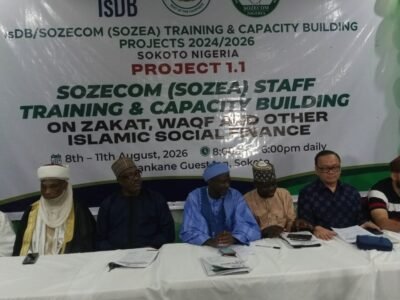
The Islamic Development Bank (IsDB), in collaboration with the Sokoto Zakkat and Endowment Agency (SOZEA), has intensified efforts to strengthen Islamic social finance institutions in Nigeria with a specialised staff training and capacity-lnbuilding programme on Zakkat, Waqf and other Islamic social finance instruments.
The training, held on Sunday at Dan Kane Guest Palace, Sokoto, is part of the IsDB/SOZEA Training and Capacity Building Projects e2024–2026, Project 1.1, designed to enhance the professional competence and institutional capacity of personnel responsible for administering Islamic social finance programmes in Sokoto State.
The programme, conducted under the leadership of Malam Lawal Maidoki, is expected to deepen participants’ understanding of contemporary approaches to Zakkat and Waqf management while equipping them with practical knowledge required to mobilize, administer and utilize Islamic social finance resources more effectively.
The initiative assumes particular significance against the backdrop of growing concerns over poverty, unemployment, economic vulnerability and social exclusion in many communities across Nigeria and other developing countries.
Islamic social finance, particularly Zakkat and Waqf, has historically served as an important mechanism for supporting vulnerable populations, promoting social welfare and creating sustainable community-based development. The organisers believe that strengthening the institutions responsible for managing these resources could unlock greater opportunities for poverty reduction and economic empowerment.
Speaking on the importance of the programme, Governor Ahmed Aliyu represented by the permanent secretary ministry for religious affairs, and Sultan of Alh. Muhammad Sa’ad Abubakar III, both stressed the need for professionally trained personnel capable of managing Zakkat and Waqf resources with transparency, accountability, efficiency and strict adherence to Islamic principles.
The capacity building programme also seeks to expose staff to modern institutional practices capable of improving public confidence in Zakkat and Waqf administration, particularly in the areas of resource mobilisation, beneficiary identification, documentation, monitoring and impact assessment.
With the backing of the IsDB, the project further underscores the growing international recognition of Islamic social finance as a potential instrument for achieving inclusive development and complementing conventional social protection mechanisms.
For Sokoto State, the initiative could provide a stronger institutional foundation for expanding Zakkat and Waqf interventions beyond immediate relief to sustainable programmes that support education, healthcare, livelihoods, entrepreneurship and other areas of human development.
Many speakers said the success of the initiative would ultimately depend on translating the knowledge acquired through the training into measurable improvements in the administration and deployment of Islamic social finance resources.
The programme is expected to contribute to the broader objective of building a more professional, accountable and development-oriented Islamic social finance system capable of responding effectively to the needs of vulnerable communities.
The IsDB/SOZEA partnership, stakeholders maintained, represents an important step towards repositioning Zakkat and Waqf from largely welfare oriented interventions into strategic instruments for sustainable socio-economic development in Sokoto, Nigeria and the wider Muslim world.
Never miss a moment! Get the stories shaping Nigeria, delivered straight to your phone. Follow Peoplesdaily Newspaper on WhatsApp for breaking news, exclusive reports, and the headlines everyone will be talking about, before anyone else.


