

 From: Femi Oyelola in Kaduna
The House of Justice has called for the identification and removal of sponsors and enablers of mass atrocities from political engagements, asserting that accountability must precede any negotiations with perpetrators of large-scale violence.
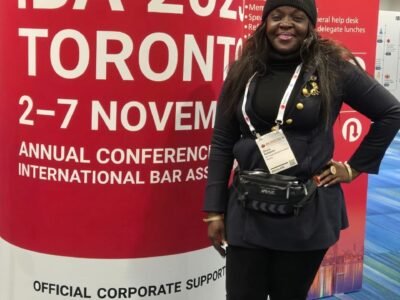
This statement was made by its Founder and Chief Executive Officer, Barrister Gloria Mabeiam Ballason, during a presentation at the 2025 International Bar Association (IBA) Conference, held at the Metro Toronto Convention Centre, commonly known as the Great White North.
Barrister Ballason described Nigeria and several Sahelian countries as exemplifying the grim reality where mass killings often lead to political negotiations rather than justice.
She expressed concern that terrorism and war crimes continue to persist in the 21st century, despite existing frameworks for prevention and accountability. Ballason warned that justice mechanisms frequently fail to correspond with the magnitude of harm inflicted on humanity and national resources.
Citing French revolutionary leader Maximilien de Robespierre, Ballason underscored that the ultimate objective must be to prevent war and terrorism from taking hold.
According to her, accountability after the fact cannot repair the irreparable damage caused by mass atrocities.
The session was attended by leading legal figures, including Dr. Babatunde Ajibade, SAN, Chair of the IBA Section on Public and Professional Interest. Ballason explained the concept of “psychic numbing,” noting that state accountability often diminishes as the scale of atrocities increases, particularly when crimes transcend political interests or fall outside conventional legal frameworks.
The House of Justice, she said, aims to encourage the public to rise above fear, confront despotism, and demand criminal sanctions against officials who are responsible for mass casualties through their actions or negligence.
Ballason urged governments to accurately define conflicts and crises, emphasizing that unlawful violence intended to intimidate civilian populations for political, religious, or ideological purposes should be labeled as terrorism, rather than being disguised as communal or farmer-herder clashes.
She added that situations that meet the legal threshold of genocide should be named as such, warning that governments must not “sugar-coat” grave crimes. “If it smells, feels, tastes, looks, or is perceived as it, then it is,” she stated.
Since 2014, Ballason noted that the House of Justice has pursued accountability for terrorism and mass atrocities through litigation, public advocacy, and petitions aimed at preventing alleged enablers and sponsors of terrorism from holding political office.
She cited past actions involving senior public officials. She made allegations regarding governance failures, human rights abuses, and state negligence during periods of heightened violence, emphasizing that such claims are pursued within legal and advocacy frameworks.
The organization also renewed its call for global collaboration to address the root causes of terrorism, disrupt terror financing, strengthen actionable intelligence, and promote multi-sectoral cooperation.
It stressed that victims’ justice, rehabilitation, and resettlement should be prioritized by states while financiers, instigators, collaborators, and executors of terrorism must be held accountable.
For the House of Justice, Ballason concluded, the mission extends beyond legal advocacy to encompass the broader goal of entrenching the supremacy of the rule of law as the foundation for just societies and a safer world.
Never miss a moment! Get the stories shaping Nigeria, delivered straight to your phone. Follow Peoplesdaily Newspaper on WhatsApp for breaking news, exclusive reports, and the headlines everyone will be talking about, before anyone else.


