
By Ochiaka Ugwu
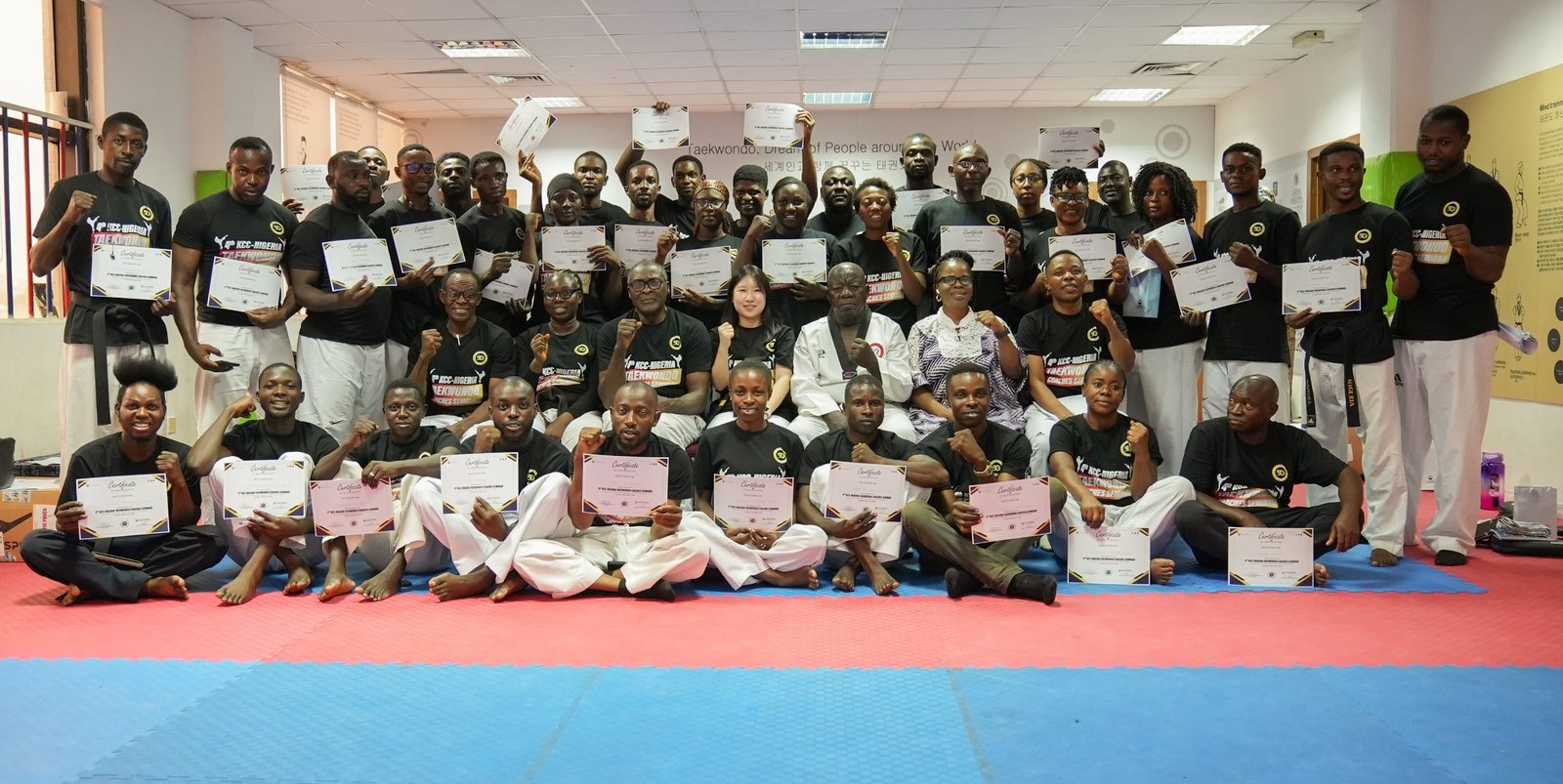
Korean Cultural Centre held its 4th Edition of KCC-Nigeria Taekwondo Coaches Seminar alongside equipment donation ceremony to make the 50 years anniversary of Taekwondo in Nigeria on the 18th and 19th of April 2024 with the theme: “21st Century Approaches to Taekwondo Coaching: Assessing the Past 50 years to Strategize for the Next 50 years”. More than 50 Taekwondo Coaches were invited from different private, military, paramilitary, universities and civil government institutions. They converged at the Taekwondo High Performance gym of the Korean Cultural Centre Nigeria, Abuja.
A total of ten instructors taught at different points in the interactive seminar. A zoom-based webinar was done for morning sessions of each day. Afternoon sessions went fully practical. Taekwondo enthusiasts from Nigeria, Ghana, Côte d’Ivoire, UK, Ireland, US and South Korea linked up with the morning online sessions.
DAY-ONE (Thursday 18 April): Speaking as the Lead Paper Presenter, Grandmaster George H. Ashiru explored historical development of taekwondo from the perspectives of Nigeria and Africa in General. From his speech, listeners noted Côte d’Ivoire reputation as the first African country to practice Taekwondo. The first Korean Taekwondo instructor in Africa was sent to Côte d’Ivoire in the late 1960s. The founder of Taekwondo in Nigeria (Grandmaster Aikpa Aime) was one of the pioneer students of the Korean Taekwondo instructor in Côte d’Ivoire. GM Aikpa Aime brought Taekwondo to Lagos Nigeria in late 1974, meeting first with Messrs Tunde Edunjobi and Basset Dominic, before eventually opening a club at the National Stadium Surulere in April 1975. Shortly before he left Nigeria in 1977, GM Aikpa Aime conducted the first Taekwondo grading in Nigeria for the pioneer students, where Messrs Dominic Bassey, Kofi Anani and Emmanuel Ikpeme became the first Dan graduates. The 2nd TKD black belt grading held in 1979. The 3rd grading held in 1980. These featured the next set of pioneers, Adedapo Adetola, Boniface Nwachukwu, Charles Owah, Azubike Uzuaro, Pius Ilukhor, etc. Two factional Taekwondo organizations, NNTA and NUTA led to the formation of the Nigeria Taekwondo Black Belt College which in 1986, inspired by Korean Instructor, Kim Moo Cheon. Messrs Kim and Master Jung Rae Park had been contracted by the Nigerian Army in late 1983 and started teaching at the Nigerian Military Training School, Zaria, in 1984. The NTBBC led to creation of the Taekwondo Association of Nigeria (TAN/NTF) in 1986, which was then inaugurated formally in July 1987. Taekwondo first featured at the All Africa Games in August 1987 at Nairobi Kenya. In 1983, Gen. Inuwa Wushishi used his office as CoAS and was responsible for signing the bilateral agreement bringing the Korean Taekwondo dispatch instructors to Nigeria. Taekwondo practice in Northern Nigeria was first recorded at The Federal Government College Kaduna, Malali, in 1982. The George Ashiru- led NTF and the NTBBC hosted GM Aikpa Aime in 2017 (40yrs after leaving Nigeria). Within the first 50 years of existence, Nigeria Taekwondo won silver in the heavyweight category of Barcelona ’92 and bronze Beijing 2008 Summer Olympics through Emmanuel Peters Oghenejoboh and Chika Chukwumerije, respectively. Just at this moment Nigeria made another history following Master Thursdaline Peters’ selection to officiate at the Paris 2024 Summer Olympics TKD event. She is the first Nigerian TKD IR to officiate at the Olympics.
In his lectures, Master Richard Allen harped on the need for Taekwondo coaches to utilise common technology to achieve uncommon feats. Common technologies like the internet, video cameras, fitness reading machines etc are game changers in Taekwondo. While putting emphasis on “AI”, Master Allen noted that Daedo electronic scoring system works slightly different from the KPNP version. He cited the need for the Nigeria TKD coaching crew to carry out experiments and scientific researches on Gen-1, Gen-2 and currently Gen-3 systems. According to him, some countries buy these systems to dismantle and analyze. Why can’t NTF Coaching Dept do this? It’s at this point that the differences between kicking power and strength were stated. The concept of “Spiral Force” was highlighted here.
Barrister Saad Adams spoke on the need for Taekwondo practitioners to develop a positive mental attitude and emotional intelligence. According to him, these are foundations for conflicts prevention among taekwondo people. We also learnt that there are structures for conflicts mediation which should be headed independent, respected and impartial persons within the Nigeria Taekwondo community. The NTF should create a structure that ensures resolution of grievances within the four walls of taekwondo. A question was asked that “how best could a junior practitioner report an offence of a senior against the latter?” A lot of inputs came in from online and physical participants on the need to follow the tenets of taekwondo in all cases.
Master Gbolahan Ogunmuyiwa delivered a lecture on “Taekwondo First-Aid and Safety Education”. We identified common injuries in Taekwondo and the best First-aid for each. The class covered a case study of death or serious injury during a taekwondo class or competition. Participants were taught steps to take against being liable to lawsuit in such cases.
Practical sessions for Day-1 covered jogging, stretching, plyometric training and agility programmes. GMs Dominic Bassey and Awodi Peter with the support of Master Funmi Bamishe (the only female instructor), touched on areas of self-defence against weapons. The class ended with a discussion session on effective ways to “second” a taekwondo athlete during a tournament.
DAY-TWO (Friday 19 April): The Nigeria Taekwondo Federation President (GM Abdullahi Saidu) taught on Sociocultural aspects of taekwondo from the Nigerian perspective. He spoke on the need to have a Nigeria Taekwondo devoid of discriminations. According to him both the able-bodied and physically challenged members of Nigeria have equal rights to taekwondo practice. Hence, when planning budgets, seminars or tournaments physically challenged members of the taekwondo community should be remembered.
Course 202 was handled by Chief Superintendent of Police Ebere Amaraizu, the Chairman Enugu State Taekwondo Association. He identified importance of taekwondo as a tool for national unity and youths’ positive orientation. In his speech, he noted that life-grooming values in taekwondo are more valuable than the physical skills of sparring or self-defence. He highlighted the importance of cooperation between government, private, religious and community groups in funding grassroots sports, especially taekwondo. This, he said, is one of the ways to divert minds of young people away from crime.
Grandmaster Abdulmumin Yusuf presented his lecture live at the KCCN studio Abuja. The seminar format was turned to a live symposium. Deputy Commissioner of Police, John Ali Zongo, GM Peter Awodi, GM Abdulmumin Yusuf and GM George Ben were the panelists. The discussion was on the tenets of taekwondo from perspectives of a TKD coach and an athlete practical application of the five tenets amongst them is grit, resilient, bullying, networking, business opportunities, self-development & Unity. He proposed that Nigeria should localize the five Tenets by adding UNITY to become six Tenets of TKD locally. He emphasize on using TKD to solve contemporary global challenges like bullying especially amongst five to 19 years old, he insisted that interest in bullying would further add values to TKD Coaches that earn from teaching in schools.
All participants took a paper test of multiple-choice objective questions and theory section. KCCN coaches marked and rated the exam at 100%.
CLOSING CEREMONY & TAEKWONDO EQUIPMENT DONATIONS: By 17.00hrs, the Closing Ceremony was flagged off. Master Hye-Rim Lee (Manager of KCCN TKD Dept) was flanked by CSP Bisi Okuwobi (Commander of Nigeria Police special youths-based unit called POCACOV) and the Seminar Grandmasters. About 12 different taekwondo clubs from different states, universities, military and paramilitary formations received assorted taekwondo training equipment that worth millions of naira.
FEEDBACK FROM PARTICIPATING COACHES AND SPEAKERS: Coach Olubunmi Ooni, from MSD Taekwondo Team Dove Mess 7 Guards Brigades at Lungi Barracks saw this seminar as an eye opener that exposed her to the history of Taekwondo and the current trends in the Martial art. For her, she wishes the Korean Cultural Centre will reach out to more Coaches in Nigeria. Mr. Joshua, a student of Taekwondo who is experiencing the training for the first time, saw the training as a knowledge closing gap opportunity. He was excited to meet historic Taekwondo personalities in Nigeria.
Coach Joyce Joseph from Plateau State Sport Council who was attending the Seminar for the first time, said her expectations were met because practical issues that affects Coaches were dealt with extensively. Coach Onofe Sunday a former national Taekwondo athlete and now a Coach that represented the National Civil Defence Corp even though this is his fourth time attending the Seminars, he pointed out he keeps getting refreshed knowledge of the sport and the method of teaching.
Grandmaster Abdulmumin Yusuf, Vice President of Black Taekwondo College celebrates the Centre for carrying out its passion for promoting Taekwondo in Nigeria through trainings and donations. Grandmaster Dominic Bassey, one of the pioneers of Taekwondo in Nigeria, saw the seminar as a beautiful initiative of the KCC to further and keep the knowledge of Taekwondo alive. For him, he hopes the KCC will invite other pioneers of Taekwondo in Nigeria to future seminars so that participating Coaches could learn other techniques and have a balanced knowledge of the Sport.
The 50 years anniversary is a yearlong celebration that has just been flagged-off through the 2024 KCCN Taekwondo Coaches Seminar. Other taekwondo events in the year will still hold other landmark events on it, example awards. The KCC stands with its commitment to promoting Taekwondo as it is gaining widespread popularity regardless of age or sex, through Taekwondo lectures, events, and other forms of promotions that encompass all citizens inclusive of the underprivileged in the host country. Plans are ongoing for major events such as Youth Taekwondo and the Ambassador’s Cup Taekwondo competitions in Nigeria.