

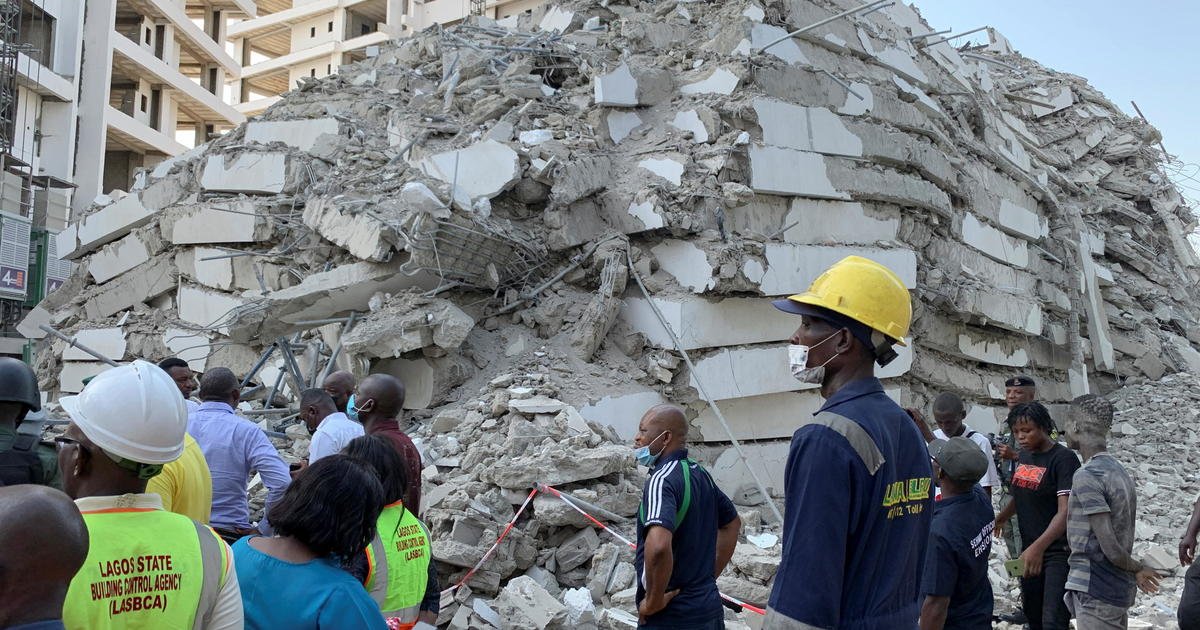
The regularity of building collapse in Lagos, once Nigeria’s capital city is alarming, to say the least. The latest happened on Nov. 1 in Ikoyi, the city’s posh residential hub. It was a 21- storeyed house still under construction. Over 30 persons were confirmed dead and many injured.
The Ikoyi tragedy followed the collapse of a two-storeyed building on the same date in the Lekki area of the state. The structure, also still being built, was said to have caved in during a night downpour. Before then, the Lagos State Building Control Agency (LASBCA) had confirmed the partial collapse of a three-floor house in Aguda, Surulere area, on October 25, 2021. The house owner was blamed for the accident. The general manager of the LASBCA, Arc. Gbolahan Oki, said that the owner had carried out illegal renovations and added attachments to the building.
In July 2021, a three-storeyed building at Church Street on Lagos Island partially collapsed at night while residents were asleep. The LASBCA said structural failure of a part of the beam carrying a water tank was responsible for the incident. In the same month, another two-storeyed building under construction at Isawo community in Ikorodu described as an attachment, collapsed and killed the owner.
According to the Nigerian Institute of Building (NIOB), no fewer than 43 buildings under construction collapsed in Nigeria in 2019, killing several persons. The National President of NIOB, Kunle Awobodu, said that 17 of the cases were recorded in Lagos alone. The rest occurred in other parts of the country.
Governor Babajide Sanwo-Olu has ordered a probe into the Ikoyi tragedy just as his predecessors had done. We commend this prompt action. While we await the outcome of the fact finding, we note what has been said about previous mishaps.
While we await the outcome of the fact-finding panel, we unequivocally condemn the frequent building collapse that Lagos has become notorious for. The fact that virtually all the cases were traced to abuse of process and use of inferior materials suggests crass criminality. Deliberate negligence and collusion with regulatory authorities cannot be ruled out.
What is shocking is the persistency of this impunity in spite of the existence of legislation to penalize perpetrators of building collapse. For instance, there is the Cement Grade Policy introduced by the Standards Organisations of Nigeria (SON) in 2014. During the public hearing on it, many stakeholders testified that “non-adherence to professional ethics, wrong combination of materials, poor supervision, corruption” were responsible for buildings collapsing.
They called for “decisive enforcement and monitoring’ of the National Building Code. The national building code published in 2006 was initiated by the National Council on Housing and Urban Development to address professional and regulatory deficiencies in the building industry. To achieve that goal objectives, state governments were required to domesticate the provisions of the code into their local laws, particularly those relating to design, construction and maintenance (post-construction) and “efficiently monitor” the implementation of the code.
On its part, the Lagos State government introduced the a Building Code and Regulation, setting out the minimum requirements for the design, construction and maintenance of buildings. However, compliance with the law mainly has been in the breach. This is the crux of the matter of the frequency of buildings collapsing in Lagos.
Lagos and other state governments will, therefore, do well to enforce the National and State Building Codes. They should ensure stricter application of the Builders’ Liability Insurance/Insurance of Buildings under Construction. This component of the Compulsory Insurance Scheme launched in 2003 requires that every owner or contractor of any building under construction with more than two floors must take out an insurance policy to cover liability against construction risks caused by the negligence of the contractor, owner, servants, agents, consultants which may result in death, bodily injury or property damage to workers or the public.
The frequency of buildings collapsing must stop. We agree that physical structures do fail occasionally due to natural causes. But we can prevent human errors. And we have ample legislation to do that.