

ADC, Bala Gombe and Justice Lifu: When Political Ambition, Judicial Pronouncements and Propaganda Become Bedfellows.
ADC National Leader, Persons With Disabilities (PWD).
Member, ADC 50 Wise Men and Women Policy and Manifesto Committee and
Member, ADC Presidential Campaign Council.
When Politics Goes to Court and Propaganda Comes Out. There comes a point in the life of a democracy when citizens must stop looking at individual political events in isolation and begin examining the larger picture. Nigeria may be approaching such a moment.
The unfolding controversy surrounding the African Democratic Congress (ADC), Senator David Mark, Nafiu Bala Gombe and the recent judicial interventions by Justice Peter Odo Lifu raises fundamental questions about the relationship between political ambition, party democracy, judicial independence, institutional integrity and the growing weaponisation of propaganda in Nigeria. This is no longer simply an internal disagreement within a political party. It has become a test of whether opposition politics can survive the combined pressures of political manipulation, institutional uncertainty, strategic litigation and media sensationalism and at the centre of this controversy is a rather uncomfortable question: Can a political disagreement, once dressed in legal proceedings and amplified through propaganda, become a weapon for undermining an entire opposition movement?
I believe Nigerians deserve to examine the facts.
THE ADC TRANSITION AND WHAT ACTUALLY HAPPENED ON JULY 29, 2025?
Let us return to the beginning. On Tuesday, July 29, 2025, the African Democratic Congress held its historic 99th National Executive Committee meeting at Chelsea Hotel, Abuja. This was not a clandestine gathering in somebody’s living room. It was a formal party meeting involving the existing leadership, members of the National Executive Committee and relevant stakeholders. I was there in perssn. The meeting was monitored by officials of the Independent National Electoral Commission (INEC). Chief Ralphs Okey Nwosu, the founding National Chairman of the ADC, presided over the transition process through which the party’s existing National Working Committee was dissolved and a new caretaker leadership was constituted. Senator David Mark emerged as Interim National Chairman, while Ogbeni Rauf Aregbesola emerged as Interim National Secretary. These decisions were subsequently communicated to INEC.
Indeed, INEC’s own affidavit, confirmed that the commission received the invitation to monitor the meeting, deployed officials, obtained their monitoring report and subsequently uploaded the names of the new leadership to its portal. These are important facts.
The irony in the present controversy is that Nafiu Bala Gombe, whose subsequent legal challenge would become the centre of this national political drama, was present at the transition process as confirmed by the former National Chairman, Ralph Nwosu who subsequently publicly maintained that Bala and other state leaders were present, participated and witnessed the process. This raises a legitimate question, If you attended a meeting, participated in its proceedings, witnessed the emergence of a new leadership and did not challenge the process at the time, what subsequently changed? Was there a constitutional discovery that was previously unknown? Was there a procedural irregularity that suddenly became visible or did the political circumstances surrounding the emergence of the coalition create new interests that were not present when the decisions were being taken? These questions deserve answers as I am particularly interested in the distinction between genuine constitutional grievances and political disagreements disguised as constitutional grievances. Our democracy cannot afford to make every political disagreement an opportunity for institutional sabotage.
THE LAND THAT WAS VOLUNTARILY HANDED OVER.
Let me use an analogy. Imagine that Chief Ralph Okey Nwosu owns a parcel of land and has the Certificate of Occupancy where he occupied and managed the property for years. Then, following a properly convened meeting of the relevant stakeholders, he voluntarily hands over the title documents to another management team. The transaction is witnessed. The necessary documentation is executed and relevant authorities are notified. The new management takes possession and begins developing the property and suddenly, somebody who participated in the handover process returns to claim that the transfer never happened and begins selling portions of the same land to prospective buyers. He advertises plots, collects deposits and promises prospective purchasers that they will eventually receive their allocations but there is a fundamental problem. You cannot sell what you do not own and you cannot create a legitimate competing ownership structure merely by announcing that you have one. In this analogy, the Certificate of Occupancy represents the INEC Certificate, an institutional legitimacy and documentation arising from the ADC’s transition process with which Chief Ralph Okey Nwosu handed over the leadership following the party’s NEC resolutions and the David Mark-led executive assumed responsibility. This transition was documented, witnessed and communicated to INEC and this is why the party’s constitutional records, meeting minutes, attendance records and INEC monitoring report matter so profoundly. They are not political decorations, they are the documentary history of what happened, so the question is whether subsequent litigants can erase that history by simply advancing a competing interpretation of the party’s constitution.
THE SUPREME COURT: APRIL 30, 2026, AND THE IMPORTANCE OF FINALITY.
The ADC leadership dispute eventually reached the Supreme Court and on April 30, 2026, the Supreme Court delivered a unanimous decision setting aside the Court of Appeal’s status quo ante bellum order, which had contributed to INEC’s decision to remove the David Mark-led leadership from its portal. The apex court considered the circumstances surrounding the preservation order and found it unnecessary, improper and unwarranted and the matter was returned to the Federal High Court for the substantive proceedings to continue. Following the judgment, INEC restored the David Mark-led executive to its portal. Now, let us be precise about what happened, the Supreme Court did not finally determine every substantive question concerning the validity of the ADC leadership transition but it resolved the appeal concerning the interim judicial order and cleared the way for the substantive case to proceed, this distinction matters. However, the decision also demonstrated the danger of allowing interlocutory orders to produce consequences that substantially alter the political and administrative operations of a political party before the substantive dispute has been determined. Much as the Supreme Court’s intervention restored the immediate institutional position that had existed before the controversial preservative order, it was a significant victory for the David Mark-led leadership and also a reminder that judicial orders must be carefully examined for their actual legal effect rather than the political interpretations subsequently attached to them. This brings me to one of the most enduring observations in Nigerian judicial history, the late Justice Chukwudifu Oputa, former Justice of the Supreme Court of Nigeria, famously observed – “We are final not because we are infallible, rather we are infallible because we are final. Justices of this court are human beings capable of erring. It will certainly be short-sighted arrogance not to accept this obvious truth”. That statement is profoundly important and reminds us that judicial finality is not synonymous with human perfection. The judiciary is an institution of constitutional authority, but judges remain human beings ann their decisions must command respect as much as their reasoning must also withstand intellectual scrutiny. The right to appeal, review and challenge judicial decisions through established legal procedures is not an attack on the judiciary but a part of the architecture of justice and this is precisely why the ADC must pursue its appellate remedies against this November 5 2026 judgment.
BALA GOMBE: FROM PARTY DISAGREEMENT TO A NATIONAL POLITICAL SPECTACLE.
The emergence of Nafiu Bala Gombe as the central figure in this controversy deserves examination. I am not interested in ridiculing anybody’s background or humble beginnings. There is absolutely nothing wrong with rising from humble circumstances to become wealthy, influential or successful and Nigeria should celebrate legitimate prosperity but public political ambition comes with public accountability. Questions about the sources of extraordinary political expenditure, the financing of political operations and the interests behind political activities are legitimate questions in a democracy. There have been questions and observations about Bala Gombe’s reported high-end lifestyle, his alleged residence in Asokoro, frequent appearances at Transcorp Hilton and the conspicuous security and vehicle convoy associated with his movements with a reported seven-vehicle combination of jeeps, pickups and buses, accompanied by armed security personnel, certainly invites public curiosity. Where does the financing come from? Who are the sponsors? What is the political and financial interest behind the activities? Who pays for the logistics, accommodation, security and mobilisation? These are questions, not findings of financial wrongdoing and Nigerians have every right to demand transparency from individuals seeking to exercise political authority.
Now, at a time when the Federal Government continues to borrow heavily, when millions of Nigerians are struggling to afford food, transportation, electricity and healthcare, the optics of sudden political affluence deserve public scrutiny. I ask, is political opposition now another investment opportunity or are political disputes becoming commercial enterprises or are unsuspecting Nigerians being recruited into elaborate political schemes whose ultimate beneficiaries are a few individuals? These questions must not be dismissed simply because they are uncomfortable.
THE POLITICS OF DUMEBI KACHIKWU AND THE APC PROPAGANDA MACHINE.
One cannot examine the political developments surrounding the ADC without considering the broader political environment. The ruling APC has every right to defend its record, promote its achievements and challenge opposition parties and that is democracy. However, democracy also demands that political competition should not degenerate into the deliberate manufacture of confusion around opposition institutions.
Consider the political relevance of Dumebi Kachikwu, who was the ADC’s presidential candidate in the 2023 general election, an electoral cycle that has long ended with the mandate expiring with the election thus, the political relevance attached to being a presidential candidate in that particular election did not confer permanent ownership of the ADC. A political party is not the private property of its former presidential candidate nor does a previous presidential nomination translate into perpetual authority over the party. The ADC has its constitution, its organs, its membership and its established procedures for leadership succession. The exclusion of Kachikwu from the July 2025 NEC decisions was a party matter that must be understood within the context of those decisions. My concern is that political actors who have lost relevance within the new political arrangement can become useful instruments in a broader campaign to discredit or destabilise the emerging opposition. Whether particular individuals are consciously working with the ruling APC or merely advancing interests that happen to benefit it is a question that should be answered with evidence and the political consequences are clear. A weakened opposition or a divided opposition benefits the incumbent just as an opposition trapped in endless litigation has less time to campaign, organise and present alternative policies and constantly forced to defend its legitimacy has less opportunity to challenge the government’s performance. This is why the ADC must remain vigilant.
JUSTICE LIFU AND THE NOVEMBER 5 JUDGMENT: THE DIFFERENCE BETWEEN LAW AND POLITICAL PROPAGANDA.
On November 5, 2026, Justice Peter Odo Lifu delivered a judgment in the substantive ADC leadership dispute. The court ruled in favour of Nafiu Bala Gombe, nullified the David Mark-led leadership structure and invalidated the processes through which the party produced its presidential candidate, Atiku Abubakar and also directed INEC to recognise the leadership emerging from its decision. I personally as a legal novice know that this is not a serious development as is being peddled about, thank God, the Independent National Electoral Commission (INEC) through, through its National Commissioner and Chairman of the Information and Voter Education Committee, Mohammed Haruna, confirmed awareness of the ruling as the commission navigates conflicting judicial directives regarding the party’s leadership and clarified that the commission granted the David Mark-led faction access to its candidate nomination portal based on an earlier Supreme Court directive, accepting 471 candidates.
It would be intellectually dishonest to pretend otherwise anyways and however, a judgment of a court of first instance is not the end of the judicial process where a competent appeal lies. The ADC has indicated its intention to challenge the decision where the real legal questions now include whether the court properly interpreted the ADC Constitution and adequately considered the proceedings and resolutions of the 99th NEC meeting. I ask, what weight was given to the INEC monitoring report and the commission’s earlier affidavit and whether the constitutional powers of the NEC were properly evaluated. Did the court correctly interprete the consequences of the transition from the Ralph Nwosu-led executive and are the orders made, justified by the evidence and applicable law.
These are matters for appellate determination but there is another issue that Nigerians must understand. A court judgment and the political propaganda surrounding that judgment are two different things because a judicial decision must be interpreted according to its actual orders, its legal reasoning and the applicable constitutional provisions. It should not become an unrestricted licence for political actors to announce whatever interpretation best serves their interests. This is where the media must be particularly careful. Headlines declaring that an opposition presidential candidate has been permanently eliminated, that a political party has ceased to exist or that a political movement has collapsed must be supported by the actual legal position. The public deserves journalism, not judicial sensationalism. The judiciary must be respected too but respect for the judiciary does not require surrendering the responsibility to scrutinise judicial decisions.
THE CHARCOAL AND SUGAR STORY: SELLING WHAT DOES NOT EXIST.
There is an old primary-school-style story about a merchant who advertised sugar to customers but delivered bags of charcoal instead. The customers paid for, anticipated sugar, were promised sugar but when the bags were opened, what they found was charcoal. The lesson is simple, a product does not become sugar because somebody has printed the word SUGAR on the bag. Political organisations should learn from this story. A political declaration does not automatically become a legitimate party structure just as an announced leadership does not automatically become a recognised leadership. Simply put, a collection of names does not automatically become a constitutionally constituted National Executive Committee and the sale of nomination forms does not, by itself, create an electoral entitlement. There have been allegations surrounding the sale of nomination forms and the organisation of parallel party activities by individuals claiming to represent another ADC leadership, any such transactions deserve careful examination.
Who authorised the forms, under whose authority were they issued, what is their standing under the party’s recognised constitutional processes, what assurance was given to prospective aspirants, what happens to the money collected if the purported congresses or nominations are subsequently declared invalid?
These are serious questions so that prospective aspirants should not be turned into financial casualties of a leadership dispute. I opine that political ambition must not be exploited.
Anyone purchasing a nomination form deserves clarity about the legal authority under which that form is being issued. The ADC must ensure that no Nigerian is deceived into spending money on an electoral process that cannot withstand legal scrutiny.
THE MEDIA: WHEN HEADLINES BECOME POLITICAL WEAPONS.
One of the most disturbing features of Nigeria’s political environment is the increasing willingness of sections of the media to amplify sensational political claims without adequately interrogating their legal foundations.
A judgment is delivered and a press statement is issued and a sensational headline follows. Within hours, political commentators begin announcing the death of an opposition movement but where is the full judgment, the legal analysis and the constitutional context?
Where is the other side of the argument and where is the distinction between a trial court decision and the appellate process? The media must not become an extension of political propaganda machinery since her responsibility is to inform, investigate, interrogate and educate and not to manufacture political outcomes through headlines.
The Nigerian media should remember that the credibility of journalism is not measured by how quickly a headline is published but by how accurately the public is informed. The ADC leadership must equally continue to communicate more effectively as silence creates information vacuums that create opportunities for propaganda which when repeated often enough, can acquire the appearance of truth even when its underlying claims are disputed.
THE APC SHOULD BE MORE WORRIED ABOUT THE NIGERIAN PEOPLE THAN THE ADC.
Let us move beyond the courtroom.
What exactly is the ruling APC afraid of and why should a political party that is confident of its performance be excessively concerned about the organisational development of an opposition party?
Nigeria is facing enormous challenges where the cost of living has become unbearable for many households. Food prices remain a serious concern, businesses are struggling with operating costs, electricity supply remains unreliable, young Nigerians and the vulnerable persons with disabilities are increasingly anxious about employment and economic opportunities. The national debt and the cost of servicing it continue to demand serious public scrutiny. Millions of Nigerians are asking whether the sacrifices imposed on them by government policies will eventually translate into a better standard of living.
The opposition’s responsibility is to provide credible alternatives and the ADC, under the leadership of Senator David Mark and with Atiku Abubakar and Rotimi Amaechi as its presidential ticket, is seeking to occupy that space and our responsibility is to present a convincing alternative economic, security, social and governance agenda. That is where the political contest should be not in endless manufactured controversies or in the commercialisation of internal party disagreements and certainly not in turning the judiciary into the principal arena for determining who gets to participate in Nigerian politics.
SOKOTO AND KEBBI: THE PEOPLE HAVE BEGUN TO SPEAK.
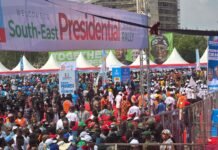
While some individuals have been occupied with the ADC leadership controversy, something else has been happening. The Nigerian people are beginning to make their political preferences known. On November 4 and 5 2026 respectively, the ADC presidential campaign was flagged off in Sokoto and Kebbi states where Atiku Abubakar and his running mate, Rotimi Amaechi, were received by an extraordinary gathering of supporters. Reports from the event described thousands of people lining the route from the airport to the party’s state secretariat in Sokoto with the journey, reportedly covering approximately seven kilometres, took about three hours because of the crowds and in Kebbi too, it was not different even with sponsored thugs attacking convoys of the party arriving from the road border with Sokoto state and those coming into town from the Kebbi airport. Former Governor Aminu Waziri Tambuwal, Senator David Mark, party leaders and other political stakeholders participated in the campaign activities and both rallies went ahead despite attempts to frustrate its access to venues and accommodation. The scale of the reception is still attracting national media attention. This is politically significant and demonstrates that the ADC’s political future cannot be reduced to the personal ambitions of individuals involved in its leadership dispute. There is a larger constituency with millions of Nigerians who want an alternative.
There are young people who want employment, farmers who want security, traders who want affordable, manufacturers who want electricity, persons with disabilities who want dignity, accessibility, participation and economic inclusion. There are Nigerians who want a government that listens and there are citizens who believe that the 2027 general election presents an opportunity to change the direction of the country. The Sokoto and Kebbi flag-offs was an important demonstration of that political energy and also a reminder that political legitimacy is ultimately tested before the Nigerian electorate.
THE PERSONS WITH DISABILITIES AND THE POLITICS OF INCLUSION.
As ADC National Leader for Persons With Disabilities, I have a particular interest in what this political development means for Nigerians living with disabilities. The political participation of persons with disabilities cannot be reduced to campaign photographs and occasional expressions of sympathy. We are citizens. We are voters. We are political organisers and are professionals, entrepreneurs, policy thinkers and legitimate aspirants for public office.
Our ADC’s GAMECHANGERS initiative and its disability inclusion agenda remain central to the party’s political identity as we insist on accessible political structures, reasonable accommodation, meaningful representation, economic empowerment and the implementation of disability rights. Nigeria cannot build a new political order by reproducing the exclusionary practices of the old one. Thankfully again, the ADC led by Senator David Mark with Atiku Abubakar and Rotimi Amaechi as Presidential and Vice Presidential candidates have led other political institutions to recognise that inclusion is not charity. It is a constitutional, democratic and human rights obligation and this is why all the attempts to distract the ADC from its broader political mission must not succeed. We have work to do and Millions of Nigerians are waiting for a political alternative that recognises their dignity and potential.
THE REAL JUDGMENT WILL BE DELIVERED BY NIGERIANS IN 2027.
There is a fundamental difference between winning a court case and winning the confidence of a nation and both matter just as they are not interchangeable.
The judiciary determines disputes according to law and the electorate determines political leadership through the ballot. Neither institution should be manipulated to undermine the other. The ADC must pursue its appeals, defend its constitutional position and ensure that every procedural and substantive question is addressed through the appropriate judicial channels whilst we continue to build our national structures, strengthening our policy platform and preparing for the 2027 elections.
Those who believe that a court judgment has permanently extinguished the aspirations of millions of Nigerians should remember that political movements are bigger than individual litigants, courtrooms, headlines certainly bigger than the ambitions of those who believe that political confusion can be converted into permanent relevance. The David Mark-led leadership is determined to respond to this challenge with legal competence, political discipline and organisational determination. My Principals, HE. Atiku Abubakar and HE. Rotimi Amaechi must remain focused on presenting this their national alternative nd the party must ensure that the rights and interests of its members and aspirants are protected throughout the process. The APC should prepare for a genuine electoral contest rather than celebrate every controversy involving its principal opposition because the real question confronting Nigeria is not whether Bala Gombe has won a particular legal battle. It is whether Nigerians are prepared to accept another four years of the economic and governance challenges confronting them. That question will not be answered at Transcorp Hilton or the Asokoro office of Bala Gombe. It will not be answered by political press releases or by newspaper headlines.
It will be answered by Nigerians at polling stations.
MY CONCLUSION: THE COURTROOM IS NOT THE COUNTRY.
The Nigerian judiciary must remain the sanctuary of justice, not an unwilling participant in the theatre of political propaganda. Our judges must remember that their decisions have consequences beyond the immediate parties before them. Political litigants must understand that the judiciary is not a marketplace for the commercialisation of political ambition.
The media must understand that a headline is not a judgment and a press statement is not a constitutional provision and political parties must understand that their constitutions are binding documents, not convenient instruments to be interpreted according to whoever happens to have the loudest microphone.
Justice Oputa’s words remain relevant noting that Judges are human, Courts can err and the right to challenge an error through lawful appellate procedures is part of the very system that gives judicial authority its legitimacy. My ADC will defend its institutional interests through the courts and will defend its political interests through organisation. We will defend our manifesto through ideas and will defend our electoral mandate through the Nigerian people. To those who believe that the ADC can be buried under a mountain of litigation, propaganda and political manoeuvring, I have a simple message – You may delay, distract or challenge a political movement but you cannot permanently extinguish the aspirations of a people who have decided that their country deserves something better.
The journey to May 29, 2027, is still ahead and our destination is the Presidential Villa.
The courtroom is not the country. The headlines are not the electorate.
Political propaganda is not democracy.
Nigeria belongs to Nigerians and Nigerians will have the final say.
DR. CHIKE OKOGWU.
ADC National Leader, Persons With Disabilities (PWD).
Member, 50 Wise Men and Women Policy and Manifesto Committee.
Member, ADC Presidential Campaign Council
Abuja.
Nigeria, November 2026
Never miss a moment! Get the stories shaping Nigeria, delivered straight to your phone. Follow Peoplesdaily Newspaper on WhatsApp for breaking news, exclusive reports, and the headlines everyone will be talking about, before anyone else.