

By Mashe Umaru Gwamna
A former Minister of Information and Culture, Lai Mohammed, has reaffirmed that democracy remains the most viable system of governance despite its inherent imperfections.
The position was contained in a statement issued on Thursday by Nnamdi Atupulazi, Head of Strategic Communications at Lai Mohammed’s Media Office.
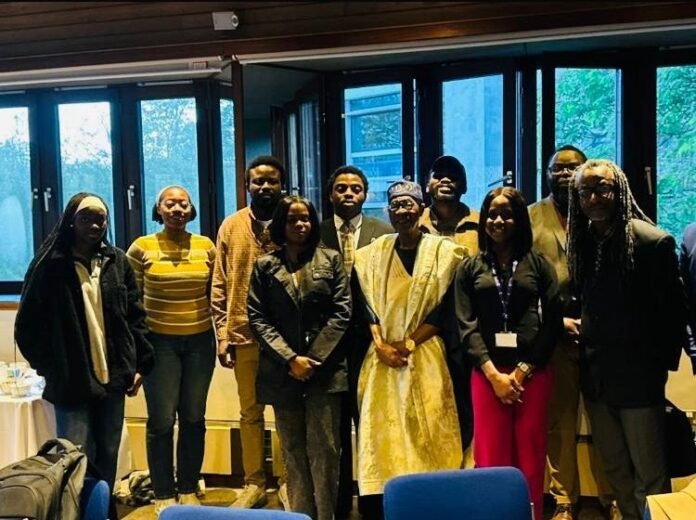
According to the statement, the former minister made the assertion on Wednesday during a high-level interactive session at St John’s College, Cambridge, convened by the Cambridge University Nigeria Society.
The event brought together Nigerian students and scholars in the diaspora for a candid discussion on the state of democracy, governance, and development in Nigeria.
Responding to concerns about the effectiveness of democracy in the context of low educational penetration, Mohammed stressed that the real challenge lies not in the principle of equal voting rights but in the socio-economic conditions that shape voter behaviour.
He noted that improving access to education, healthcare, and infrastructure—particularly in underserved regions—is critical to strengthening democratic outcomes.
Addressing the link between insecurity and social exclusion, he said insurgency and banditry are driven in part by poverty, lack of education, and marginalisation.
He emphasised that military action alone is insufficient and called for a balanced approach that integrates non-kinetic measures such as education and economic development.
Earlier in his presentation, Mohammed underscored the central role of communication in governance, describing it as the “lifeblood” that connects leadership to the people. He argued that governance in the modern era cannot succeed without deliberate, strategic, and credible communication.
“Communication is not a supporting function of governance; it is central to it,” he said. “It is the bridge between the state and its citizens—the system through which policies are explained, legitimacy is built, and trust is sustained.”
Drawing on his experience as both an opposition spokesman and government spokesperson, he highlighted the transformation of political communication in the digital age.
“We have moved from top-down messaging to real-time public conversation. Citizens today do not just receive information; they interrogate it, challenge it, and actively shape the narrative,” he said, warning that governments must adapt by becoming more transparent, responsive, and consistent in their communication strategies.
Reflecting on his time in office, Mohammed identified as a defining achievement the administration’s deployment of multi-platform communication strategies spanning traditional media, digital platforms, and direct citizen engagement.
“We moved communication from one-way broadcasting to meaningful engagement. We listened as much as we spoke, and we fed citizens’ feedback into governance,” he said.
Citing examples from his book, Headlines and Soundbites: Media Moments That Defined an Administration, he reinforced the centrality of communication to governance, illustrating how effective strategies were instrumental in managing crises, shaping narratives, and defending national interests.
On Nigeria’s response to the COVID-19 pandemic, he described communication as the country’s most critical tool in the absence of vaccines and treatments.
“At a time when there was no cure and no vaccine, communication was our strongest weapon. We used it to promote behavioural change, including social distancing, mask-wearing, and hygiene practices, and it proved highly effective,” he said.
He added that the high level of public compliance contributed significantly to limiting the pandemic’s impact in Nigeria and reducing projected fatalities.
Turning to the $9.6 billion P&ID arbitration case, Mohammed said communication also played a decisive role, noting that the government adopted a dual strategy combining legal action with robust media engagement.
“We understood that we were not only fighting in the courtroom but also in the court of public opinion. We had to reshape the global narrative and present the case as one of fraud against Nigeria,” he said.
On the EndSARS protests, he described the episode as a classic example of how fake news and disinformation can escalate crises.
“The digital age has amplified not just the speed of information but also the spread of misinformation. Unverified reports can inflame tensions and distort reality,” he warned.
He also addressed the controversial decision to suspend Twitter (now known as X), describing it as one of the most difficult decisions of his tenure.
“It was a tough call. We were fully aware of the economic and social implications. But in governance, public interest must take precedence over individual interest,”
he said, adding that the decision was driven by concerns over national security and the responsible use of digital platforms.
According to him, these experiences underscore a fundamental reality: in times of crisis, communication is not optional—it is indispensable.