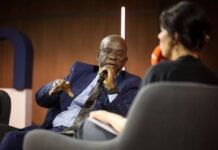

•95m Nigerians living below poverty line, ex Finance Minister
•Prog will help new governors develop skills for democratic governance, Tambuwal
By Lateef Ibrahim, Abuja
Ahead of the May 29 inauguration of the new President and Governors in the country, the Director-General of World Trade Organization, WTO, Dr (Mrs) Ngozi Okonjo-Iweala has declared that the task of nation building requires a lot of trust factor, lamenting however that trust in Nigeria has always been fragile.
Okonjo, a former Minister of Finance and Coordinating Minister of the Economy in the country, noted that a lot of trust was broken in Nigeria during the last general election.
Similarly, the Deputy Secretary General of the United Nations (UN), Ms Amina Mohammed has said that when elected officials fail to deliver on their promises to their electors, “we erode their faith in power, in politics, in the state”.
Okonjo-Iweala, Amina Mohammed and several others spoke yesterday at an induction program organized by the Nigeria’s Governors Forum, NGF, for Governors-elect and re-elected Governors at the Banquet hall, State House, Abuja.
The DG of the World Trade Organization categorically told the incoming Governors that they have a lot of healing to do within their states, and between them.
She said, “Honourable governors, let us be candid: trust in Nigeria has aways been fragile but following the election, a lot of trust has been broken.
“Through your words, deeds, and policies, you need to demonstrate to Nigerians that they are equally loved. That they can settle and do business in any part of the country without fear.
“I love Nigeria deeply and I want to feel welcome in any part of this country.
“Just as different states need to rebuild perceptions among people across Nigeria, we collectively need to rebuild the Nigerian brand in the wider regional and international economy”, the former Minister of Finance said.
Speaking in the same vein on the issue of nation building, Amina Mohammed said that one estimate from UNDP suggests that terrorism has cost Nigeria over US$97 billion in ten-years.
According to the Deputy Secretary General of the United Nations, “When we fail to deliver for people on their rights and their futures, we erode their faith in power, in politics, in the state.
“And that results in a loss of trust, in resentment between generations and towards elites; and in greater tensions between groups, cultures, ethnicities, and religions.
“The only way to build a more cohesive nation and a more harmonious world is to deliver better for people:
“Better services, better opportunities, better safety, better government, and a healthier environment.
“And despite all the challenges, I believe we have what we need to make a great leap forward in these areas in the next few years.
“Massive investment and political attention in a number of concrete areas could be key”, she said.
Continuing, the former Nigeria’s Minister of Environment said, “Globally, we need to end our addiction to fossil fuels while building base load and expanding access to reliable, clean and affordable energy for all.
“In Nigeria, we face a situation where 36 per cent of households do not have access to the electricity grid and where we remain almost entirely dependent on fossil fuels for electricity generation.
“Nigeria has a well defined energy transition plan. Our energy mix must change and the international community must meet its investment pledges to support countries in this transition.
“We know that the green and blue economy has the potential to unleash the next great wave of human development with women and youth the beneficiaries.
“It’s absolutely crucial that we unleash a rapid and just transition to clean energy – opening new frontiers in the economy, creating new jobs, improving health, strengthening human and digital connectivity, and protecting our natural environment.
“The same is true in other areas where we need to both expand and rethink: food and agriculture; education and skills; digital connectivity; social protection and protecting our environment.
“In each of these areas, we face great challenges but if we can find the tools to breakthrough, the opportunities for Nigeria and indeed the world are immense.
“So, we need to make sure that Nigeria does not get left behind.
“As you look to your governors’ mission, you must answer a key question: what do you need to accelerate these transitions in your state?, she told participants at the program.
Speaking further, the DG of the WTO said, “The World Bank estimates that with the COVID-19 pandemic having pushed 5 million more of our fellow citizens into poverty, the number of Nigerians below the national poverty line reached 95 million last year, 43% of our population, which has considerably worsened from 40% in 2018/19, and an estimated 37% in 2015.
“Food insecurity is also on the rise. A government-led, UN-supported analysis earlier this year warned that the number of Nigerians at risk of facing hunger could rise from 17 million to nearly 25 million in the lean season between
June and August.
“It is really hurtful when I hear Nigeria listed internationally as one of those countries where people may need food assistance.
“As a country with fertile arable land we have no business being in that category.
We have challenges on the fiscal, debt, and monetary policy fronts.
“Nigeria’s gross debt level has climbed from N19.3 trillion in 2015 to $N91.6 trillion in 2023. The debt-to-GDP ratio has almost doubled from 20% to 39% over that time period.
“While the debt-to-GDP ratio may not look so alarming, as revenues decline, the burden of debt servicing has increased dramatically.
“The debt service to revenue ratio is certainly alarming, at 83.2% in 2021 and 96.3% in 2022, according to the World Bank.
‘This means that at the federal level, after servicing our debt there is little room to pay for recurrent expenditures, let alone investment”, she said.
The Chairman of the Nigeria’s Governors’ Forum and Governor of Sokoto, Hon Aminu Waziri Tambuwal, in his opening address earlier, explained that the induction seminar was organized to support the new governors in developing the essential skills for democratic governance for the implementation of pre- elections blueprints,
According to Tambuwal, “To kickstart this post-election democratic process, we have Invited governance experts, bureaucrats, and entrepreneurs within and outside the shores of this country, to share their expertise on democratic governance in a diverse political economy with unique peculiarities in modern governance framework.
“I am pleased to acknowledge in our midst the presence of democratic leaders from Africa, United Kingdom, Canada, and the United States of America who have obliged to share their vast experience with us.
“Your Excellency, we have had a robust and fruitful engagements with you as a listening father for the past 8 years of your administration. In the National Economic Council”, he said.
Tambuwal dosclosed out that President Muhammasu Buhari recently accented to some constitutional alteration bills into law. Electricity, Railways, and Correctional Services are now in the Concurrent Legislative List. States have been empowered constitutionally to generate, transmit, and distribute electricity in areas covered by the national grid.
He said, :We now have financial independence of State Houses of Assembly and State Judiciary. Presidents and Governors are expected to submit the names of persons nominated as Ministers and Commissioners within 60 days of taking oath of office for confirmation by the Senate or State House of Assembly. These, among others, are landmark constitutional reforms.