

Burn the Libraries: West Africa’s Strange War on Sharia
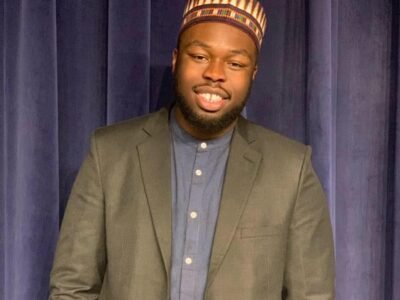
By Mustafa Briggs
Two things crossed my screen this week, within days of each other, and together they said something about the state of the African mind that I have not been able to shake.
The first was Captain Ibrahim Traoré, the military leader of Burkina Faso, a man who has become a folk hero across the continent and the diaspora for his defiance of France and his rhetoric of sovereignty. In a national broadcast, he turned his attention to young Burkinabè who travel to Saudi Arabia to study Islamic law, and his message to them was blunt: do not come home. Instead of acquiring the technological knowledge and skills that could develop the country, he said, they had chosen to study Sharia, and those who would not accept that the constitution stands above all religion could remain where they had studied. He even floated stripping them of their nationality.
The second was a graphic from a Gambian social-media page, fronted by a Gambian-American personality named Alhassan Alex Darboe, no scholar, no statesman, but a man with an audience, declaring that Arabic students studying Sharia and Hadith in Saudi Arabia are “a waste to the productive sector of the country.”
I hold a Gambian passport. So while Traoré’s words concerned me as an African and a Muslim, the Gambian one landed somewhere more personal. And taken together, they are not two isolated outbursts. They are the visible edge of a rising current in West African discourse, a current that has learned to look at its own oldest and deepest intellectual tradition and see only backwardness, waste, and threat. I want to take that current seriously, because parts of it are responding to something real. And then I want to explain, carefully, why it is so profoundly, dangerously wrong.
What Is Real
Let me begin by conceding what deserves to be conceded, because an honest argument does not flinch from the strongest version of the other side.
There is a genuine threat, and it would be dishonest to pretend otherwise. Violent revivalist movements have done terrible things to West Africa. Boko Haram in the Lake Chad basin, the insurgencies tearing through the Sahel, the armed groups that have displaced millions and murdered teachers, worshippers, and children, these are real, and they are, in part, the product of a particular imported, politicised, literalist strain of religious ideology that did not exist in this form in the West Africa of my grandparents. When Traoré speaks of young men returning from abroad wanting to impose on their society a rigid vision they acquired elsewhere, he is pointing at something that has, in specific and bloody cases, actually happened. I will not wave that away. A leader fighting an existential insurgency has every right, indeed every duty, to worry about the ideological pipelines feeding it.
But notice how quickly the legitimate worry, about violent extremism, about foreign-funded ideological hardening, slides into something else entirely: the claim that studying Sharia as such is a waste, that religious knowledge is economically useless, that the student of Islamic law is a drain on “the productive sector.” That is not a security argument. That is a civilisational self-repudiation. And it rests on an ignorance so deep that it mistakes the disease for the patient.
A Thousand Years They Have Forgotten
Here is what the people making these statements do not know, because, and this is the heart of it, almost none of them have ever actually studied the thing they are dismissing.
Sharia is not a fringe subject that a few misguided young men wandered off to memorise. It was, for the better part of a thousand years, the preeminent legal and intellectual system of a huge portion of humanity. From Córdoba to Baghdad, from Cairo to Samarkand, entire civilisations, at the very peak of their scientific, philosophical, medical, and artistic achievement, were built and governed by people trained in it. The jurists who mapped the principles of Islamic law were the same intellectual class that produced algebra, optics, and the hospital. To sneer at Sharia as the enemy of development is to have skipped the several centuries during which it was the operating framework of the most developed societies on earth.
And this was not something that happened far away, in Arabia, and was merely imported to Africa as a foreign disruption. West Africa was one of its great centres. The empires of Mali and Songhai rose to their height as centres of Islamic learning. Timbuktu, whose name the West now uses as a byword for the middle of nowhere, was a university city whose scholars traded in manuscripts worth more than gold. The literacy, the administration, the diplomacy, the very international prestige of these African empires flowed through Arabic and Islamic scholarship.
Consider Askia Muhammad Touré, the great ruler of the Songhai Empire at the turn of the sixteenth century. When he made his pilgrimage to Mecca, he stopped in Cairo, then one of the intellectual capitals of the world, and there he sat with Jalal al-Din al-Suyuti, one of the most prolific and celebrated scholars in the entire history of Islam, who counselled him on how to govern justly and adapt Islamic law to the realities of the Sahel. He was invested with the title of Caliph of the lands of the Blacks. This is what African statecraft looked like: an African emperor taking counsel from the foremost jurist of the age, weaving Islamic law into the governance of a West African empire, and returning home to found schools and libraries. That is not a man who studied something useless.
Or consider the empire of Kanem-Bornu, around Lake Chad, at its height under Mai Idris Alooma in the late sixteenth century. Bornu conducted formal, sophisticated diplomacy with the Ottoman Empire, the superpower of the age. It sent an embassy across the Sahara to Istanbul, negotiated with the Sultan, and secured firearms and military expertise; a reciprocal Ottoman delegation travelled south to the Bornu capital. Alooma maintained standing relations with Tripoli and Egypt, and fielded a corps of musketeers trained by Turkish military advisers, one of the earliest gunpowder armies in sub-Saharan Africa. This was a Muslim African state operating as a confident equal in the international politics of the Islamic world, its rulers and envoys moving through that world precisely because they were formed by its language, its law, and its learning. The Arabic and the Sharia were not a retreat from power. They were the very instruments of it.
Let me give you my favourite illustration of what that education actually meant. In the 1820s, the British explorer Hugh Clapperton visited Sultan Muhammad Bello, the ruler of the Sokoto Caliphate, in what is now northern Nigeria. On his second expedition, Clapperton presented the Sultan with a copy of Euclid’s Elements, the foundational text of Greek geometry, no doubt expecting to impress the African monarch with the fruits of European civilisation. Bello thanked him, and then explained that he already had a copy, one that had been in his possession until it was lost in a fire. He already knew Euclid, because the Arabic-Islamic scholarly tradition he had been raised in had carried the entire inheritance of Greek mathematics for a thousand years. The African Muslim did not need the Englishman to bring him Euclid. He had been reading Euclid, in Arabic, the whole time.
And notice what all of this means. For centuries, long before any European arrived to instruct us, the African trained in Sharia and Arabic was very often also fluent in mathematics, astronomy, medicine, logic, history, and geography. At Sankore in Timbuktu, students who mastered Islamic jurisprudence studied the movement of the stars and the properties of numbers in the same breath; the surviving manuscripts, mathematical, astronomical, medical, are still there to prove it. Sacred knowledge and the sciences were never enemies in our tradition; they were two branches of the same tree, and Arabic was the language in which both were taught. This is the deepest reason the modern dismissal is so short-sighted. Western-style schooling is not the only form of education that has ever produced a scientist, a diplomat, or an administrator; our own tradition did it for a thousand years. And if a young person has been given the gift of a rigorous education in Arabic, then nothing on earth stops them from studying medicine, or engineering, or any of the disciplines we are told will “develop the country,” in Arabic, now, just as their ancestors studied astronomy in it then. The language and the discipline are a foundation to build upon, not a wall to be trapped behind. To look at such a person and see only waste is not to see clearly at all. It is to have accepted, without noticing, that knowledge only counts when it wears a European coat.
That is what these men are calling a waste to the productive sector.
Less Than Three Percent
So where did the contempt come from? It came, as so much of our self-contempt came, with colonialism and the secularisation it installed. The colonial project needed Africans to believe that everything predating and outside the European framework was primitive, and religious knowledge was the first thing marked for the bin. Independence did not undo this; it inherited it. And so in the postcolonial imagination, “real” knowledge became Western knowledge, “development” became the imitation of Europe, and the vast inheritance of Islamic learning was recategorised as, at best, private devotion and, at worst, an obstacle.
And when this modern mind pictures Sharia, what does it see? It sees a hand being cut off. It sees the hudud, the small set of fixed corporal punishments, and it sees nothing else, because that is the only part that makes the news. But the hudud are a tiny fraction, well under three percent, of what Islamic law actually is. The overwhelming body of the Sharia is a sophisticated system of contract, trade, inheritance, marriage, property, ethics, governance, taxation, water rights, the treatment of animals, the conduct of war, the resolution of disputes. It is a thousand years of jurisprudence on how human beings should live together justly. To reduce it to hand-chopping and then discard the entire tradition is like judging the whole of English common law by the history of the gallows and concluding that law itself is barbarism.
And I find it revealing that this three percent is held up as proof that Sharia is incompatible with a civilised modern order, by people who are remarkably relaxed about the moral record of the order they are comparing it to. The modern international legal system, the enlightened Western framework we are told to aspire to, is presiding, right now, in real time, over famine, occupation, and the mass killing of civilians, with its grand courts and conventions proving conveniently powerless whenever power finds them inconvenient. I am not interested in a competition of atrocities. I am simply noting that those who dismiss an entire millennial legal civilisation on the basis of its harshest three percent, while treating the daily failures of the Western order as unfortunate exceptions, are not making a moral argument. They are making a prejudiced one.
The Skills They Pretend Not to See
But let me meet them on their own ground, the ground of usefulness, of skills, of the productive sector, because even there the argument collapses.
The claim is that studying Sharia produces nothing transferable, that it fits a person for nothing but standing in a mosque. This is simply false, and everyone who has spent five minutes around Western education knows it is false. Consider how the West treats its own equivalents. Nobody stands up in Britain and says that the study of law is a waste. Nobody tells the Oxford graduate in Philosophy, Politics and Economics that he has drained the productive sector. Nobody sneers at the student of classics or liberal arts. On the contrary, we understand perfectly well that a rigorous training in law, in argument, in textual analysis, in ethics and logic and language, builds a mind that can be applied anywhere, and we watch PPE graduates walk straight into government, finance, journalism, and law. The entire Western elite is built on the premise that a demanding humanistic or legal education produces transferable excellence.
The study of Sharia is exactly this. It is the study of law, of a vast textual tradition, of Arabic, of logic and disputation and moral reasoning, conducted at a high level of rigour. Why would that alone, of all the legal educations on earth, produce nothing useful?
It does not. Let me give you two living proofs, people I know.
The first is my own teacher, Shaykh Muhammad al-Amin, a son of the great Shaykh Ibrahim Niasse of Senegal. He studied Sharia wa’l-Qanun, Islamic law and jurisprudence, at al-Azhar. And when he came home, that training did not confine him to a prayer niche. He served for years as the Consul-General of Senegal in Jeddah. His mastery of Islamic law, of Arabic, of the culture and diplomacy of the Muslim world, made him precisely the man to represent his nation in the diplomatic arena. That is the “unproductive” Sharia graduate: a national diplomat.
The second is Muhammadu Sanusi II, the former Emir of Kano and former Governor of the Central Bank of Nigeria. Sanusi first studied economics, earning his bachelor’s degree at Ahmadu Bello University in 1981 and a master’s in the same subject in 1983, before entering the banking world in the mid-1980s. And then, at the height of a promising banking career, he left it. In 1991 he travelled to Sudan and spent the best part of a decade at the International University of Africa in Khartoum, studying Arabic, Sharia, and Islamic jurisprudence, returning in 1997. He then re-entered banking, rose through the ranks, and was ultimately appointed Governor of the Central Bank of Nigeria. And he told me himself that it was precisely because he had studied the Sharia, because he understood Islamic jurisprudence from the inside, that he was able, as Governor, to grant the licence that established Jaiz Bank, Nigeria’s first Islamic bank, and to open the door to the entire Islamic finance sector in the country. Note the shape of that career: economics, then Sharia, then the two fused together to build something neither could have built alone. The Sharia education did not subtract from his usefulness. It created an entire industry.
And look at what that one licence grew into. Jaiz Bank did not remain a symbolic gesture. Within little more than a decade it had swelled into a major financial institution, its total assets crossing one trillion naira and climbing past 1.2 trillion, its annual profits doubling year on year, its balance sheet expanding faster than much of the conventional banking sector, powered in large part by sukuk, the Islamic bonds that Malaysia had already shown could finance the building of a nation. And look at who stands behind it. Its founding chairman was Umaru Abdul Mutallab, one of the most decorated figures in Nigerian finance, a former federal minister and former chairman of First Bank, the oldest and largest conventional bank in the country, who chose to pour that lifetime of expertise into building the Islamic one. Its major shareholders read like a roll call of the most serious industrial wealth in West Africa: the oil magnate Muhammadu Indimi; the Dantata dynasty, the oldest and one of the richest merchant families on the continent, whose founder Alhassan Dantata was the wealthiest man in colonial West Africa; and Dangote Industries itself, the empire of Aliko Dangote, the single richest man in all of Africa and, as it happens, a great-grandson of that same Dantata line. Even the Jeddah-based Islamic Development Bank holds a stake. When the richest man on the continent parks his capital in an Islamic bank, that is not charity or piety for its own sake; it is a sober judgement that this is real, serious, profitable finance. This is not a fringe curiosity for the devout. It is real capital, real infrastructure, real national wealth, an entire ethical-finance sector woven into the Nigerian economy, and it exists in that form because a man who had taken years out to study Sharia understood something the sneering commentators do not.
Diplomacy. Central banking. Foreign affairs. An entire new financial sector. These are the fruits of the education we are being told is a waste. The skills are transferable; the discipline of earning a difficult degree is transferable; and a legal training in a language other than your own opens doors, not closes them. The student of Sharia is not condemned to the mosque any more than the student of law is condemned to the courtroom.
Nobody Calls Malaysia Backwards
And if the living examples of individuals do not convince you, then look at an entire country that made this its national strategy.
Look at Malaysia. Nobody, anywhere, calls Malaysia backwards. It is one of the most developed and dynamic economies in the Muslim world, a place of gleaming cities, advanced manufacturing, and a highly educated population, precisely the model of “development” these African commentators claim to want. And Malaysia is also the global capital of Islamic finance. It holds something like half of the entire world’s market in sukuk, Islamic bonds; Islamic finance makes up more than a third of its domestic banking sector; and Kuala Lumpur hosts some of the most important Islamic financial institutions and universities on earth. This is a multi-hundred-billion-dollar industry, drawing investment and talent from across the globe.
And how did Malaysia build it? By doing the exact opposite of what Traoré proposes. It did not exile its Sharia scholars or brand them a waste. It integrated them, deliberately and at the highest level, into its financial and regulatory system. It put Islamic jurists onto the Shariah advisory boards of its central bank and its financial institutions, it built research academies to produce internationally accepted Islamic legal rulings, and it created world-class institutions to train the specialists this industry runs on. Malaysia looked at the very expertise these African leaders are dismissing as economically useless, the mastery of Sharia, and it recognised it for what it was: the foundation of an entire high-value modern industry. It turned religious scholarship into national wealth.
That is the choice on the table, laid bare. You can treat a thousand years of Islamic legal expertise as a liability to be exiled at the airport, as Burkina Faso now threatens to. Or you can treat it as an asset to be integrated and deployed, as Malaysia did on its way to becoming one of the most advanced economies in the Muslim world. One of these countries is a byword for development. It is not the one turning its scholars away.
Opportunity, and the Real Culprit
And there is something else here that the sneering misses entirely, something about opportunity and class.
For a great many of these young people, the Islamic path was not a rejection of Western education. It was the only door that was open. Western schooling is expensive; across much of West Africa it is a luxury the poor cannot afford. Islamic schooling, by long and beautiful tradition, is generally free. And so the brilliant child of a poor family, shut out of the fee-paying Western track, finds in the Islamic school a ladder, and the very brightest of them earn scholarships to study further in the Arab world. Strip away the sneer and what you are often looking at is a poor, gifted student who took the one opportunity available and excelled at it. To then tell that student he is a waste, that he should not come home, is to punish him for his poverty and reward the accident of who could afford the other school.
Now, I will grant one thing, and grant it gladly. There should be far more provision made for graduates of Islamic schools to go on into STEM, into medicine, into engineering, into the fields we are told will “develop the country.” I am all for it. But the point is that studying Sharia does not disqualify you from any of that. You can graduate in Islamic law and go on to postgraduate study in another field, carrying the discipline and rigour you learned with you, exactly as the West’s own liberal-arts graduates retrain into a hundred professions. The answer to a young population hungry for both faith and development is to build the bridges between them, not to stand at the border telling the returning scholar he is unwelcome in his own country.
Because here is the deepest dishonesty of the whole complaint. Scroll the comments under these viral clips and you will find the same refrain, dripping with an inferiority complex I find genuinely painful to watch: China is developing, India is racing ahead, and here we are, Africans, wasting ourselves on religion. As though the reason Africa is not China is that too many Gambians studied Hadith.
This is a lie, and a convenient one. Africa is not underdeveloped because its young people study Sharia. Africa is underdeveloped for the reasons Walter Rodney laid out with such devastating clarity half a century ago in How Europe Underdeveloped Africa: centuries of slave-trading that drained the continent of its people, colonial extraction that hollowed out its economies, and a global order engineered so that, in his words, Africa helped to develop Western Europe in the same proportion as Western Europe underdeveloped Africa. And it continues today, through the structural adjustment programmes that gutted African public institutions, through trade agreements written to keep the continent exporting raw materials and importing finished goods, through debt, through sanctions, through the simple, daily humiliation of an African passport that cannot cross the borders a European one waves through.
Those are the chains. Not the madrasa. It is so much easier to blame the boy studying Arabic than to confront the machinery of the world. Pointing at the Sharia student is displacement, the underdeveloped mind scapegoating its own heritage for a poverty that was manufactured elsewhere.
Reclaim It
So let me say plainly what I believe.
This anti-Sharia current, for all that it sometimes dresses itself in the language of security and development, is at bottom something uglier: it is Islamophobia, imported and internalised, an inferiority complex that has learned to despise the very knowledge that once made Africa a beacon. And it is not only unjust. It is strategically suicidal.
Because both Burkina Faso and the Gambia are overwhelmingly Muslim countries, whose people hold Islam in deep esteem. If your genuine aim is to guide those populations away from violent extremism, the worst thing you can possibly do is alienate, exile, and humiliate the very scholars those populations actually trust. A people take their faith seriously; they will listen to a credentialed scholar of their religion long before they listen to a social-media personality or a secular official who has never opened the books. Drive those scholars out, brand them useless, threaten their citizenship, and you do not weaken extremism, you strengthen it. You create exactly the grievance, the alienation, the sense of a home that has rejected you, in which the real radicalisers do their finest recruiting. Demonisation produces the friction it claims to prevent.
The intelligent path, the path of a leader who actually wanted both development and stability, is the opposite. It is to reclaim this heritage and integrate it. To honour the scholar and put him to work, in the foreign ministry, in the courts, in finance, in education, in the hard work of building a moderate, confident, rooted religious mainstream that can answer the extremists in their own language and beat them. To build the bridges from the madrasa into the university, so that the poor gifted child who learned discipline over the Qur’an can carry it into medicine or engineering. To treat a thousand years of African Islamic scholarship not as a foreign contaminant to be quarantined, but as what it actually is: ours. A pillar of who we have been, and a resource for who we might yet become.
The colonisers taught us to burn our own libraries and call it progress. I had hoped we were done taking their word for it. The student returning from Cairo or Madinah with a head full of Arabic and law is not the disease afflicting Africa. He is the descendant of the men who owned Euclid while Europe was still in the dark, who counselled emperors and treated with sultans and read the stars in the language they prayed in. It is long past time we remembered that, and welcomed him home.
Never miss a moment! Get the stories shaping Nigeria, delivered straight to your phone. Follow Peoplesdaily Newspaper on WhatsApp for breaking news, exclusive reports, and the headlines everyone will be talking about, before anyone else.


