

By Wilfred Okiche
In this review, art critic Wilfred Okiche examines Olakunle Bolawa’s portrait series She Carries the Future, exhibited at SNA Anambra Annual Art Exhibition, situating the work within contemporary African photographic practice and global debates on memory, labor, and futurity.
Exhibited at Kenneth Dike State Library, Awka from 27-29 November, 2024, Olakunle Bolawa’s She Carries the Future is a quietly radical body of work that repositions African womanhood as a site of authorship, continuity, and foresight. Rather than rendering women as symbolic figures frozen in ethnographic time, the series frames them as active bearers of knowledge, embodied archives through whom history, labor, and futurity circulate.
Bolawa’s portraits resist spectacle. The women are composed with restraint and dignity, their expressions calm yet resolute. This stillness is not passive; it signals authority. Through careful attention to posture, gaze, and balance, the artist foregrounds presence as power. These are not images that plead for visibility; they assume it. The subjects meet the camera on their own terms, asserting self-possession rather than performance.
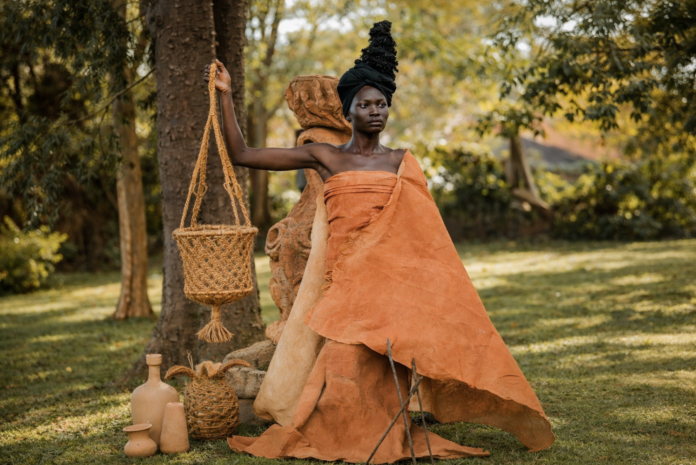
Central to the series is the recurring motif of carrying baskets, vessels, shells, gourds, and ritual objects. In Strength of a Woman, a figure stands grounded within a natural landscape, her arm extended as she holds a woven basket suspended in space. Clay vessels rest at her feet, anchoring the image in labor and sustenance. Her body forms a sculptural silhouette against the trees, transforming an everyday act into a declaration of endurance, responsibility, and cultural stewardship. Carrying here is both literal and symbolic: an articulation of inheritance and obligation, borne with resolve.
Regal Balance sharpens this logic through vertical composition and direct address. A woman gazes unwaveringly at the viewer, a clay pot balanced on her head, encircled by gourds and leaves. The emphasis on equilibrium between body and object, motion and stillness, suggests that knowledge, like water, must be carried with discipline and intention. The vessel becomes an extension of the self, collapsing the boundary between subject and object, tradition and presence.
In Woman’s Gaze, the series turns inward. Seated and contemplative, the subject delicately lifts a strand of shells from a plate, studying it with quiet attention. Historically associated with trade, memory, and adornment, the shells are rendered here as instruments of reflection rather than display. The image foregrounds care as labor and introspection as strength, revealing femininity as a site of deliberation, creativity, and inherited wisdom.
Materiality plays a crucial role throughout She Carries the Future. Clay, fiber, shells, and earth-toned textiles function as a visual language rather than decorative accents. They reference indigenous technologies and economies often dismissed within modernist narratives as obsolete. Bolawa reframes these materials as intelligent, adaptive systems evidence of continuity rather than lack. By integrating them into portraiture, the artist expands the genre beyond likeness into relational identity, where the self is shaped through labor, memory, and care.
In this respect, Bolawa’s work resonates with a lineage of Black photographic practice that asserts dignity through counterpoint rather than exposure. One might recall Eileen Perrier’s early portraits of Ghanaian family life, where quotidian details, discolored walls, domestic tools, moments of rest were easily misread as signs of deprivation, yet instead revealed discipline, confidence, and self-possession. Perrier’s insistence on everyday authority finds an echo in Bolawa’s refusal to dramatize his subjects. Both artists understand representation as an ethical act, capable of restoring complexity where dominant visual cultures flatten experience.
Crucially, She Carries the Future proposes continuity as a form of futurism. It challenges linear narratives of progress that imagine the future as a rupture from the past. Bolawa suggests instead that futurity is carried forward through embodied knowledge through gestures learned, materials handled, and responsibilities inherited. The women in these portraits are not positioned at the margins of history; they are its enduring center, holding the world steady while shaping what comes next.
In asserting African women as active agents of cultural transmission rather than passive symbols, Bolawa offers a compelling reconfiguration of portraiture itself. She Carries the Future stands as a measured yet forceful contribution to contemporary photography, one that insists that the future does not simply arrive, but is borne, daily and deliberately, on the body.