

By Christiana Ekpa
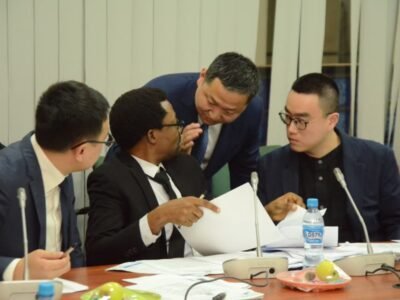
The House of Representatives Ad-Hoc Committee investigating the $460 million CCTV surveillance project in the Federal Capital Territory has directed the Central Bank of Nigeria to suspend further payments to ZTE Corporation pending satisfactory explanations on the execution of the contract.
The resolution, adopted on Tuesday, followed lawmakers’ outrage over what they described as inconsistencies, vague responses, and a lack of transparency from ZTE officials regarding the project’s scope, deployment locations, and operational status.
The committee ordered the company to reappear with verifiable documentation, including a detailed inventory of all equipment supplied and installed, exact locations nationwide, and the identities and contact details of the 456 Nigerians it claimed were trained to operate and maintain the system.
The decision followed a motion moved by Ali Shettima and seconded by Kolawale Akinlayo during an investigative hearing at the National Assembly of Nigeria.
Committee Chairman Donald Ojogo said the probe was a fact-finding exercise, not a witch-hunt, stressing that Nigerians deserve clear answers.
Representing ZTE, Irene Momoh said the company installed CCTV infrastructure in Abuja and Lagos between 2011 and 2012 but admitted he could not confirm whether the system is still functional.
The disclosure drew sharp reactions from lawmakers, who questioned how a project of such scale could lack a sustainable maintenance framework. Momoh said ZTE maintained the system for six months before handing it over, blaming its current state on the government’s failure to sustain funding.
Lawmakers also disputed claims on deployment locations. Iyawe Esosa cited records from the Federal Ministry of Police Affairs indicating installations in Edo State, contradicting ZTE’s position.
Akinlayo also rejected claims of installations in Ekiti State, insisting there was no visible deployment across the state.
Tensions escalated when Momoh blamed gaps in his responses on his recent appointment, noting that officials involved in the original contract were no longer with the company. Lawmakers warned this could be viewed as an attempt to evade responsibility and hinted at possible referral to the Nigerian Bar Association.
Meanwhile, a representative of the apex bank, Josiah Okike, advised that the directive be routed through the Office of the Accountant-General of the Federation. He disclosed that as of March 2026, ZTE was due to receive $15.37 million under the loan repayment arrangement.
The committee resolved to invite the company again and insisted on documentary proof of project handover, including details of the government agencies that assumed custody of the infrastructure.
Never miss a moment! Get the stories shaping Nigeria, delivered straight to your phone. Follow Peoplesdaily Newspaper on WhatsApp for breaking news, exclusive reports, and the headlines everyone will be talking about, before anyone else.


