


By Tobias Lengnan Dapam
In Jigawa state, the challenges of Water Sanitation and Hygiene (WASH), lay side by side with the successes
in most of the schools across the state.
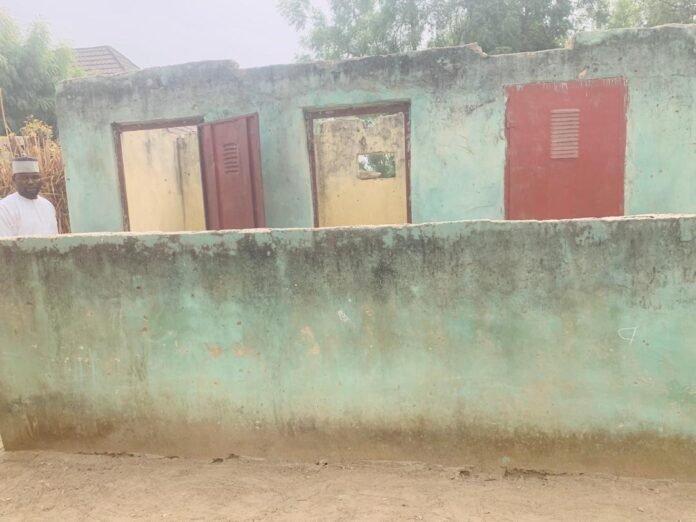
The challenges which are common features in about four schools visited by our reporter included; poor and absence of WASH facilities which are disturbing despite partnership between the state government and relevant partners to remedy the situation.
Another disturbing factor is the lack of water source connected to the toilets in all the three schools visited in the state capital. To add to the challenges, disability friendly facilities were not available at the time of the visit.
But the only story all the schools have in common is the lack of soap, sanitizer and detergent for hand washing.
It would be recalled that Jigawa was recognized as the first state in Nigeria to be declared Open Defecation Free (ODF) in 2022.
The development followed a rigorous assessment by the National Task Group on Sanitation (NTGS) across its 27 local government areas.
But the current development on ground begging for urgent attention of government is a stain on the historic record of 2022.
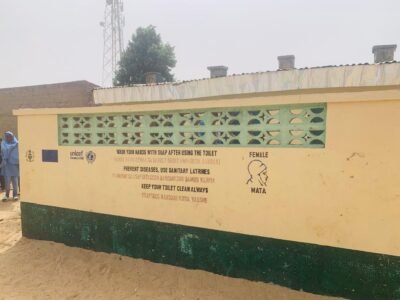
Adamu Awalu, head teacher of Shuwarin Primary School, in Kiyawa Local Government Area, said members of the community are overloading the facility.
He said people from the community usually forced their way in to the school premises to use the eight toilets which are meant for the 1,662 pupils in the school.
“This intervention has helped our students in so many ways. Unfortunately, members of the community usually come into the school to use the facilities without any authorization.
“It is even disturbing that they sometimes vandalize the padlock or jump the dwarf fence of the facility to gain access. This is a serious challenge to us and to the facility that we are using.
“ We are appealing to the government to fence the school so as to prevent members of the community from using and destroying the facility that is meant for pupils.”
In Chomo Central Primary Schoo, Dutse Local Government, the head teacher, Abba Ado said the facility stopped working about four months ago. He said the facility barely worked for two months after commissioning.
He said the school has 1,184 pupils who are currently without any WASH facility.
On steps taken to address the situation, he said several letters were written to the relevant authorities but no action was taken.
He said they decided to use the old pit toilet to address the challenges of hygiene.
“ When the facility was commissioned, it worked only for two months and stoped. As we speak, it has been four months since it stopped working and all efforts to get response from the relevant authorities proved abortive.
“Initially, I thought it is something that the authorities would address in a couple of days. But it is months now and there is no response despite several letters to that effect.
“As it stands, we are using the old pit toilet that was abandoned. The students fetch water from their houses to help wash the toilets. We are hoping and praying that help would come.
Also, at Gadadin Primary School in Kachi Ward, Dutse Local Government Area of Jigawa, WASH condition is poor.
The school, which has 1,084 pupils and 13 staff members, has six toilets designated for pupils which are non-functional. The head teacher said they were destroyed by flooding and wild animals about seven years ago.
The headmaster, Malam Ali Alhaji, said the situation forced the pupils to resort to open defecation within and around the school premises.
On the steps taken, he said the incident was earlier reported to the Local Education Authority, which responded with an assessment visit, but no positive response followed that visit.
He also said that the four staff toilets connected to a water system, were non-functional due to lack of water and maintenance.
“Currently, the school does not have a functional water source. This makes our pupils and staff to bring water from their houses.
“Before now, there was a community well used by pupils. It is is risky for them because it is open and unprotected, usually contaminated during the rainy season. Also, a pupil died while attempting to fetch water during school hours.
“Also, a cholera outbreak occurred after our pupils consumed water from the well, forcing the authorities to ban its use.”
While in Kuho (744) primary school, in Dutse local government, the head teacher,
Haruna Shehu revealed that there is no enough water to cater for the 752 pupils in the school.
He said the two boreholes which were not connected to the toilets were drilled by the state government and a philanthropist.
“We usually advice the pupils to fetch water from the tap to use after usage. Unfortunately, most of the pupils use the toilet without water. This is not good for their health and the good of the school. We are appealing to the relevant authorities to help us and connect the bore hole to the toilets.”
Speaking on ways to improve the challenges, the Chairman of the Jigawa State Universal Basic Education Board SUBEB, Prof. Haruna Musa, disclosed that the 2026 budget has been designed to prioritize the scaling up of WASH facilities.
Speaking at a 2-day media dialogue organised by UNICEF in partnership with the Child Rights Information Bureau (CRIB) of the Federal Ministry of Information and National Orientation,
He said the state currently manages 8,689 toilets across 2,727 primary and 618 junior secondary schools but noted that gaps remain.
“We are very strategic. Whatever is provided in the Medium Term Sector Strategy MTSS is what we implement in the budget.
“Our target is to achieve 100 percent implementation in terms of budget provision. This is a commitment from our side; we have to deliver”, Prof. Musa stated.
He added that the state has recruited 10,000 school guards to prevent encroachment and insecurity.
Prof. Musa also emphasized the role of sustainability, calling on Teachers, Parents and Mothers’ Associations to take ownership of the facilities.
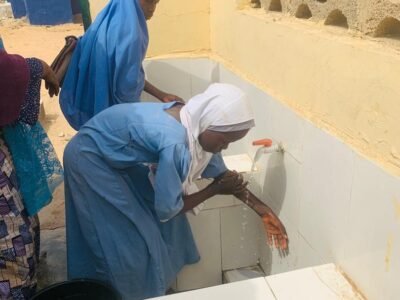
He specifically urged learners to maintain hygiene, noting that “leaving the toilet the way you met it” is essential for long-term use.
Technical Adviser to Governor Umar Namadi on Basic Education, Dr Hauwa Babura, said the state, with its creation of a dedicated Ministry of Basic Education, is in the right step.
“If we continue at the rate we are going today, we will be able to achieve 100 percent level for our WASH facilities,” Dr. Babura said.
She said WASH is a critical pillar for the Sustainable Development Goals, SDGs, particularly regarding equity and female education. “Providing water to girls gives them the confidence and self-esteem to sit in the classroom and learn with comfort and safety”, she stated.
On her part, UNICEF’s Chief Communication Specialist, Susan Akila, commended Jigawa for interventions in critical sectors.
She said the state is a model for health interventions.
Speaking further she urged the government to improve on the challenges of a WASH in the state.
“Simple things like having WASH facilities can make a girl drop out of school because she is not comfortable during her menstrual period”.
She further urged the government to ensure that the facilities are gender-segregated and disability-friendly, especially in rural areas.
But to effectively respond to these emergency calls begging for answer, the state government must speed up action in addressing the challenges raised by the teachers of various schools.
Expert have also warned that the schools are gradually resorting to old methods, and might slide in to ODF if urgent steps are not taken to permanently address the challenges.





[…] Read more on Peoples Daily Newspaper […]