

UN Deputy Secretary General visits Yelewata, IDPs mega camp in Benue
By Uche Nnorom, Makurdi
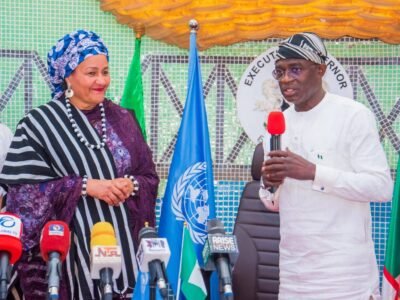
The United Nations Deputy Secretary-General, Dr. Amina Mohammed, on Friday, visited Yelewata and the mega camp being put in place at Mbayongo for Internally Displaced Persons in Benue State.
Dr. Amina expressed concern on the recurring conflicts that are setting back efforts towards enduring peace, recovery, and the resilience to actualise their potentials.
She sympathised with the families of those killed in the recent attacks in the state, and expressed solidarity with all affected communities.
Dr. Amina said there is a growing sense of uncertainty globally as conflicts, climate shocks,
economic pressures and displacement converge, placing growing strain on communities around the world.
She averred that the war in Iran is a stark reminder of how quickly conflict can escalate, with
consequences that reverberate far beyond one country or region.
The deputy secretary general said that the UN welcomes the ceasefire between the United States and Iran, saying it was an important step towards deescalation and diplomacy.
According to her, across the region, these intersecting pressures are testing resilience, deepening vulnerabilities and reinforcing the importance of inclusive development, strong institutions and social
cohesion.
The former Nigeria Minister fot Environment obseryed that in spite of these challenging times, the direction, Benue State Government is setting deserves recognition.
She noted that the state’s 2026 Budget of Rural Development, Livelihood Support and Sustained Growth sends an important signal of commitment to improving lives, expanding opportunity and
anchoring development where it matters most.
Said she, “the human toll of insecurity is profound. It disrupts lives, weakens livelihoods, erodes
trust and undermines the foundations for peace and development.
“What is required is not only a security response, but a broader commitment to peacebuilding that starts at the grassroots—strengthening early warning and early response, rebuilding trust across communities, and creating the conditions for reconciliation to take root.”
Dr. Amina said Benue holds enormous potential as Nigeria’s food basket, which plays a critical role
not only in feeding the country, but in generating livelihoods, enterprise and broader prosperity.
The UN Deputy Secretary-General acknowledged the efforts being made to pursue durable solutions for displaced families—including through access to agricultural land and opportunities for self-reliance—reflect the kind of joined-up leadership this moment demands.
“This is how the Sustainable Development Goals, SDG are advanced in practice through integrated action that connects humanitarian response to long-term development, restores agency, reduces dependency and leaves no one behind.
“With sustained leadership, stronger partnerships and continued investment in livelihoods and value chains, Benue is well placed to translate its assets into more inclusive and resilient growth.
“The United Nations stands ready to support these efforts in ways that are practical, coordinated and aligned behind State priorities.
“Justice and accountability are also essential. Without them, peace remains fragile and
reconciliation incomplete. We must also be mindful of the risks that come when complex crises are reduced to narrow or simplified narratives.
“Oversimplified narratives can inflame tensions, strain the social fabric and make the work of
peacebuilding and reconciliation even harder.
“This is why responsible leadership, careful language and a commitment to dialogue and social cohesion are so important at this moment.
“Benue’s launch of the BRACE-UP initiative is an important step in bringing unenrolled children
into school and protecting every child’s right to education.
“In communities affected by conflict and displacement, this imperative becomes even
greater.
“Children who have already experienced disruption and loss must not be left further behind, and continued support will be essential to ensure their safe integration into host schools and their access to learning materials and opportunity, She emphasized.
Speaking on the significance of the visit the United Nations Children’s Fund, UNICEF, Representative in Nigeria, Wafaa Saeed Abdelatef, said, “it is about the partnership between the United Nations team led by the Deputy Secretary General and the state government, bringing hope, sustainable development to bring change.
“So we affirm our commitment to support the state. And we really acknowledge the leadership of the Governor of the state.”
In his remarks, Governor Hyacinth Alia said as the food basket of the nation, the state’s stability is directly linked to the stability of Nigeria’s food systems and West Africa’s broader supply chains.
He pointed out that the state is at the frontline of complex challenges, including farmer–herder conflicts, climate-induced vulnerabilities, and the realities of over 500,000 internally displaced persons across communities.
Never miss a moment! Get the stories shaping Nigeria, delivered straight to your phone. Follow Peoplesdaily Newspaper on WhatsApp for breaking news, exclusive reports, and the headlines everyone will be talking about, before anyone else.


