
By Matthew Ma
“Today, it has become almost impossible for someone to hold a political office either by appointment or election without patronizing a godfather because of their power and influence. The godfather uses all he has to make sure his godson wins an election or gets a political appointment with the hope of getting or receiving something in return. Godfatherism in Nigeria is a political investment where the investors ensure to make a profit at all costs. The godfathers can do anything humanly and spiritually possible to protect their investment.”
The conflict arising from godfatherism and endorsement is a dominant attribute of Nigerian party politics. Its role as a political phenomenon has harmed the political structure of Nigeria. It has emerged as a potential threat to a relatively new democracy. The works of Plato, Aristotle, and other classical philosophers have focused on the concentration of political power in the hands of a few in the early Greek and Roman civilization. The elitist thinkers such as Vilfredo Pareto (1848–1923), Gaetano Mosca (1858–1941), and Robert Michels (1876–1936) devoted their political analysis to how power is used and abused by the elite class in different contexts. Pareto emphasized the psychological and intellectual superiority of the elite. He insists that they are the highest achievers in any field. He discusses the existence of two kinds of elites: ruling elites and non-governing elites. Mosca emphasizes the sociologic and personal characteristics of elites. He said elites are an organized minority, and the masses are an unorganized majority. The ruling class is composed of the ruling elite and the sub-elites. He divides the world into two groups: the political class and the non-political class. Mosca asserts that elites have intellectual, moral, and material superiority that is highly esteemed and influential. Sociologist Michels formulated the iron law of oligarchy, maintaining that a few run social and political organizations and that social organization and the division of labor are crucial. He believed that all organizations were elitist and that elites have three basic principles that help in the bureaucratic structure of the political organization: the need for leaders, specialized staff and facilities, utilization of facilities by leaders within their organization, and the importance of the psychological attributes of the leaders. The domination of power by the hegemonic class in many parts of the modern world can thus be said to be nothing new but has a full pedigree. The main lesson of all these works is that studying political elites is essential for understanding the trajectory and threat of paternalism in Nigerian politics.
Godfatherism politics is not a new phenomenon in the Nigerian political arena. The inherent danger or harm it poses to a fragile democracy like Nigeria cannot be overemphasized. Since the return to democratic rule, the country has witnessed a heightened tempo in the politics of godfatherism that continues to reduce the legitimacy of government and void the electoral value of the citizens. A year ago, a photo of Umo Eno kneeling in front of Akwa Ibom State Governor Udom Emmanuel appeared on the internet. The Akwa Ibom state commissioner of land and water resources, a man in his 50s or 60s, knelt to ask for blessings from Governor Udom. The picture of a 60-year-old man (in the voice of Asari Dokubo) kneeling before his mate or even his younger person who just happened to have occupied a higher position is a replica of how Nigerian politics plays out. Sometime last year, a picture of a 61-year-old Nigerian senator, James Manager, representing the Delta southern senatorial district surfaced online, begging the former governor of Delta State, James Ibori, to push his 2023 governorship ambition. Western Nigeria is the pacesetter of godfatherism. Just as the godfather is the boss in the mafia world, Bola Tinubu is the governor, senator, and political figure in that region that governors, senators, house of representative members, and other political office holders take instructions. If you dare to do otherwise and fail to follow his directives, you no longer qualify to be called a godson. Such an act of insubordination is punishable as you will never return to the political position you were occupying unless you have grown some wings to help you flourish independently without him. This issue was the case of the former governor of Lagos state, Akinwunmi Ambode. Based on his track records and achievements, he was to return for the second term, but due to disobedience, they denied him the second term. Comrade Adams Oshiomhole tried this system in Edo state but failed miserably, as the opposition was able to fight his propaganda and control of the state. They introduced and sold the “Edo no be Lagos” slogan to eulogize Godwin Obaseki against Oshiomhole. Godfatherism is a multi-headed monster in Benue and the country as a whole. It has negatively impacted the practice of popular political participation and good governance. Benue State should have been one of the most developed and wealthy, considering the immense human and material resources of Benue state. But for poor leadership, since the return of democracy in 1999, little has been achieved in progress and development. The reason for this is not difficult to discern. It is a soured relationship between godfathers and godsons. A few years ago, the rift between George Akume and Samuel Ortom of Benue state began when the latter reshuffled his cabinet and removed members of Akume’s camp. The governor retained four commissioners and seven advisers employed by his predecessor. After 48 hours of sacking the commissioners loyal to Akume, he fired the Executive Chairman of Benue Internal Revenue Service (BIRS), Mrs. Mimi Adzape-Orubibi, and his Urban Development Board counterpart, Richard Agwa, who were close associates of Akume. The rift in their relationship widened when Terkimbi Ikyange, the Speaker of the Benue State Assembly, said to be loyal to Akum, was impeached. The development left Akume with eight loyal lawmakers and Ortom with 22. Later, eight lawmakers loyal to Akume served the governor with an impeachment notice. However, the plan fell through after the Makurdi High Court, chaired by Justice Theresa Igoche, issued an interim order limiting eight lawmakers from continuing impeachment proceedings against the governor. This rift marked the fallout between Akume and Ortom.
The 2023 presidential election, like other elections, started with the endorsement of some presidential candidates by prominent individuals, influencers, and socio-cultural organizations in the country. On November 4, Nollywood actors, under the auspices of the Progressive Coalition of Entertainers, declared support for the presidential candidate of the All-Progressives Congress (APC), Asiwaju Bola Tinubu, for the 2023 general elections. The group made their support public during a courtesy visit to the speaker, Lagos State House of Assembly, Mudashiru Obasa, at the assembly’s complex in Lagos. A month earlier, Nollywood veterans like Patience Ozokwor (Mama-G), Mr. John Okafor (Mr. Ibu), and Alex Osifo announced their endorsement of the presidential candidate of the Labor Party, Peter Obi, in the 2023 general election. The veterans, alongside a support group promoting the 40 Million Ballots Movement, unveiled a donation campaign to support Obi and his running mate, Baba-Ahmed Datti, ahead of the elections. In September, the leader of Afenifere, Ayo Adebanjo, announced in a press conference that the group decided to back the presidential candidate of the Labor Party, Peter Obi, for equity and inclusiveness. Mr. Adebanjo said the Yoruba took the first turn of the zonal arrangement in 1999, which led to the emergence of President Olusegun Obasanjo. Now, power is supposed to return to the south imminently without negotiation. According to him, we cannot continue to demand that the Igbo people remain in Nigeria while we continue to marginalize and exclude them from the power dynamic. Adebanjo position did not go well with some other members of the body. In late October, some Afenifere leaders opposed Peter Obi’s endorsement and endorsed the presidential candidate of the All-Progressives Congress, Asiwaju Bola Tinubu. They made this endorsement public when Tinubu visited the national leader and other group leaders at his country home in Akure, the Ondo State capital. The endorsement and counter-endorsement raised questions about who the leader of Afenifere is and which of the backing seems valid. The Middle Belt Forum also backed Peter Obi as their preferred candidate. The forum said it was throwing its weight behind Obi’s candidature because it believes in fairness, equity, and justice. This decision was disclosed by the chairman of the Forum and Convener of Middle Belt for OBIDATTI 2023 while unveiling Peter Obi and Yusuf Datti as their candidate for the 2023 presidential election at the Rwang Pam Township Stadium, Jos, Plateau state capital. Similarly, Arewa Youth Progressives Alliance (AYPA) endorsed the former vice president and presidential candidate of the People’s Democratic Party (PDP), Atiku Abubakar, for the 2023 elections. AYPA Secretary-General Hamza Lawal said that after recent interactions with some of the presidential candidates in Kaduna, the group realized that Atiku was the right person to serve as the president, given his vision, experience, and capabilities. Therefore, he is the best candidate for president.
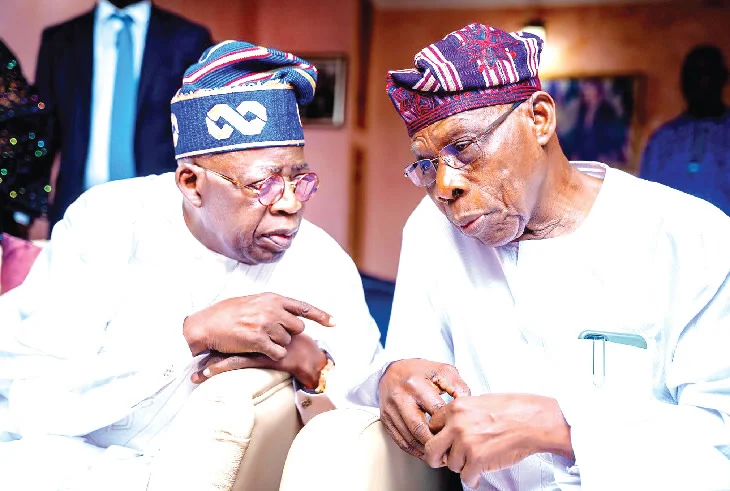
Once again, the current political climate in Nigeria is under the tyrannical influence of the political godfather. The recent endorsement from former Nigerian president Olusegun Obasanjo, of Peter Obi, the presidential candidate of the Labor Party, as his preferred choice for president in the February election did not go well with other political parties. In an open letter to young people on New Year’s day, Mr. Obasanjo encouraged the young people to vote for Mr. Peter Obi of the Labor Party. Mr. Obasanjo said that in light of the failures of the current regime and the lack of capacity from the other major political parties to help take Nigeria from the doldrums of hardship it finds itself, Nigerians should vote for Peter Obi, the presidential candidate of the LP. He believes that the former Anambra governor can unite the country, has a listening ear, is young, and is willing to save Nigeria from economic collapse. According to him, Mr. Peter is a needle connecting the north and south lines, which cannot be lost. The endorsement of Obi by Obasanjo on Sunday sparked reactions across rival political camps, with the All-Progressives Congress describing it as a worthless political move, adding that it would not affect the ambition of its presidential candidate, Bola Tinubu. The spokesman of the party, Niyi Akinsiju, argued that out of four living ex-military leaders—Gen. Gowon (Rtd), Gen. Abdulsalami (Rtd), Gen. Babaginda (Rtd), and Obasanjo is the only one that behaves as non-elder statesman. He also said that the endorsement of the former president of Obi does not cast doubt on his third-term presidential ambitions and that he will not lose sleep over it. The People’s Democratic Party also argued that Obasanjo is looking for a proxy to fulfill his defeated desire for a third term. According to the spokesman, Daniel Bwala, the idea that Obi is more susceptible to control makes him the perfect match for Obasanjo’s third-term agenda.
Rev. Ma, S.J, is a Jesuit Catholic priest and PhD candidate in public and social policy at St. Louis University in the state of Missouri, USA