

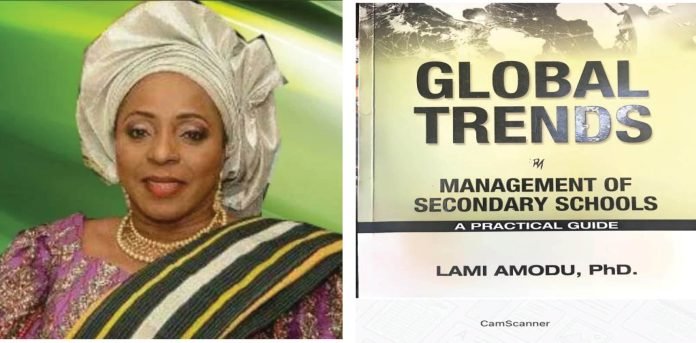
Title: Global Trends in Management of Secondary Schools: A Practical Guide
Author: Lami Amodu, PhD
Publishers: Spotlite Images Limited
Year of Publication: 2019
Pages: 177
Reviewer: Theophilus Abbah, PhD
Global Trends in Management of Secondary Schools: A Practical Guide is written by Dr Lami Amodu, a woman whose life is an embodiment of the country’s education sector. She was the Principal of the Federal Government Girls’ College, Gboko, Benue State; Queens College, Lagos and Federal Science and Technical College, Uromi, Edo State. She Director of Secondary Education in the Federal Ministry of Education.
The 177-page book, divided into twelve chapters, is the product of the author’s experience as a policy formulator and implementer of such policies in her 36-year career as a civil servant in Nigeria’s Ministry of Education. It is a critical evaluation of the philosophy of education for the secondary school sector in Nigeria and a prescription of the changes that should urgently by implemented in line with global trends in secondary education, if Nigeria must keep pace with advancement in science and technology in the world space. The first three chapters establish the legal framework of the country’s education system, taking the reader through the Fundamental Objectives of Education as enshrined in the 1999 Constitution of the Federal Republic of Nigeria. After identifying all the objectives of secondary education in the statute book, the author interpretated each of them, providing how they apply to secondary school students. She further identified the laws guiding secondary education in the country, and reflected on the factors militating against their proper implementation. In the first three chapters, the author took a deep dive into the foundational issues in the country’s education system and takes a practical look at them, from the perspective of an educator who had implement them, with success and challenges that current school administrators face.
Why are the country’s secondary education policies and systems not producing the desired results? The question is answered in the remainder part of the book, from Chapter 4 to Chapter 12. In Chapter 4, from pages 47 t0 49, the author itemizes seven ways in which policies not well thought-out have been implemented, but reversed on account of the fact that they do not align with the country’s cultural reality. For instance, she identifies a factor called ‘Musical Chair Syndrome’. Explaining how this applies to the country’s education system, she writes: “The game of musical chair is best illustrated by the frequent changes of political leadership of education ministries… Each new minister comes not to ensure continuity and consolidation of past achievements – but to carve a niche through “brand” new reforms leading to derailing of policy implementation.” Though ministers of education claim to change policies for the good of secondary school students, in reality, many changes hurt teaching and learning.
The book, Global Trends in Management of Secondary Schools, does not dwell on the challenges facing the system; rather, in several chapters, it emphasizes how besetting challenges could be corrected. The prescriptions are found specific chapters like “Principal as Teacher and Mentor;” “Teacher as Motivator and Enforcer”; “Students’ Learning Environment and Teachers’ Working Environment”; “Student’s’ Discipline and Character Education”; and “Vice Principal and the Principal’s Powers to Delegate Responsibility”. Other relevant chapters include “Making a Difference in Parent-Teacher Association”; “Management of Organizational Conflicts”, and “Guidance and Counselling: Self-Management; Drug Abuse and Cultism.”
In the Foreword to the book, written by Professor Uduogie M.O. Ivowi, former Executive Secretary, NERDC Past President, Nigerian Academy of Education, Former President/Coordinator, World Council for Curriculum and Instruction (WCCI), the foremost educationist states that he is enthused with the book because of its “frank and forthright discussion” on current issues affecting the education sector. “I am very confident that secondary school teachers and principals as well as students of educational management will find this book to be very useful in their works.”
The author has played vital roles in the development of the country’s education sector. She served in the World Bank Assisted Education Projects Implementation Unit (WBPIU) and was involved with the Technical Education Project, National Primary Education Project II; Home-Grown School Feeding and Health Programme (HGSFHP). She has served as Executive Secretary of the Universal Basic Education Commission (UBEC); Head of Federal Inspectorate Services (FIS), now Federal Education Quality Assurance Services (FEQAS). She retired in 2019 as the Director of Basic and Secondary Education, Federal Ministry of Education.
Global Trends in Management of Secondary Schools is Dr Amodu’s second book. She is the author of an educational autobiography, Thorns of Success: Reminiscences of and Educationist.