

By Femi Oyelola
Amidst plenty, Nigerians continue to wallow in abject poverty, all because of corruption from the top to the bottom, experts have alleged.
Speaking to Weekend Peoples Daily on the general wellbeing of Nigerians, the Deputy Executive Director of the African Network for Economic and Environment Justice (ANEEJ,) which is a corruption watchdog organisation , Mr.Leo Atakpu, said corruption is endemic , devastating and the increasing poverty level in Nigeria is mainly caused by it.
According to him, the rich get richer while the poor get poorer, as corruption permeates every sector of the society since the bourgeoisie and the elite have held on to the pervasive popular culture of corruption and economic exploitation.
It is unfortunate and worrisome that the giant and supposedly richest nation of Africa, richly blessed by God with huge human and natural resources, is one of the poorest of the poor nations of Africa and the globe.
Thers’s no gainsaying that corruption is responsible for the current whole mess in the Nigerian society. It is common knowledge that corruption, either directly or indirectly, is the source of poverty in Nigeria. Various reports and researchers have suggested this.
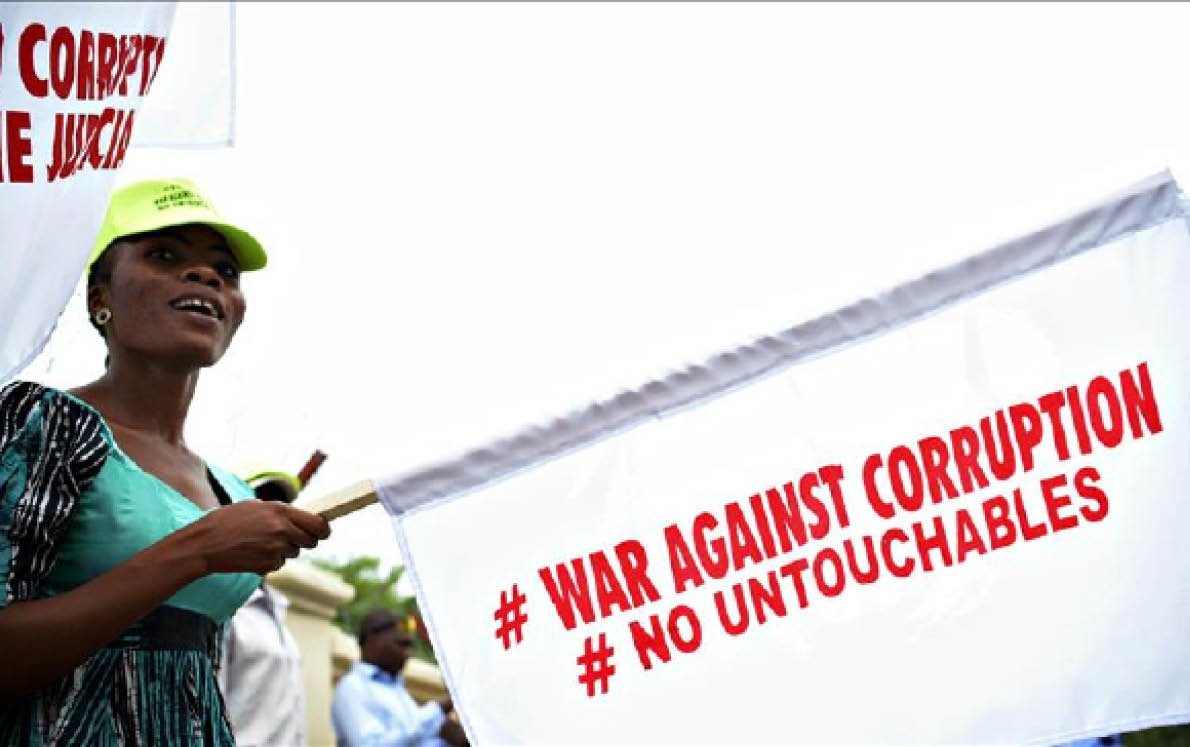
The Corruption Perceptions Index, released annually by Transparency International (TI), also gives credence to the pervasive corruption in the sub-Saharan country. Nigeria has always floated at the bottom of the list, among the most corrupt nations in the world.
Findings have also revealed that just as the country continues to rank very high on the index, there is a proportionate decline in the Human Development Index released every year by the United Nations Development Programme (UNDP). This goes without saying that as resources meant for human development are being frittered away, Nigerians sink into the deeper abyss of poverty.
Poverty according to experts is a multidimensional phenomenon and summarizes the various dimensions as a lack of opportunity, lack of empowerment and a lack of security.
The window of opportunity remains closed to the poor masses and this makes them practically inactive in society.
Their lack of empowerment limits citizen’s choices in almost everything and their lack of security makes them vulnerable to diseases, violence, and so on.
It means susceptibility to violence, and it often implies living on a marginal or fragile environments, without access to clean water or sanitation.
The phenomenon called corruption seems to have come to stay put in Nigeria, and for any corruption watchdog to have succeeded in the advocacy for fighting it for thirty years is not a child’s play.
The African Network for Economic and Environment Justice (ANEEJ) recently marked 30 years being at the front fighting the corruption menace that has turned Nigeria into the headquarters of poverty.
The ANEEJ Deputy Executive Director Leo Atakpu said over 130 million Nigerians live in multidimensional poverty traceable to the crumpling effect of corruption.
According to him, from experiences in the past 30 years, corruption has caused serious damage to Nigerians.
Mr. Atakpu explained that regime after regime, from the military through civilian administration, corruption has taken its toll heavily on every aspect of the citizen’s lives.
The Corruption watchdog expert lamented that the very fabric of the foundation of nationhood is being destroyed by the cankerworms of corruption.
“Is it in the area of infrastructure, socio-economic sector, education, health, name it, electricity supply, the energy sector, hydrocarbon industry in Nigeria, it is all bleeding from corruption.
“Is it the governmental sector, here in Nigeria, we have heard that snakes removed billions of Naira from the vault. We have heard that rats, rabbits, and termites removed billions from public vaults. Human beings and Nigerians made those comments.
“All those who made those comments, who told panelists of inquiry that monkeys, snakes, scorpions, termites removed billions from our nation’s treasury are walking around as free men.
“The implication is that people are rarely punished for corrupt practices. Nigerians, the majority of citizens, are living in so much hardship today,” he submitted.
The ANEEJ Executive Director stressed that the roads in the country are in terrible states, and electricity with poor supply; all of these are old stories of corrupt regimes because billions of dollars have been voted into these sectors, and you have little or nothing to show for it.
He observed that because the energy sector is in bad shape, the electricity supply is in a terrible state, and the economy is run by diesel generators across the country, saying no nation can grow economically in that manner, and all of these are traceable to corruption.
Mr Atakpu expressed doubts in terms of the sincerity of Nigeria’s government in tackling this menace because, according to him, so many officials of government are reeling in corruption, it becomes extremely difficult to tackle the menace.
He opined that reports from the Corruption Perception Index published annually by Transparency International continue to place Nigeria way below the ladder among countries that thrive in integrity.
There, according to him, are many reports revealing that billions of dollars leave Africa annually, over 50 billion dollars, and most of those from Nigeria are frittered to safe havens in offshore countries where they are kept in secret jurisdiction and where they also buy properties with secret shelf names.
He said it is painful that Nigeria is a signatory to many anti-corruption charters, like the UN Convention Against Corruption, UNCAC, the Global Forum for Asset Recovery, Nigeria is one of the pivotal countries that also embraced the initiative. Others are the African Union Charter Against Corruption Agency, all those instruments, Nigeria signs them off but where are we in terms of instruments to tackle corruption?
“I think we are not far from it; we have done well, we have measured progress at least, we now have proceeds of crime law, anti-money laundering law or Acts, and several others are in place to fight corruption.
“But when the instruments put in place to fight corruption are themselves reeling in corruption, then it becomes concerning.
“If you drive along Nigerian roads, you will find those who are supposed to enforce the law, the Nigerian Police being involved in petty corruption.
“You also have those at the upper side who connive with unscrupulous elements who also connive with the private sector, the banking sector for example.
“There is no amount of money that is frittered away from Nigeria that the Banks are not involved and there is a law, the Nigeria Financial Intelligence Unit (NFIU), law, the banks are supposed to give signals to the anti-corruption agencies when there are suspicious transactions. How many of those are reported and then when they are reported, what actions are taken?
“That’s not also to say that we have not made some progress; some progress has been made, some corrupt elements have been stopped, some persons involved in heavy corruption practices have been stopped,” he said.
Mr. Atakpu, however, stressed that what seems to have played out these past 30 years of his organization’s involvement in the fight against corruption was the fact that an impression is being created that only opposition party members are corrupt.
He emphasized that it was only the Obasanjo Administration that had the moral teeth to bite its ministers found wanting corruptionwise.
“But in the current administration, we found a sitting minister and the Head of the Social Protection Agency, involved in suspected alleged corrupt practices involving billions of naira meant to cushion poverty of the poorest of the poor and today, one year after, the minister, the agency’s head apart from being suspended from office, have not been brought to justice.
“We expected that by now, investigations would have been concluded and those two officials, charges would have been pressed against them but nothing seems to happen to them.
“So, that gives the impression that, when people commit corrupt practices in government, most times, they go scot-free but when people in opposition parties are seen involved in corrupt practices, then they go after them.
“Those are the ones you find recoveries and others, but we expect that the fight against corruption should be holistic; it should be no respecter of any person because the law, ordinarily, should be an ass.
“But as the late Dele Giwa would put it, if the law in Nigeria is an Ass, by now, that ass will be deaf, dumb, and mentally deranged because we find a situation where even the judiciary in Nigeria is reeling in corrupt practices as some evidence has pointed out over time.”
The anti corruption expert surmises that the war against corruption must be holistic, and those at the helm of the dispensation of justice must, themselves, be above fault.
He advised that they must not only be held to dispense justice but also be seen to dispense justice, and must not be involved in corrupt practices.
“For us at ANEEJ, we have been strongly involved in advocacy to end corruption in Nigeria, advocacy to put in place required laws, legislative instruments like the Proceeds of Crime Acts, like the Transparency Initiative, like the whistleblower protection law, the anti-money laundering law, the Nigeria Financial Intelligence Unit Act.
“ANEEJ has been involved in advocacy for the passage of those anti-corruption laws in Nigeria, and we have also, in the past 30 years, been involved in the campaign for the r restitution of looted assets.
“Assets that have been stolen from this Country, from common patrimony, and taken overseas to be stashed in secret bank accounts. We launched campaigns many years ago for the return of those assets.
“We are also involved in the campaign for proper management of looted assets so that some stories that we experience, like looting of returned assets, will not occur.
“So, we are happy to be part of some of the success stories that we can brandish anywhere in the world today. One of them is the mantra story, monitoring transparency and accountability in the Management of Returned Assets, MANTRA.
“We were able to undertake an end-to-end monitoring of returned Abacha loots, that I,s 322.5 million US dollars that were returned in 2017 and were used to finance federal government social protection programs under the CASH transfer program.
“We did the end-to-end monitoring for three years, and we can report that the returned assets were paid to poor Nigerians who benefitted from those restituted assets.
“We are also part of the work of the restitution of the Abacha 3, Abacha 4 Ibori loot, and several others that were committed to three major projects.
“The second Niger Bridge, the Abuja-Kano expressway, and the Lagos-Ibadan expressway, these three legacy projects equally received returned assets which formed parts of the funds used in the construction of those projects.
“Some of them are at various stages of completion,n but I’m aware the second Niger Bridge had been fully completed,d and that has greatly reduced traffic in that part of the country in the South-East.
“So, to that extent, we can look back as an organization to count ourselves as those who have been part of such success stories, and to that extent, we say that we are grateful to God Almighty for giving us the privilege to play our little role in this country”
Never miss a moment! Get the stories shaping Nigeria, delivered straight to your phone. Follow Peoplesdaily Newspaper on WhatsApp for breaking news, exclusive reports, and the headlines everyone will be talking about, before anyone else.


