
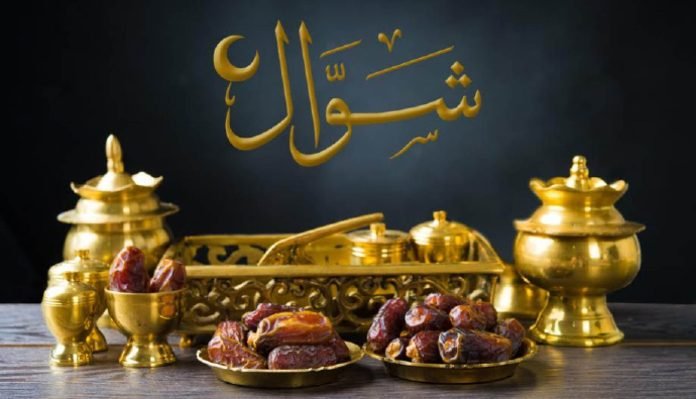
Shawwal is the tenth month of the lunar year, after Ramadan and just before Dhul Qadah. It is also known as ‘the month of feast’ (eid). The word “Shawwal,” which derives from the root of Shawl, has a variety of definitions such as ‘lifting,” “water remaining at the bottom of the bucket,” “old age.” The reasons why the name Shawwal was given to the tenth month during Jahiliyyah are explained as follows: While the Arabs were changing the old names of the lunar months, this month was so named due to either the decrease of the camels’ milk or increase in temperatures during the summer.1
Can you Marry in Shawwal?
During Jahiliyyah, the Arabs considered the month of Shawwal cursed and would not marry during this month.2 They believed that unrest would occur among spouses who got married this month, and therefore the marriages would not continue. To change this belief in a curse, the Prophet Muhammad married the respected Aisha and Umm Salama (may God be pleased with them) within the month of Shawwal.3 Aisha (may God be pleased with her) would proudly narrate that she married the Prophet in Shawwal, and recommend the women around her to conduct their marriages in Shawwal.4
Following Ramadan, the month of Shawwal is a blessed month of which the first three days are celebrated as Eid al-Fitr. The Prophet Muhammad referring to the Ramadan and Shawwal crescents, reported: “Do not fast until you see the new moon; and do not eat until you see the (next) new moon. Should clouds interfere (with your sight), estimate the month.”5 At the sight of a new moon, Prophet Muhammad would supplicate as follows: “Allah is the greatest. O Allah, let the crescent loom above us in safety, faith, peace, and Islam, and in agreement with all that You love and pleases You. Our Lord and your Lord is Allah.”6
Shawwal Fasting
The Prophet Muhammad has forbidden fasting on the first day of the month of Shawwal, the first day of Eid al-Fitr. Fasting for six days in the month of Shawwal after the eid is an important Sunnah of the Prophet Muhammad . The Messenger of Allah gave the good tidings that anyone who fasted in Shawwal for six days in this following hadith:
Whoever fasts during the month of Ramadan and then follows it with six days of Shawwal will be (rewarded) as if he had fasted the entire year
Bulugh al-Maram, Fasting, 1164
The Prophet Muhammad (peace and blessings be upon him) completed his “itikaf” (social seclusion) during the month of Shawwal whenever he could not complete it within Ramadan.
Shawwal is also the first of the pilgrimage months. The Qur’an mentions “the season of pilgrimage” through this verse : Hajj is [during] well-known months.”7 The Prophet Muhammad clarified the expression “well-known months” as the first ten days of Shawwal, Dhul Qadah and Dhul Hijjah.8 These are the last three months of the Islamic calendar. The pilgrimage is performed only during this time and it is an indication of how blessed and significant this time period is.
Some of the important events that occurred in the month of Shawwal during the life of the Prophet Muhammad are as follows:
Return of first immigrants from Abyssinia to Mecca (5th Year of Prophecy) 9
Siege of Taif: (A few nights 10 or three nights before the end of Shawwal – 10th year of Prophethood )11
Marriage of the Messenger of Allah and the respected Aisha (raduyallâhu anha) (1st year of the Migration)12
Death of the respected Asad ibn Zurara (1st year of the Migration)
The Construction of the Masjid Al-Nabawi and the House of Prophet (1st year of the Migration)13
Expedition of Ubaydah ibn al-Harith (1st year of the Migration)
The first Eid al-Adha (2 years after the Migration)
Al-Kharrar expedition
Expedition of Ghalib ibn Abdullah al-Laithi (Mayfah) (10th Shawwal/ 2 years after the Migration)14
Expelling Banu Qaynuka from Medina (Shawwal 15 – Dhu al-Qadah 1/2 years after the Migration)15
The Battle of Uhud (7th or 11th Shawwal/ 3 years after the Migration) 16
The Battle of Hamrau’l-Asad (3 years after the Migration)17
Marriage of the Prophet with the respected Umm Salama (may God be pleased with her) ( 4 years after the Migration)18
Expedition of Abdullah ibn Rawaha (6 years after the Migration)19
Expedition of Bashir ibn Sa’d al-Ansari (Fadak) (7 years after the Migration)20
Marriage of Abu Bakr with Asma bint Umays (8 years after the Migration)
Expedition of Khalid ibn al-Walid (Banu Jadhimah) to invite them to Islam (8 years after the Migration)21
Battle of Hunayn (8 years after the Migration)22
Siege of Ta’if (8 years after the the Migration)23
The Arrival of Committee from Banu al-Harith to Mecca (10 years after the Migration)
The Arrival of Committee from Banu Salaman to Mecca (10 years after the Migration)24