

By Femi Oyelola
In Nigeria’s context, the Government Reserved Area (GRA), can be interpreted to be a euphemism for a residential area with lavish infrastructure and exclusively occupied by the persons whose standard of living mirrors their affluent lifestyle.
GRAs, originally, were exclusive residential areas created to cater for white colonial administrators. However, after independence, Nigerians began to occupy administrative senior posts that hitherto used to be the exclusive preserve of the white overlords, including their highbrow and secluded GRA residences.
Today, GRAs are well-serviced areas with good road networks, serviced estates and properly maintained environment that sometimes, hosts state government houses, top brass politicians, celebrities, and other affluent and influential people in the society.
In every city in Nigeria, there’s one GRA reserved for the high and mighty in society, and in most cases, they are no-go areas for the less privileged as prices of property there are usually out of the reach of the common man.
In Kaduna city, the Malali GRA in Kaduna North Local Government Area of the state stands out as the most unique because that is where you find two conflicting definitions of the acronym GRA: one well maintained and depicting the life style of the rich and influential. and directly adjacent to that state-of-the-art facility is the other ‘GRA’ that is shabby, stinking and neglected with broken down facilities, telling the story of the poor and weak in the society. You can call it Government Rejected Area (GRA) for what it is.
The ‘Government Rejected Area’ according to a resident of Malali, Dr. Abraham Timothy, is a ghetto, has no road networks, and most times serves as hideouts for criminals. He added that in Malali, the two areas; Government Reserved Area and the ‘Government Rejected Area’ are separated by the 3 kilometre Ghana road.
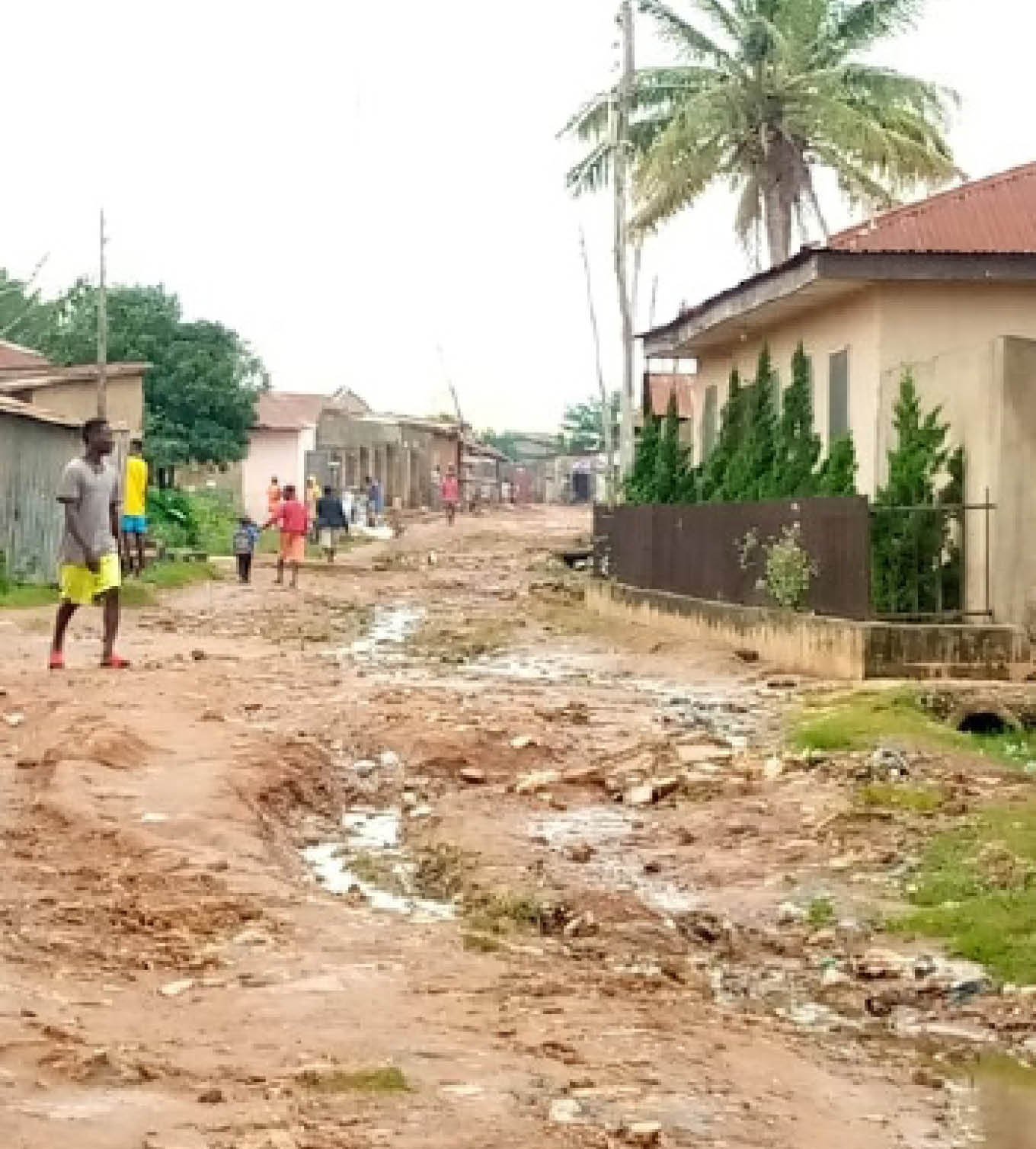
In the words of Mrs. Mary Kabuk, “Government has rejected and forgotten about us. This is a community that harbours over 200,000 citizens, but no single motorable road that links the communities to the outside world.”
Mrs. Kabuk, a retired nurse an residence of Ungwan Maisamari, said her community is one of the rejected communities that cannot boast of any visible government project, though their neighbours who live a stone’s throw from them are living paradise -on-earth lifestyle with functional government facilities at their disposal.
Similarly, a resident of Ungwan Gado, another ‘rejected’ community, an octogenarian, Mallam Musa Haruna, said his community has never witnessed any government presence in terms of infrastructure development, though the community is being tagged as part of the Kaduna metropolitan city.
He expressed disappointment that he, like any other youth in the community gave their all to work when the Federal Government constructed the State/Federal low-cost Housing units to host the Festac ‘77, but painfully, he grew up seeing government development focused only on the ‘real’ GRAs at the expense of their community.
Mallam Haruna, therefore sends a ‘save our souls’ to the Kaduna State Governor, Senator Uba Sani, to consider their community in his development plans and save the citizens from their current predicaments.
“Whoever is returning to this community will have to stop on Ghana road, and then walk down to his destination or preferably pick up an ‘Okada’ (a bicycle), which is now on the high side considering the hike in fuel pump price.
“There’s lots of insinuations making the rounds why this community is being neglected by successive governments.
“Some believe that it’s due to it’s ethno-religious background, but I do not share that opinion. Rather, I see it as a case of negligence that needs to be corrected.
“No single functional healthcare facility within the community. No security, as most times we send distress calls to Malali Police Division, but because of the state of the roads, they always come later when the harm had already been done.
“However, we are grateful to the immediate past governor of the state, Mallam Nasir El-Rufa’i, for constructing a three-story state-of-the-art primary school for our children located at the signboard,” Mallam Haruna said.
Alhaji Musa Ibrahim of Ungwan Shekara, another neglected community along Ghana road, said each time he was dropped by Signboard, he had to walk down to his house, and one day while returning from office he was attacked and his handset forcefully collected at “dagger-point.”
Ibrahim denied the insinuation that the communities suffer negligence because of its ethno-religious background, in his words; “We have a large number of Christians and Muslims. Every tribe is represented here in the area. During the political era, all parties’ major candidates either came personally or sent their representatives to canvass for votes.
“So, it is just negligence of successive governments that has caused underdevelopment of the area and should be corrected in the spirit of fairness and equity,” he said.
Mr Ishaya whose wife lost her baby while waiting for a vehicle to convey them to the Malali Primary Health Care at Kenya Road, said if the roads were motorable my baby would have survived.
Another rejected community is Malali village. The two days spent by this Reporter in the village can only attest to one thing – gross under-development which is vissible in lack of access roads, water, and insecurity. It is an understatement to day that this area and Ungwan Mai Maisamari are in dire need of help from Governor Uba Sani.
The Chief of Ungwan Maisamari, popularly called “Dakaci” said the prayer of the community is for Governor Uba Sani’s urgent intervention.
In the same vein, Pastor Bernard Amos said all what the Malali rejected areas needs is government intervention, pleading with the governor to look at situations in Malali village, Ungwan Gado, Ungwan Maisamari, and Ungwan Shekara for his intervention.
According to a security expert, it should be something worrisome because these communities serve as exit routes to other parts of the city. From Ungwan Gado, one can get to Ungwan Yero, Badarawa, Ungwan Dosa, and Kawo. Also, from Malali village, one can connect to the Millennium City.
Most worrisome is the proximity to institutions like Federal Government College, Malali Federal Technical College Malali, and other institutions in an area struggling for basic amenities.
Our investigation further revealed that Malali is the seat of the powerful in Nigeria. It is home to serving and retired generals, senators, top government functionaries, and politicians, but divided by Ghana Road, which houses the downtrodden, poor, and angry population.
A resident of Malali village, Hassan Musa, said their requests are for assistance in the construction of drainage systems and upgrading of roads respectively saying the main assistance is for the government to help with the survey and give direction for the construction of drainage in the community.
Never miss a moment! Get the stories shaping Nigeria, delivered straight to your phone. Follow Peoplesdaily Newspaper on WhatsApp for breaking news, exclusive reports, and the headlines everyone will be talking about, before anyone else.

