
*Amendments reflect yearnings of Nigerians, says Akpabio
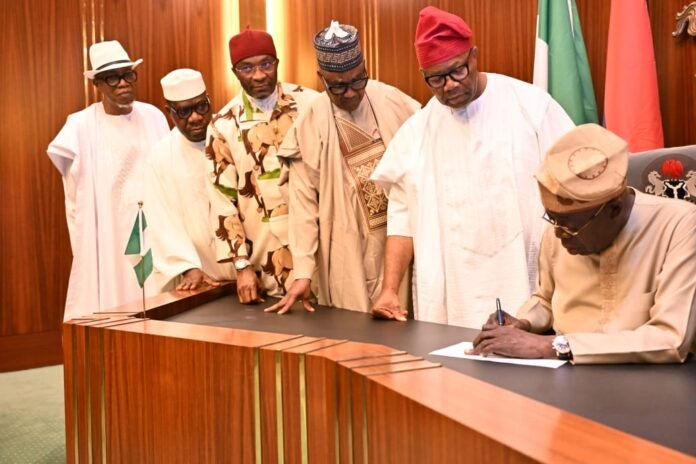
President Bola Tinubu on Wednesday signed the Electoral Act 2026 (Amendment) Bill into law, formally establishing the legal framework for the conduct of the 2027 general elections.
This development came just days after the Independent National Electoral Commission (INEC) released the official election timetable, scheduling presidential and National Assembly elections for February next year.
The Act was signed at a brief ceremony held in the State House, Abuja, Wednesday evening, with principal officers of the National Assembly and senior government officials in attendance.
The amendment, passed by both chambers of the National Assembly on Tuesday, introduced a range of adjustments aimed at strengthening transparency, improving logistics and closing operational gaps observed in previous election cycles, particularly in the areas of result collation and technology deployment.
President Tinubu in his remarks after assenting to the bill commended the National Assembly for what he described as a rigorous and patriotic process, stressing that the objective of the reforms is to safeguard democratic stability and prevent voter disenfranchisement.
He said: “I followed keenly what you were doing. The essence of democracy is to have very solid brainstorming discussions committed to national development and nation-building and the stability of the nation,” Tinubu said.
“What is crucial is that you manage the process to the extent that there will be no confusion and no disenfranchisement of Nigerians, and we are all going to see democracy flourish.”
Tinubu emphasised that while technology remained important, elections ultimately depend on human management and public trust.
He said the manual voting and counting process remains central to Nigeria’s electoral system, with electronic transmission serving as a support mechanism rather than a replacement.
“No matter how good a system is, it is managed by people, promoted by people and finalised by people. You are not going to be talking to a computer; you are going to be talking to human beings who announce the results.”
“Essentially, what we are looking at is the transmission of manual results, and we must avoid glitches. Nigeria will flourish and continue to nurture this democracy for prosperity and stability,” the President said.
Addressing newsmen after the ceremony, President of the Senate, Godswill Akpabio, said the provisions in the amended Act were carefully designed to respond to public concerns and improve the credibility of the electoral process.
“A lot of provisions in the amended Act will definitely make Nigerians very happy. We did a very thorough and painstaking job, taking cognisance of the peculiarities of our country. At the end, we believe strongly that what the President has just assented to reflects the yearnings of Nigerians and will make for better elections in the future,” Akpabio said.
Answering a question on the contentious issue of electronic transmission of results, Akpabio explained that the amendment adopts a balanced approach that accommodates both digital innovation and infrastructural limitations.
“All Nigerians wanted was to see polling unit results transmitted electronically, and we have included that. But we also recognised that there are areas without network coverage. The signed polling unit result sheet remains the primary document, and once officials move to areas with connectivity, the results will still upload for public viewing,” he explained.
He added that the new law empowers voters to independently verify outcomes, thereby reducing the likelihood of manipulation during collation and strengthening confidence in election results.
He further disclosed that the amendment enhances internal democracy within political parties by broadening participatory options in candidate selection and removing ambiguities that previously triggered post-election legal disputes.
He also highlighted a reduction in the statutory notice period for elections from 360 days to 300 days, a move expected to shift major polls earlier in the electoral calendar and potentially prevent clashes with significant religious periods.
Tinubu’s assent to the has brought an end to weeks of relentless legislative deliberations, consultations and public debate on the proposed electoral reforms, culminating in protests by some civil society groups and notable politicians at the gates of the National Assembly.