
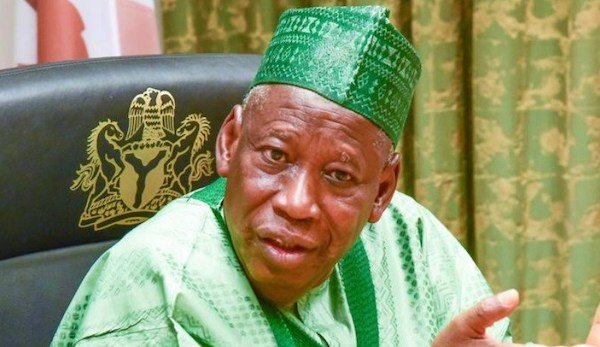
The governor of Kano state, Abdullahi Ganduje, is effusive about the “hard work” he and his colleagues in other states are doing to reverse Nigeria’s “insecurity prevalence.“ The governors, he said over the weekend, had agreed to work hard to ensure the nation’s peace and stability.
Ganduje spoke while receiving PDP ‘Kwankwasiyya’ members who defected to APC in Kano. “All governors have resolved to work hard to ensure that the insecurity prevalence is eradicated for complete peace and stability in Nigeria,” he said. “We are happy that the new service chiefs are fully committed to peace and stability in Nigeria. I will also like to seize this opportunity to appreciate and congratulate Ohaneze Ndigbo for being committed to one Nigeria.
“The Arewa Consultative Forum also believes in one Nigeria; we will continue to work for one Nigeria. I congratulate you for that. The Afenifere, we appreciate and congratulate you for making a public announcement that you believe in one Nigeria. The National Coalition of the Middle Belt People, we salute you for making a pledge that you believe in one Nigeria.
“I will like to take your aspirations to the next level. I urge you to come together and hold an important meeting to consider the issues of diversity, consider our differences, our similarities and transform them into opportunities for the development of Nigeria. Our diversity is a thing from God; it is the source of our strength. Therefore, we should convert it to unity, opportunity and take Nigeria to the next level. If God wished, He could have created all of us one tribe and in the same geographical location, but that was not the wish of God.”
That pledge to “work hard” for peace and stability, coming from Ganduje, sounds melodious to the ear. This is one governor, out of several, who has been spared the sickening evils of banditry, kidnapping and communal bloodletting. Perhaps because his Kano is a largely homogenous state in more senses than one. Its people speak one of Nigeria’s three major languages, Hausa, and are predominantly Muslim. These unity building influences apart, Kano has enjoyed good political governance under Ganduje.
However, we cannot say the same of many of his colleagues in the Nigerian Governors Forum, led by Plateau governor Samuel Lalong. If that commitment to security had come from any of them it would have been platitudinous. It would have sounded more like electioneering in an off election season. Take, for instance, the Middle Belt, made up largely of the contiguous states of Plateau and Benue states. In those two states, whatever form of governance that existed before has evaporated. Benue, in particular, is a killing field, more or less. Yet the governor there prefers to blame outsiders instead of demonstrating leadership. His contradiction is that he continues to fight a central government that he badly needs to stabilize his state.
In the Northwest, Kano is the only one of 7 states that has been spared the “years of locusts” that have ravaged this geo-political zone. Zamfara, Sokoto, Niger, Katsina, Kaduna and Kebbi are gripped by a form of insecurity characterised by banditry and kidnapping. Kaduna, in particular, is stricken by incessant labour crises. But Gov. Nasir el Rufai has turned on his colleagues for abandoning him in his moments of need. He has also accused his Benue counterpart of not doing enough on communal killings in his state.
In the Southeast, all the Igbo speaking states have been overrun by a secessionist Indigenous People of Biafra (IPOB). Although banned by the Federal Government, the governments of these states have not been able to enforce the ban and IPOB does as it wants. It spreads terror among the population such that they fear it more than they do the security forces. It kills, maims and destroys public buildings. Recently it started killing visitors from other parts of the country.
The South-west is no less insecure and the governors of the zone are just as helpless. They are their states’ chief security officers but they are unable to stop people calling for secession or breakaway from the nation.
In the South-south, it is only Rivers State that has stood up to IPOB. And this is because its governor Wike Nyesom, a no nonsense lawyer, has told the group it would not have a place in the state. And so it has none. Wike is an uncommon politician and a very practical man. All the other governors whose states have fallen to criminals need to borrow a leaf from him. They need to match their tough talks with tough actions. They also must stop fighting each other and concentrate on governance; private egos must give way to public service. They too must learn to use their security votes for the right purpose and not dissipate them on personal pleasures and political patronages. And lastly, they will have to learn to work together if they truly desire for Nigeria to be secure and peaceful again.