

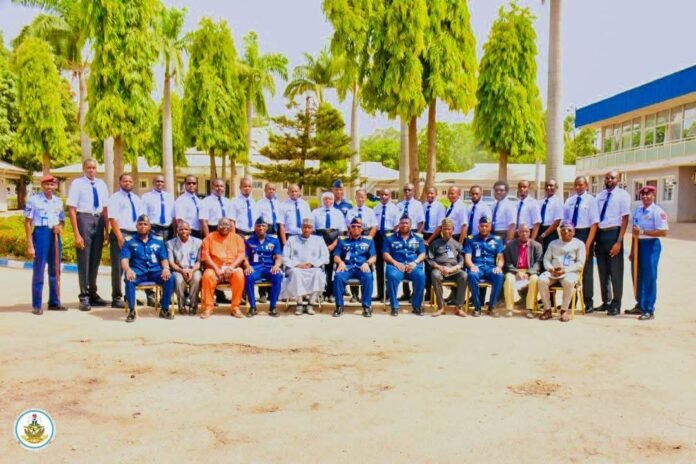
The Air Traffic Services Training Centre (ATSTC) in Kaduna has inaugurated the Air Traffic Control and Surveillance Radar Course 3 (ACSR 3) as part of efforts to strengthen safety and efficiency in Nigeria’s airspace.
The programme, launched on Tuesday, will train 20 participants, including 10 Nigerian Air Force (NAF) officers from the Air Traffic Services specialty and 10 cadets from the Nigerian Airspace Management Agency (NAMA).
The initiative comes barely two months after the commencement of ACSR 2 for 20 NAMA cadets, reflecting sustained efforts to address the shortage of trained air traffic control personnel in the country.
The joint training highlights ongoing collaboration between the NAF and NAMA, aimed at improving coordination between civil and military aviation operations while enhancing national airspace security and efficiency.
Speaking at the inauguration, the Commandant of ATSTC, Air Vice Marshal N.B. Folaji, reaffirmed the Centre’s commitment to building capacity and producing highly skilled air traffic controllers.
He urged participants to remain disciplined, adaptable and focused throughout the 65-week training, noting that time management, teamwork and professionalism would be critical to their success.
The event was attended by key stakeholders, including a representative of the Airspace Manager, Alhaji Abdulmajid Muhammed, who also serves as Air Traffic Operations Manager at Hassan Usman Katsina International Airport, as well as senior instructors and officials of the Centre.
Folaji explained that the course is designed to meet international standards in air traffic control and radar surveillance operations, aligning with global best practices in aviation.
He added that ATSTC has continued to position itself as a centre of excellence in training airspace management professionals, whose expertise is vital for flight safety, mission planning and the seamless coordination of air operations.
The initiative, he said, further strengthens Nigeria’s aviation sector and supports national security by ensuring a steady pipeline of competent personnel to manage the country’s increasingly complex airspace.