
By Femi Oyelola, Kaduna
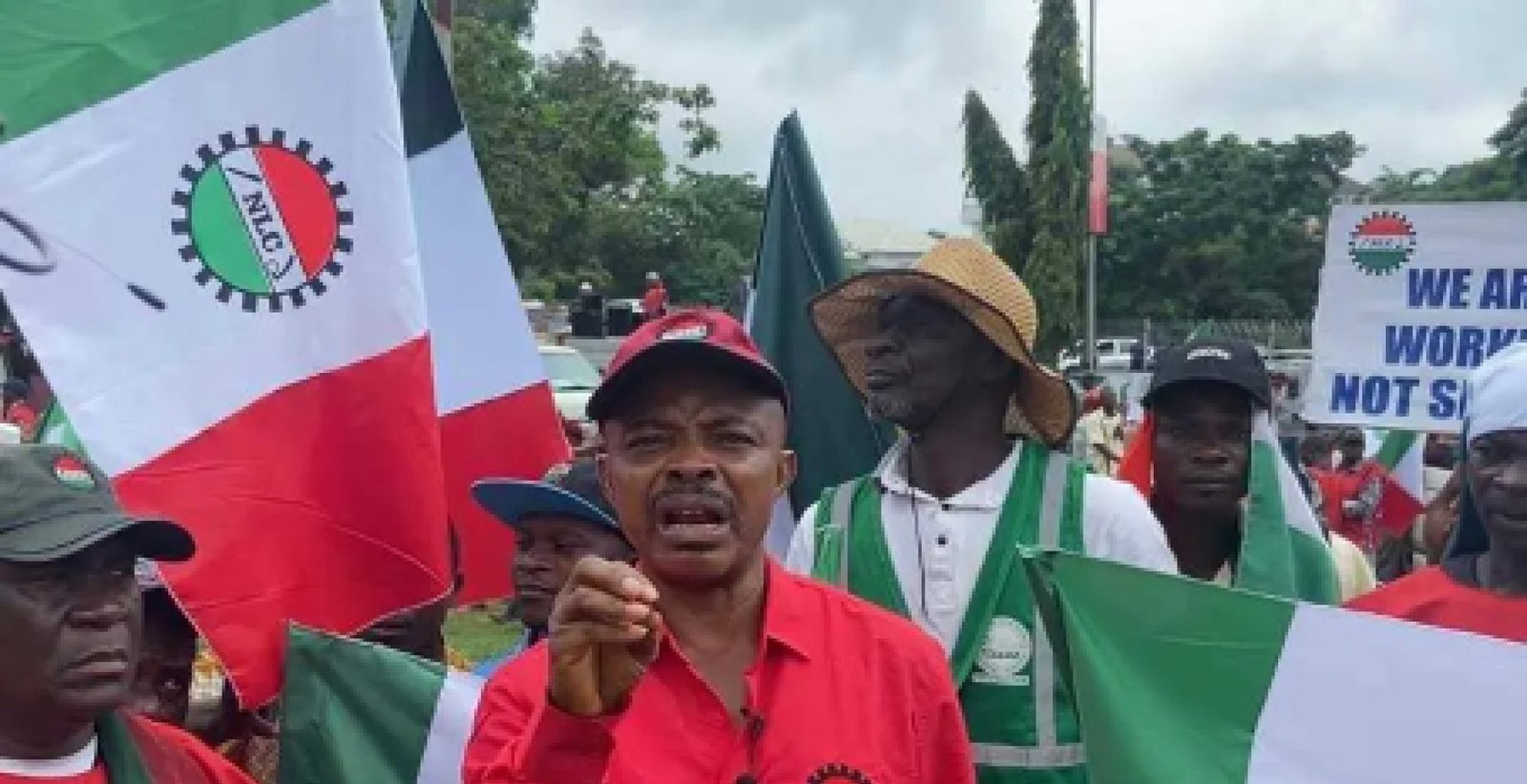
Baring a last-minute change, the Nigerian Labour Congress (NLC,) and the Trade Union Congress of Nigeria (TUC,) have again declared a nationwide strike effective from next Tuesday, November 14, 2023, following the alleged brutalization of the NLC National President, Joe Ajaero, in Imo State.
A strike is a temporary stoppage of work by a group of employees to express a grievance or enforce a demand. It involves a complete withdrawal of the workers’ services, leading to a man-made breakdown of industrial services. It is usually resorted to when other measures to agree on issues in contention fail.
Since the return to democracy in 1999, Nigeria has faced several strikes or the threats of strikes from the organised labour. These has posed tough challenges to successive administrations. Several key unions across the country have continued to mount pressure on the governments, threatening strikes and allegedly securing settlements, that have raised concerns about the future of labour conflict management in Nigeria
The Nigeria Labour Congress (NLC) and the Trade Union Congress (TUC) are the two major unions in Nigeria that have declared several strikes severally into the country.
However, there are mixed reactions from Nigerians over what they described as too much lingering strikes by organized labour without putting into consideration the plight of the masses during such mass actions.
In his reaction to the proposed strike, the National President of Arewa Youth Consultative Forum (AYCF,) Alhaji Yerima Shettima, said while he’s not holding brief for the government, it was time that the organized labour realized this is a new government whose mandate was recently validated by the Supreme Court and they need time to put policies in place.
Alhaji Shettima added that, without mincing words, Nigerians are aware that this government inherited some problems from the previous regime so time should be given to pave the way for the betterment of Nigerians.
He, however, warned that Nigerians are watching and would not fall prey to a system where billions are being spent on Yatch and Prado vehicles for a few people. So the government should take note and do the needful.
“I therefore call on the labour unions to be patient, and what happened in Imo state should be investigated so that when a strike is called for, all of us will back them up because all of us are out to fight for the right of our people.
“But as it is now, they may not get the needed support even from the workers and other Nigerians unless they want to use force, and forcing people is also a crime against the rule of engagement.”
Speaking in the same vein, Comrade Abdulsalam Moh’d Kazeem, a Public Affairs Analyst based in Abuja, condemned the brutalization of the NLC President, Comrade Joe Ajaero in Imo state.
He, however, opined that by declaring a national strike over that assault, the organized labour is stretching their luck too far.
According to him, the leadership of the two Union have trivialized strike as a tool that nobody takes the Union seriously again and all this could be traced to their involvement in the 2023 general elections.
Moh’d Kazeem, observed that the two Unions in recent times have demystified themselves and the potency of the strike.
“So, you mean workers in Yobe or Kaduna State would go on strike because of what happened to Imo?
“You people mean employers who have no trade dispute with their workers would shut down in this struggling economy and you expect them to pay the workers?”
“ When you abuse the power of the strike, it loses its potency. I think the NLC must be joking at this point.”
“Secondly, the current economic situation of our Nation cannot encourage or tolerate strikes based on the fact that people are passing through a serious economic crisis and this economic crisis is recurring due to bad leadership. It’s on record that our people are finding it difficult to survive, and since previous strikes declared by the Union did not bring food or employment to their tables, but rather added to our Nation’s economic woes, the larger populace will never join such selfish and devilish strike, it’s outright madness to call for a national strike over what happened in Imo, the same NLC never called for a national strike on the spate of insecurity, corruption, and bad leadership, indeed they have lost it.”
“Thirdly, what is the total population of the NLC compared to our Nation’s population? The union has continued to use strikes as a tool to manipulate others (the vast majority of us) on what can be described as a selfish agenda.”
“I advise the union to look outside the box and set up a think-tank on how best to push home their demands, strike is not the best option and cannot be accepted due to the involvement of the union partisan politics.” He said
Similarly, Comrade Abdul, Board of Campaign for Democracy asserted that protest or picketing is constitutionally a mandate of the worker’s right, other conventional policies internationally recognize such, but the ideology of the NLC to keep lingering on and off without many results, is the shortfall of them not being proactive in constructive engagements with duty bearers at the expense of the majority citizens.
He is of the view that organized Labour with full-time academia, professionals, and intellectuals with well vest knowledgeable Ally can hold government accountable by ways of analysing all states and national budgets bringing out the loophole all citizens will be willing to join their procession.
Comrade Abdul Bako lamented that the Government has not seen so much coming from the union leadership constructively rather than calling for strikes against them, they decided to handle most of their problem/issues nonchalantly for its strongest voices has lost substance but rather infecting hardship on the citizens.
He therefore advised that Labour Congress leaders should review its strategy to engage more conservatively for positive achievements as for now not much is felt other than hardship on the populist.
“In the leadership quest for more progressive, effective, efficient welfarism for workers, there should outlined playing to the gallery difference between politics and struggle.
The government should equally be willing to keep promises and honor agreements as the primary purpose of government is to provide needed welfare services and protect its citizens as enshrined in the country constitution.” He opined.
Speaking on this, a correspondent, the Acting Executive Director of Legal Awareness for Nigerian Women (LANW) Mrs Hannatu Ahuwan, explained that Labour union strikes in Nigeria have had both positive and negative impacts on the country.
Mrs Hannatu Ahuwan stressed that Labour union strikes have often led to negotiations and agreements with the government and employers, resulting in wage increases and improved working conditions for workers.
She added that Strikes have also raised awareness about labor rights and social issues, drawing attention to issues like corruption, poor governance, and economic inequality.
She, however, expressed dismay that Strikes can disrupt public services, such as healthcare and education, which can negatively affect the general population and can further harm the Nigerian economy by causing production slowdowns and affecting businesses, leading to financial losses.
“Strikes have sometimes led to changes in labor laws and policies, providing better legal protections for workers.
“The less privileged often rely heavily on public services such as healthcare and education. Strikes can disrupt these services, making it difficult for them to access critical medical care and education for their children. They also cannot afford to pay the cost for private hospitals when the government institutions are shut down.
“Strikes can result in economic downturns and job losses, affecting the livelihoods of the less privileged who are already vulnerable to economic shocks. Most poor people rely on proceeds of daily trading for feeding and strikes can affect this.
“Prolonged strikes can lead to inflation and price hikes, impacting the cost of living for the less privileged, who may struggle to afford necessities.
“ The less privileged may have limited bargaining power and are more vulnerable to the economic and social consequences of strikes, as they often lack financial reserves to weather the disruption.
“On the positive side, labor union strikes may help in advocating for labor rights, which can ultimately benefit the less privileged by improving working conditions and social protections.”She said
Mrs. Hannatu Ahuwan explained that the overall impact of labor union strikes in Nigeria depends on the specific circumstances, negotiation outcomes, and the broader socio-political context. Also, the impact of strikes on the less privileged can be mixed, with short-term difficulties often outweighing potential long-term benefits related to improved labor conditions and rights. Nigerians are also gradually losing confidence in the Labour Union’s ability to achieve anything worthwhile through the strikes. The government is also seen not to be respecting the rights of labor unions to exercise their freedom of association, peaceful assembly, and the right to protest.
In her reactions, the Chairman of Kaduna Social Protection Accountability Coalition (KADSPAC,) Ms. Jessica Bartholomew, said organized labor has over time taken advantage of citizens as over the years, they have gradually been seen to compromise in terms of fighting for the right of the civil servant and every other actor or resident of Nigeria
According to her, there are instances citizens see a call for strike action and then people are gearing up with faith and happiness that the labor union will be able to take forward concerns that will help those that are vulnerable, or crippled by poverty to find succor or to have such responsiveness to their needs but then they saw at the end of the day, they are called to a meeting behind closed doors and then the next day, they have called off the strike without any clear court decision or commitment or a communique that will stipulate an agreement by the federal government of Nigeria to take up some of the stands of the organized labor.
“So when I hear that strike action is about to commence, I do not care and I am saying this as somebody that rightfully knows the importance of knows labour union yet this is how I feel talk less of the poor and vulnerable citizens of Nigeria, they do not have trust in the system that is suppose to protect them.
“We are complaining of politicians, complaining of holding government accountable and that is one one of if accountability that is supposed to ensure that they checkmate some of the excesses the politicians bring on board but they seem to compromise.
“So every day you see that the poor and vulnerable people are still suffering by some of the systems put in place to ensure they do not suffer.
“For example, what are the things they want to strike about?
I have seen the president attacked and the speculation is that they are government thugs that are against the president for some of the stands of the union but if you have a clear court agreement or communique after all the close door meetings that are publicized by the party involved, you will be able to call them to account with no need for noise when you know you have taken the threat of strike to caricature, everybody laughs when they hear that the labor union wants to do strike.
“So my perception as a civil society actor is that the labor union needs to clean up its act, come together, and come to the drawing table to ask themselves what they are doing to protect the rights of every citizen of the country because if you are interested in protecting the right of the citizens, you will ensure that things are done appropriately and in a coordinated manner.
“We know that if you mention labor unions, some people will say these are interested in their pocket. There’s distrust, an arm that is supposed to be with people at the grassroots now is on the other side, the political stakeholders who we see as the reason we are where we are.
“So the union should articulate if what they want to champion is for the interest of the people and and if it is, they should do it in such a manner that is transparent and accountable.
“The labor union should be able to dialogue with citizens under the different umbrellas at the community level to be able to understand the key issues.
“Poverty is on the increase, the economic crisis is much. I am in one of the communities and I can tell you the picture is black. I am afraid that, what if tomorrow I can no longer afford food?
“We are no longer focused on other things except food just for survival to get energy and if Nigerians are now on that level where food is the priority then, the labor union should please not distract us in the bid to be able to get a source of livelihood for our family, except if they are interested in protecting the right of the citizens.” She observed.