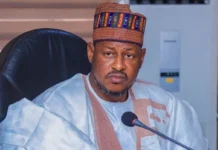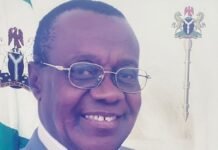

 Engr. Ishaq Mohammed, the Unit Manager, Road Sector Development Team, a department under the Federal Ministry of Works, is an engineer with 26 years experience in the road sector. Our correspondent, Chris Alu, x-rays the performance of the agency under his leadership.
The road sector development team of the Federal Ministry of Works was established in November 2004, with the aim of planning, procurement, maintaining, financing, sustaining and transforming all the federal roads in the country. It was also mandated to marshal out ways of reducing passenger travel time, vehicle operating costs and traffic related fatalities on the roads through rehabilitation, upgrading and long term maintenance.
Its main objective was to reduce road transport costs along the road, and introduce total asset management methods for delivery and management of all federal roads; as well as to plan and facilitate sustainable financing arrangements of the road sector.
It is said that the federal roads at the moment comprises a total land mark of 200,000km road network in the country, out of which 33,00km are of the federal high way, 50,000km state, and 117.00km contains feeder roads. And the road network are the major dominant of the country’s internal transport system for the haulage of people, goods and services across the states with over 95% domestic traffic flows.
To this end, government has continued to spent huge sums of money in building and maintaining the roads. However, these roads have been plagued by lots of problems, with the major ones being design faulty, leading to poor drainage system and poor maintenance culture as well as inability of those plying the roads to maintain law and order on them , which have also significantly reduced the utility of the roads ,coupled with the high rate of potholes and cracks on the highways.
These problems made it very difficult, expensive and more arduous to move products and services from one point to another which often lead to loss of man-hours and high cost of goods and services. A total estimate of the roads statistics, shows that only about 28 % of the federal roads are in good condition and to continuously maintain them in good shape requires huge amount of money.
This made the federal government, through the ministry of works, in collaboration with RSDT introduced the FRDP with the hope of strengthening the roads in good shape, so as to reduce road transport costs along the road links supported by the project; and to introduce total asset management methods for delivery and management of the roads; and also plan and facilitate sustainable financing arrangements for the road sector.
In addition, FRDP was to improve transparency and accountability for better governance, through institutional reform in key infrastructure To achieve this aim, the World Bank-assisted projects and AfDB are to support the development of the highways and the Nigerian-Cameroon ways. All these are aims of removing obstacles to the free flow of traffic and also building a common border checkpoint, limiting the number of checkpoints and controlling axle load; and building capacities of organs responsible for monitoring the implementation of the project.
When Engr. Ishaq D. Mohammed was made the Unit Manager of the Federal Ministry Of Works’ road sector development team, it obviously threw many observers off-balance, especially those who may have, albeit wrongly, underscored his capabilities.
But to prove them wrong, he buried his head to his work, in order to ensure positive progress to the growth and development of our roads in the country, engineer, having acquired much experience in the road sector spanning over 26 years, swift into action and identified some challenges that was facing our roads with the view of addressing them.
Engr. Mohammed, who hails from Nasarawa state, upon assumption of office in 2009, readily hit the ground running, with the promise that he was going to ensure optimum performance of the department in order to meet the growing needs of the federal, state and feeder roads in the country, by enforcing the provisions of the law so as to maintain standards on our roads, in order to give more confidence to the people in a more efficient and effective ways.
Having worked in the Nigerian Road Construction and Management Company, he went to the United Kingdom to work as a senior group engineer in the highways section of Atkins (H&T) Birmingham office in England, and came back with towering experience rich enough to develop our federal highway roads effectively and also give them a new facelift.
While in England, he performed several duties including that of preparing scheme reports and design of several Trunk Road projects, including schemes within the Area 10, 11, 12 and 18 highways networks. He was also responsible for the early development of the light rail route in the West Midlands in U.K., among others. As a result of his excellent performance abroad the Nigerian government needed him back so as to contribute to the development of the road sector.
Mohammed, who was employed to head the unit team of the road sector, came in with the mandate of ensuring quick and timely execution of all project activities in the country.
He was also charge with the responsibility of being the lead specialist in charge of capacity building support of the Pavement Evaluation Unit (PEU) and the Bridge Maintenance Unit (BMU) of the federal ministry of works, as well as being the team leader of the review and update of the Highway Design Manual as well as the development of Roads and Bridge Management of the ministry. Apart from being an active member of the Road Sector Reform Committee of the Ministry, he was in charge of all projects funded by mutilateral agencies across the federation.
As a result of his intellectual prowess, he brought in some initiatives, in collaboration with stakeholders that was able to developed and designed most of the federal high roads, and bridges in a more cogent manner, which proved his professionalism and worthiness to a large extent which has gone further in actualizing the dreams and aspirations of government drive in making all federal, states and feeder roads among the best in the world.
He was also able to transform our bridges across the federation and also giving them a new face-lift, with the hope of accomplishing the dreams and aspirations of the government drive to attain the Vision 20:20:20 initiatives.
Engr. Ishaq has attained professionalism in his career; he is a registered member of the Chartered Institute of Highways &Transportation (MIHT) – UK, Member of the American Society of Engineers (MASCE) – USA, Member of the Institution of Civil Engineers (MICE) – UK, associate member of the Nigerian Society of Engineers and also a registered Engineer by the Council for the Regulation of Engineering in Nigeria (COREN).